
What Is Frequency Bandwidth?
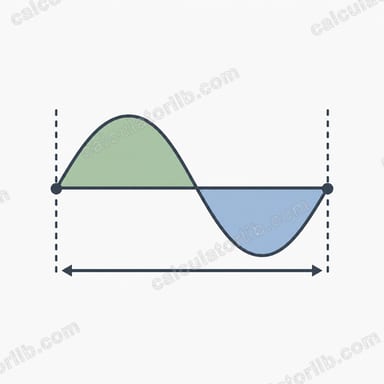
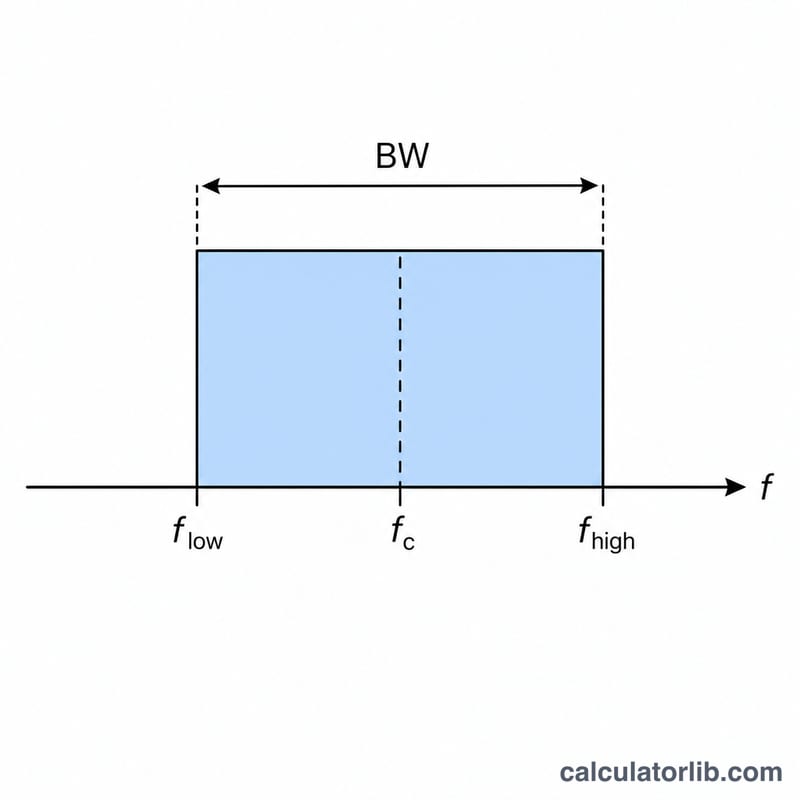
Bandwidth is the width of a frequency band — the range of frequencies a signal, channel, or system occupies. It is found simply by subtracting the lowest frequency from the highest frequency in the band. Bandwidth is a fundamental concept in electronics, telecommunications, audio engineering, and radio-frequency (RF) design, where it determines data capacity, signal fidelity, and channel allocation.
How to Use This Calculator
Enter the upper (higher) frequency limit and the lower frequency limit, both in hertz (Hz). The calculator returns the bandwidth, the center frequency (the midpoint of the two limits), and the fractional bandwidth — the bandwidth expressed as a percentage of the center frequency, which is useful for comparing how "wide" different bands are relative to their location in the spectrum.
The Formula Explained
The core relationship is \(\text{BW} = f_{\text{high}} - f_{\text{low}}\). The center frequency is the average, \(\frac{f_{\text{high}} + f_{\text{low}}}{2}\), and the fractional bandwidth is BW divided by the center frequency, multiplied by 100 to express it as a percentage. A narrowband signal has a small fractional bandwidth; an ultra-wideband signal has a large one.
$$\text{BW} = \text{Upper Frequency (Hz)} - \text{Lower Frequency (Hz)}$$where
$$f_c = \frac{\text{Upper Frequency} + \text{Lower Frequency}}{2} \qquad \text{BW}_\% = \frac{\text{BW}}{f_c}\times 100$$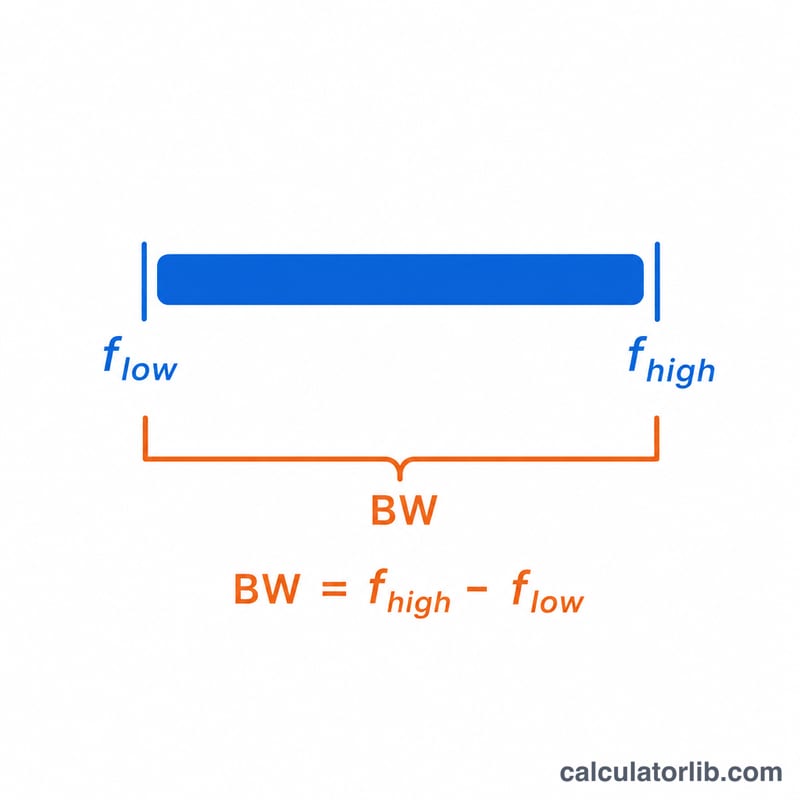
Worked Example
Consider the audible audio range: \(f_{\text{high}} = 20{,}000\ \text{Hz}\) and \(f_{\text{low}} = 20\ \text{Hz}\). The bandwidth is $$20{,}000 - 20 = 19{,}980\ \text{Hz}.$$ The center frequency is $$\frac{20{,}000 + 20}{2} = 10{,}010\ \text{Hz},$$ and the fractional bandwidth is $$\frac{19{,}980}{10{,}010}\times 100 \approx 199.6\%.$$
FAQ
What units should I use? Use the same unit for both inputs — typically hertz (Hz), but kHz, MHz, or GHz also work as long as both values match; the bandwidth comes out in that same unit.
What is fractional bandwidth used for? It tells you how wide a band is relative to its center. Antennas and filters are often classified as narrowband (<1%), wideband, or ultra-wideband (>20%) based on this figure.
Can bandwidth be negative? If you enter a lower frequency that is larger than the upper one, the result will be negative — simply swap the values so \(f_{\text{high}}\) is the larger number.