
What is a Fresnel zone?
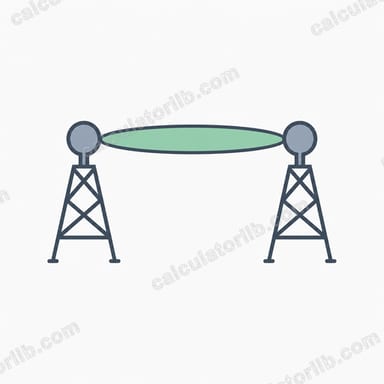
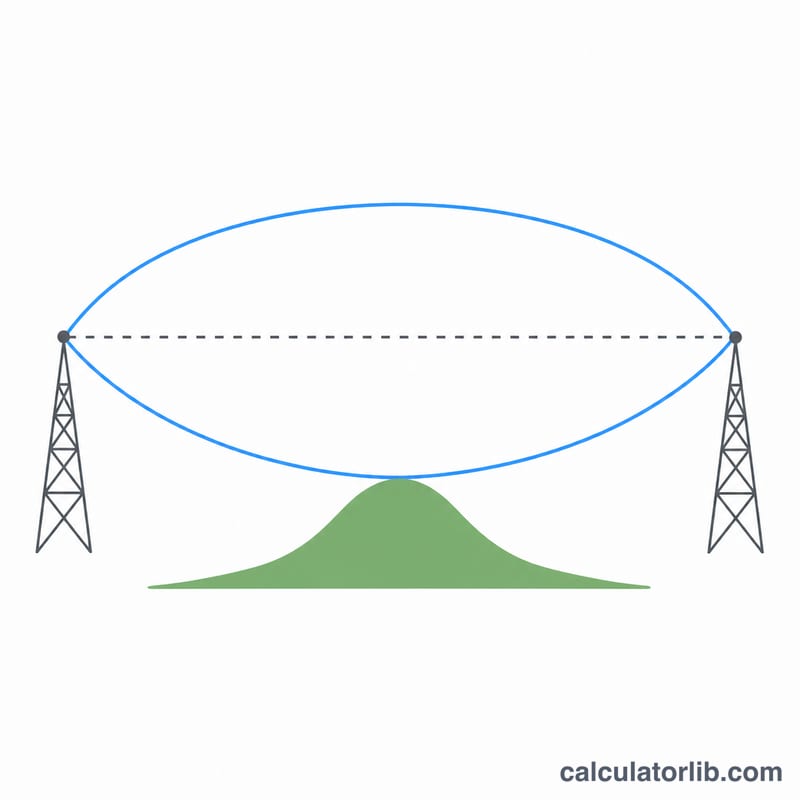
A Fresnel zone is one of a series of concentric ellipsoidal regions between a transmitter and a receiver in a radio link. The first Fresnel zone is the most important: if obstacles intrude into it, signals reflected from them can arrive out of phase with the direct signal and cause destructive interference. For a reliable line-of-sight link, engineers aim to keep at least 60% of the first Fresnel zone clear of obstructions such as trees, hills, and buildings.
How to use this calculator
Enter the link frequency in GHz, the zone number (use 1 for the first and most critical zone), and the two distances from the obstacle point: d1 (distance to antenna 1) and d2 (distance to antenna 2), both in kilometers. The radius is largest at the midpoint of the path, where d1 equals d2, so that is usually the point you check. The calculator returns the Fresnel zone radius in meters, the practical 60% clearance radius, and the signal wavelength.
The formula explained
The radius is \( r = \sqrt{\dfrac{n\,\lambda\,d_1\,d_2}{d_1 + d_2}} \), with all lengths in meters. The wavelength \( \lambda \) is the speed of light divided by frequency. Lower frequencies and longer links produce larger Fresnel zones, meaning you need more vertical clearance above terrain.
$$ r = \sqrt{\dfrac{n\,\lambda\,d_1\,d_2}{d_1 + d_2}} $$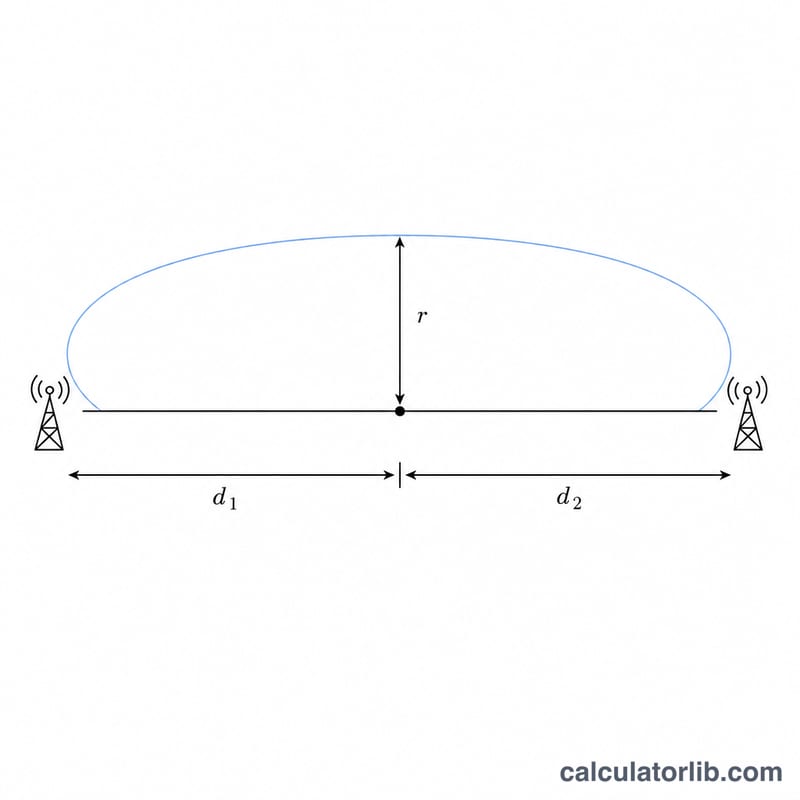
Worked example
Consider a 2.4 GHz link with antennas 2 km apart, checking the midpoint so \( d_1 = d_2 = 1 \) km. The wavelength is about 0.1249 m. The first-zone radius is
$$ \sqrt{\dfrac{1 \times 0.1249 \times 1000 \times 1000}{2000}} \approx 7.9\ \text{m} $$and the recommended 60% clearance is about 4.74 m.
FAQ
Why 60% clearance? Keeping 60% of the first Fresnel zone clear retains essentially full signal strength while being a practical, cost-effective target in the field.
Which zone number should I use? Use \( n = 1 \) for normal planning. Higher zones are used in advanced diffraction analysis.
Does this account for earth curvature? No—this gives the geometric Fresnel radius only. Long links should also add earth-bulge clearance.