
What Is Insertion Loss?
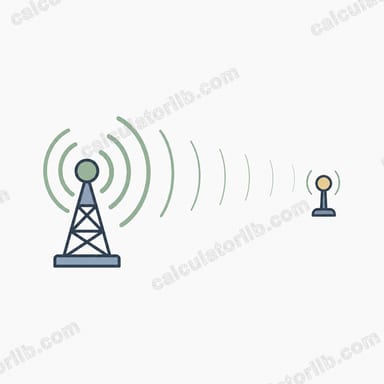
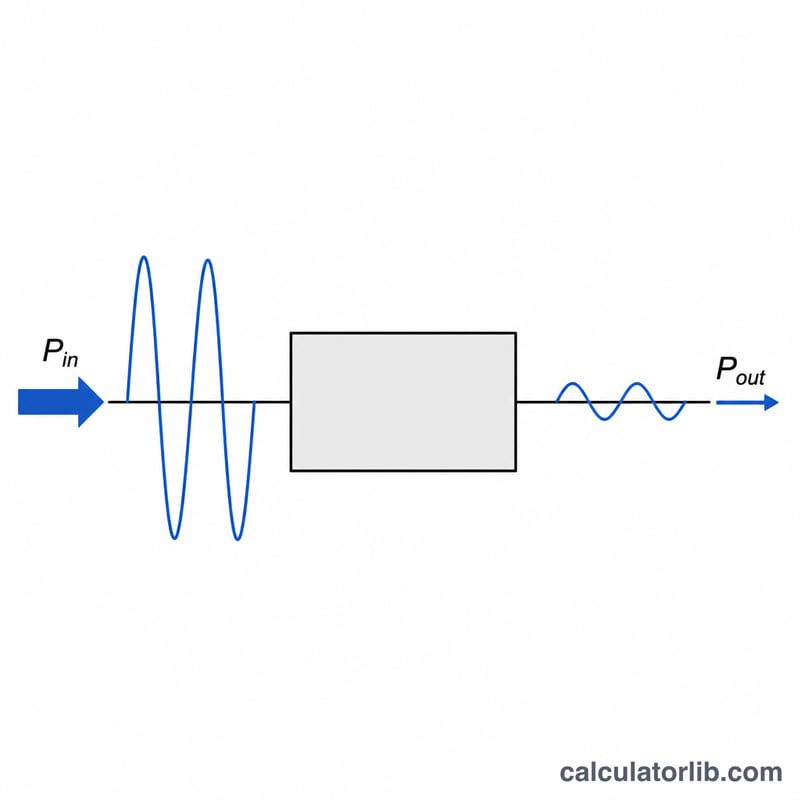
Insertion loss is the loss of signal power resulting from inserting a device — such as a connector, cable, filter, splitter, or attenuator — into a transmission line. It is expressed in decibels (dB) and is one of the most important figures of merit in RF, microwave, and fiber-optic engineering. A lower insertion loss means more of the signal makes it through the component.
How to Use This Calculator
Enter the input power (P_in) — the power going into the component — and the output power (P_out) — the power measured after it. Both values should use the same units (milliwatts are used here, but any consistent power unit works because the result depends only on the ratio). Press calculate to get the insertion loss in decibels along with the raw power ratio.
The Formula Explained
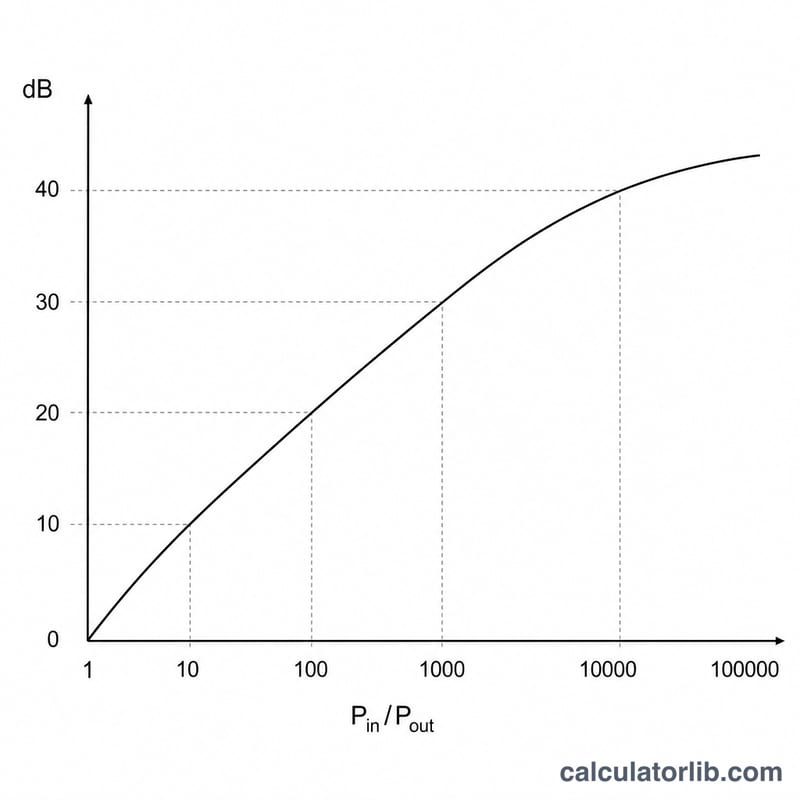
Insertion loss in decibels is defined as $$\text{IL (dB)} = 10 \cdot \log_{10}\!\left(\frac{\text{P}_{in}\text{ (mW)}}{\text{P}_{out}\text{ (mW)}}\right)$$ The factor of 10 applies because we are working with a power ratio; if you instead had voltage or amplitude, you would use a factor of 20. A positive result indicates true loss (output is less than input). If P_in equals P_out, the loss is 0 dB — the component is lossless in theory.
Worked Example
Suppose 10 mW enters a cable and only 5 mW comes out. The ratio is \(10 / 5 = 2\). Then $$\text{IL} = 10 \cdot \log_{10}(2) = 10 \cdot 0.30103 \approx 3.01 \text{ dB}$$ This is the classic "3 dB" rule: halving the power equals a 3 dB loss.
FAQ
Why is my result negative? If output power is greater than input power (e.g. an amplifier), the formula yields a negative number, which represents a gain rather than a loss.
Does the unit matter? No — as long as P_in and P_out use the same unit, the ratio (and therefore the dB result) is unchanged.
What is a good insertion loss value? It depends on the component: connectors may add a fraction of a dB, while filters or long cables can add several dB. Lower is generally better.