
What Is Free Space Path Loss?
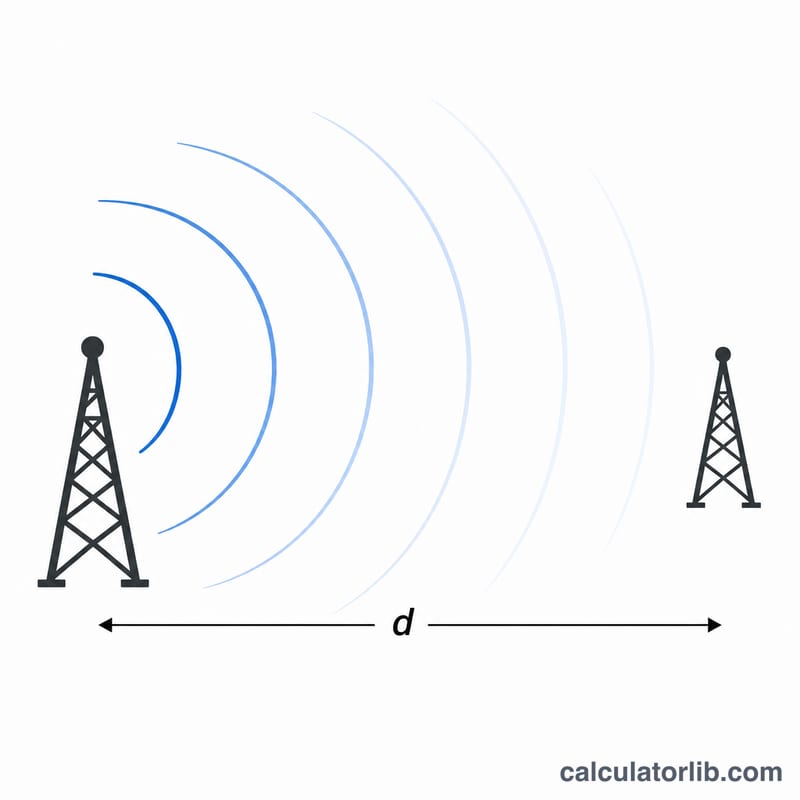
Free Space Path Loss (FSPL) is the attenuation a radio signal experiences traveling through free space (a clear line-of-sight path with no obstacles, reflections, or atmospheric absorption). It increases with both distance and frequency, and it is a foundational term in any RF link budget for Wi-Fi, satellite, microwave, cellular, and radar systems.
How to Use This Calculator
Enter the path distance in kilometers and the operating frequency in megahertz, then read the path loss in decibels (dB). Higher dB values mean more signal is lost between transmitter and receiver. To estimate received power, subtract FSPL (and other losses) from your transmit power plus antenna gains.
The Formula Explained
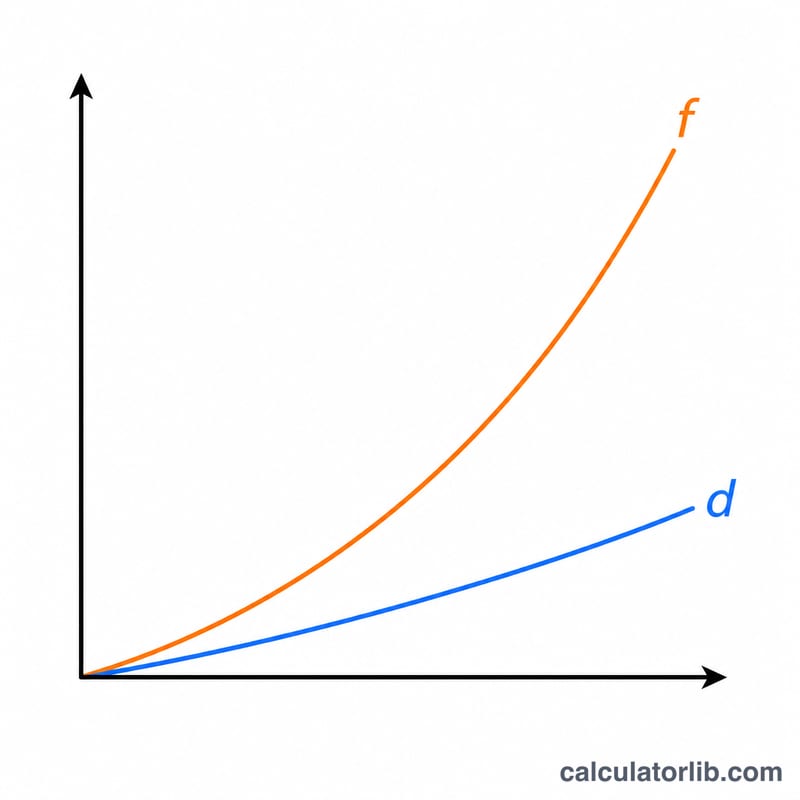
This tool uses the convenient engineering form: $$\text{FSPL}_{\text{dB}} = 20\log_{10}\!\left(\text{Distance (km)}\right) + 20\log_{10}\!\left(\text{Frequency (MHz)}\right) + 32.44$$, where \(d\) is in kilometers and \(f\) is in megahertz. The 32.44 constant bundles the speed of light and unit conversions so you can work directly in km and MHz. Doubling either distance or frequency adds about 6 dB of loss.
Worked Example
For a 2.4 GHz (2400 MHz) Wi-Fi link over 1 km: \(20\cdot\log_{10}(1) = 0\), \(20\cdot\log_{10}(2400) \approx 67.60\), plus 32.44 gives roughly 100.04 dB of free space path loss.
$$\text{FSPL}_{\text{dB}} = 20\log_{10}(1) + 20\log_{10}(2400) + 32.44 \approx 100.04\ \text{dB}$$FAQ
Does FSPL include obstacles or weather? No. It assumes an ideal unobstructed path. Real-world links add fading, rain, foliage, and diffraction losses on top.
Why does higher frequency mean more loss? The formula models loss relative to an isotropic antenna whose effective aperture shrinks with wavelength, so higher frequencies capture less energy at the same distance.
Can I use meters and Hz? This version expects km and MHz. Convert your values first (1000 m = 1 km, 1,000,000 Hz = 1 MHz).