
What is the VoIP Bandwidth Calculator?
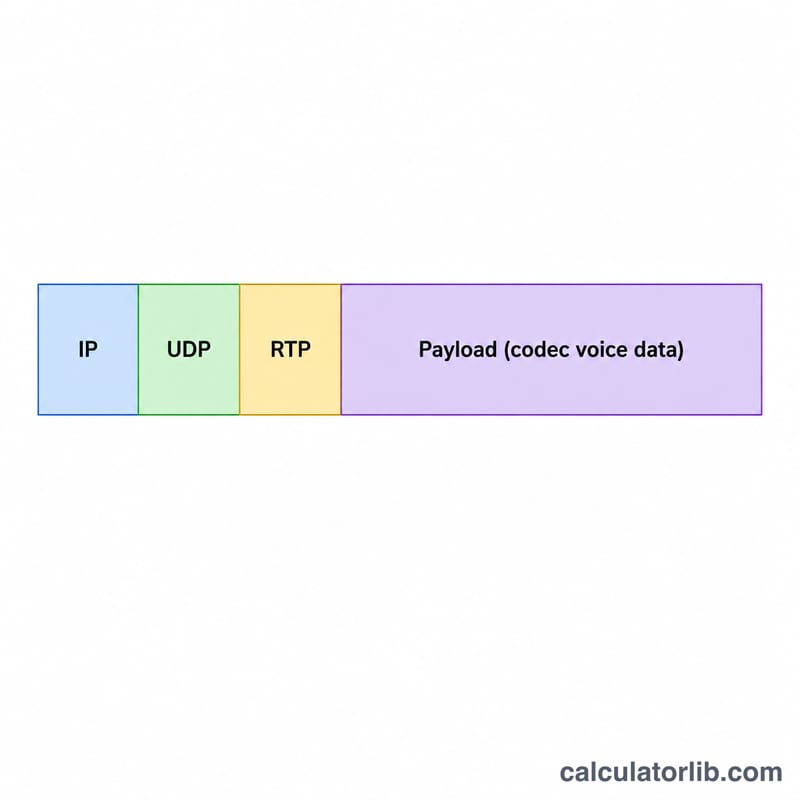
The VoIP Bandwidth Calculator estimates how much network bandwidth your Voice over IP calls consume. It accounts for the audio codec bitrate, the packetization interval (how often packets are sent), and the per-packet header overhead added by Ethernet, IP, UDP and RTP layers. The result tells you the bandwidth needed for a single call and for many concurrent calls — essential when sizing an internet connection or SIP trunk.
How to use it
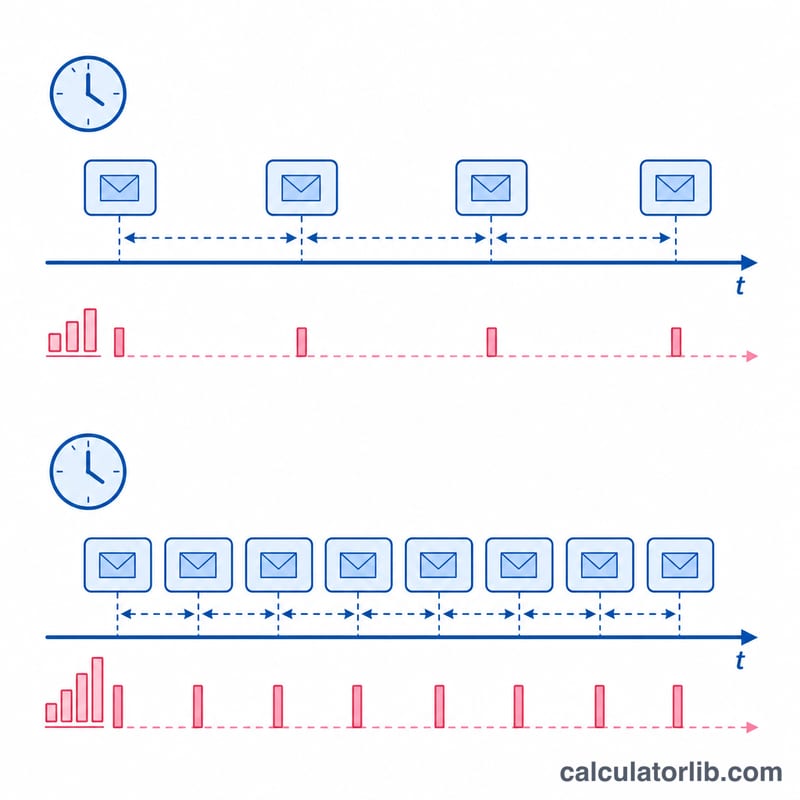
Pick your codec bitrate (e.g. G.711 = 64 kbps, G.729 = 8 kbps, G.722 = 64 kbps). Set the packetization interval in milliseconds (20 ms is the standard, producing 50 packets per second). Choose the header overhead per packet — a typical Ethernet + IP + UDP + RTP stack adds about 58 bytes. Finally enter the number of simultaneous calls. The calculator returns kilobits per second per call and the total for all concurrent calls.
The formula explained
Packets per second = 1000 / packetization interval (ms). The codec payload carried in each packet equals codec bitrate ÷ packets per second. Adding the header (in bits) and multiplying back by packets per second gives the per-call bandwidth:
$$\text{bw\_per\_call (kbps)} = \left( \frac{\text{codec\_bitrate\_bps}}{\text{pps}} + \text{overhead\_bytes} \times 8 \right) \times \text{pps} \div 1000$$
This simplifies to codec bitrate plus overhead bits per second. Total bandwidth is simply bw_per_call × concurrent calls.
Worked example
G.711 at 64 kbps, 20 ms packetization (50 pps), 58 bytes overhead, 10 calls: per-packet overhead = \(58 \times 8 = 464\) bits, \(\times\ 50\) pps = \(23{,}200\) bps = \(23.2\) kbps. Per call = \(64 + 23.2 = 87.2\) kbps. For 10 concurrent calls that is \(872\) kbps.
FAQ
Why is real bandwidth higher than the codec rate? Each tiny voice packet carries large network headers, and with 50 packets per second that overhead adds up significantly.
Can I reduce VoIP bandwidth? Use a lower-bitrate codec (G.729), a larger packetization interval (fewer, bigger packets), or RTP header compression.
Does this include silence suppression? No — this is a worst-case continuous-talk estimate; voice activity detection can cut usage roughly in half.