
What Is the Elo Rating System?
The Elo rating system, devised by physicist Arpad Elo, estimates the relative skill of players in head-to-head games such as chess. After each game your rating moves up or down based on the result and on how strong your opponent was. Beating a much higher-rated player gains you many points; losing to a much weaker player costs you many. This calculator works for any Elo-based system (FIDE, USCF, online sites), though the exact K-factor differs by organization.
How to Use This Calculator
Enter your current rating, your opponent's rating, choose the result (win, draw, or loss), and set the K-factor. The tool returns your new rating, the point change, and the expected score for the matchup. Typical K-factors: 40 for new players, 20 for most established players under 2400, and 10 for elite players above 2400.
The Formula Explained
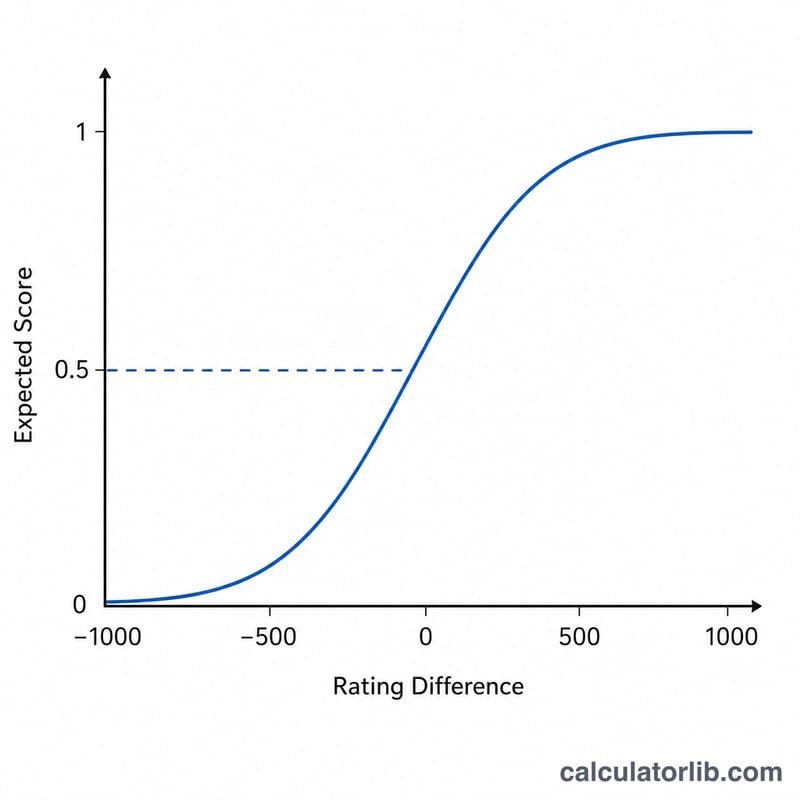
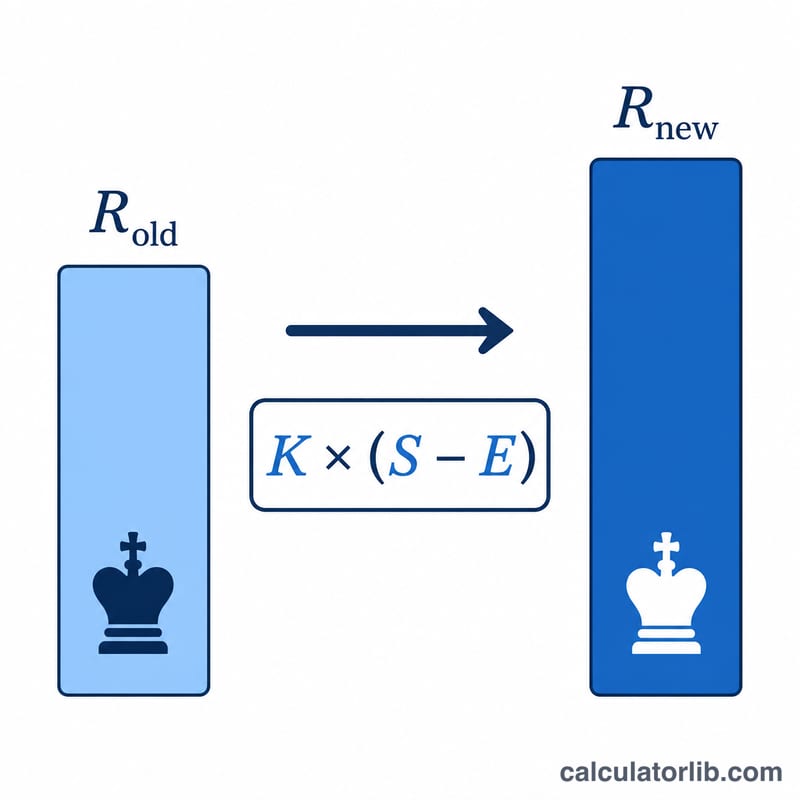
First compute the expected score $$E = \frac{1}{1 + 10^{(R_{opp} - R_{old})/400}}.$$ This is a number between 0 and 1 representing your win probability. Then the new rating is $$R_{new} = R_{old} + K \times (S - E),$$ where \(S\) is your actual score: 1 for a win, 0.5 for a draw, 0 for a loss. If you perform exactly as expected (\(S = E\)) your rating does not change.
Worked Example
Suppose you are rated 1500 and beat an opponent rated 1600 with \(K = 20\). The expected score is $$E = \frac{1}{1 + 10^{100/400}} = \frac{1}{1 + 10^{0.25}} \approx 0.3599.$$ The change is \(20 \times (1 - 0.3599) \approx 12.8\) points, so your new rating is about 1513.
FAQ
What K-factor should I use? Use 40 if you are new or have played fewer than 30 games, 20 for most players, and 10 for masters above 2400. Online platforms set their own values.
Why didn't my rating change much? If the result matched expectations, the change is small. Upsets produce larger swings.
Does a draw ever lose me points? Yes — if you are much higher rated than your opponent, a draw can lower your rating because your expected score exceeds 0.5.