
What Is the Elo Rating System?
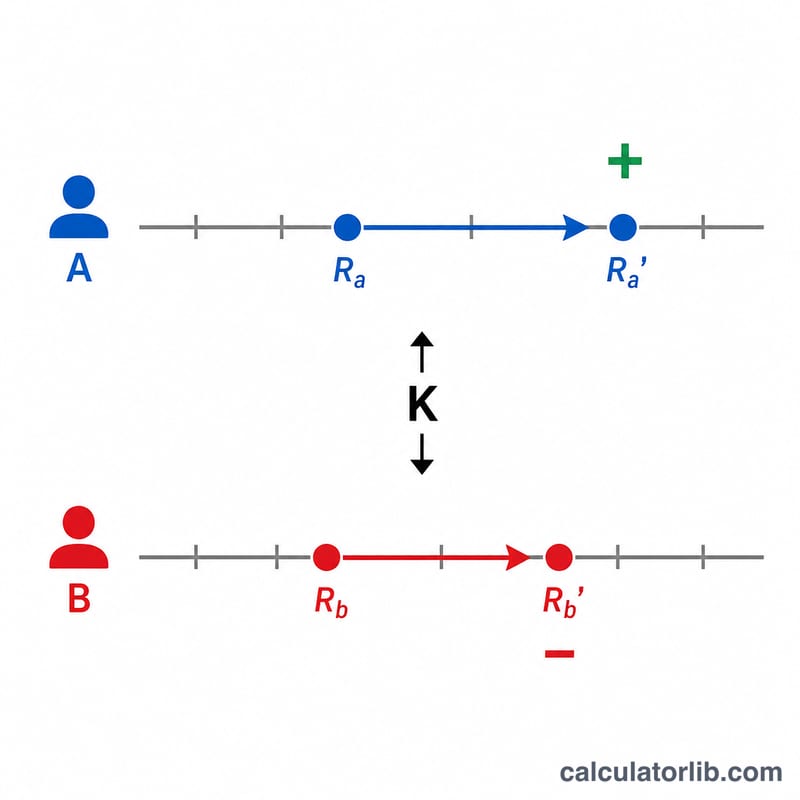
The Elo rating system, devised by physicist Arpad Elo, measures the relative skill of players in zero-sum games such as chess. Each player has a numeric rating; after every game the ratings are adjusted based on the result and on how that result compared to the expected outcome. Beating a stronger opponent earns more points than beating a weaker one, and an upset costs the favourite dearly.
How to Use This Calculator
Enter your current rating (Ra), your opponent's rating (Rb), choose the game result (win, draw or loss), and set your K-factor. Common K-factors are 40 for new players (under 30 games), 20 for most rated players, and 10 for established masters above 2400. The calculator returns your new rating, the points gained or lost, your expected score, and your win probability.
The Formula Explained
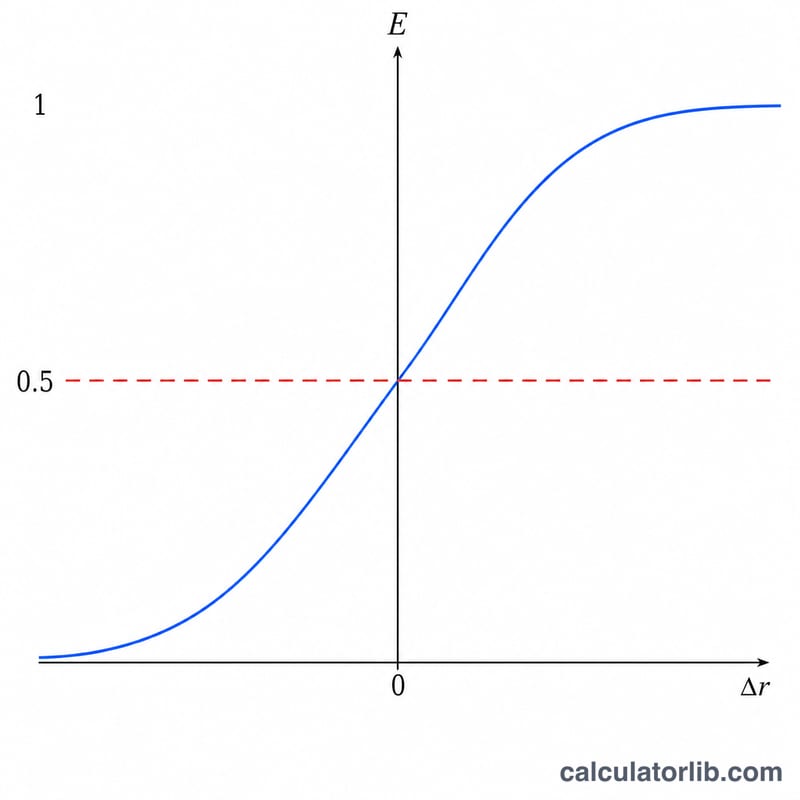
First the expected score E is computed from the rating gap: $$E = \frac{1}{1 + 10^{(R_b - R_a)/400}}$$ A 400-point advantage gives roughly a 91% expected score. The new rating is then $$R_{new} = R_a + K \times (S - E)$$ where S is the actual score: 1 for a win, 0.5 for a draw, 0 for a loss.
Worked Example
Suppose you are rated 1500 and beat an opponent rated 1600 with K = 20. The expected score is $$E = \frac{1}{1 + 10^{100/400}} = \frac{1}{1 + 10^{0.25}} \approx 0.3599$$ Your rating change is \(20 \times (1 - 0.3599) \approx +12.8\), giving a new rating of about 1513.
FAQ
What K-factor should I use? FIDE uses 40 for the first games, 20 for players under 2400, and 10 for players who have reached 2400.
Why did I lose so few points despite losing? If you were the underdog, your expected score was already low, so a loss barely changes your rating.
Are fractional ratings allowed? Federations round to the nearest whole number; this tool shows the precise value and the rounded new rating.