
What is the Guitar Capo Key Calculator?
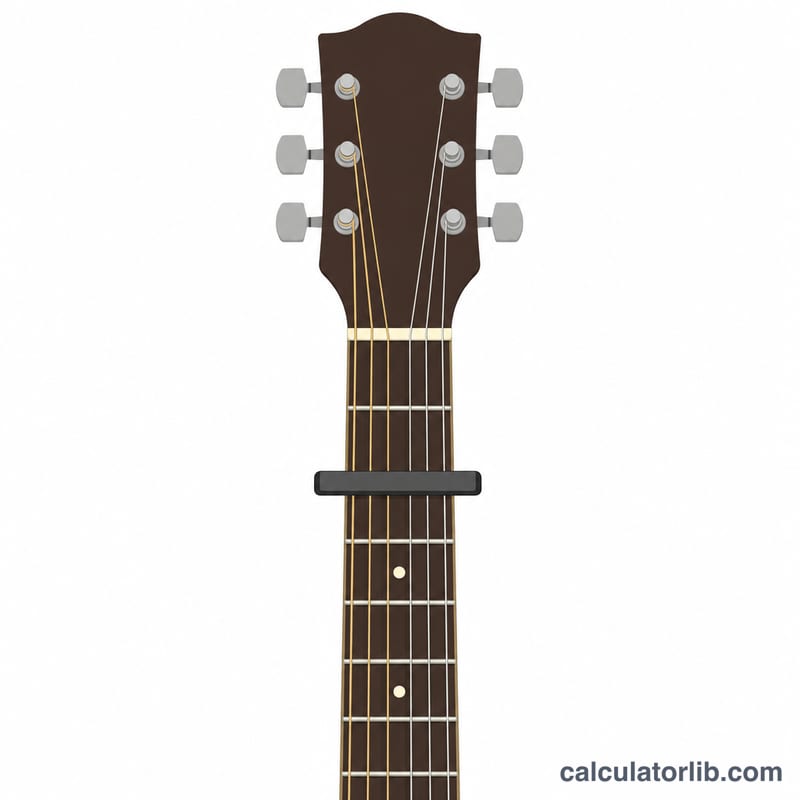
A capo clamps across the guitar neck and raises the pitch of every string by a fixed number of semitones — one semitone per fret. This calculator tells you the real sounding key when you keep using familiar open-chord shapes with a capo attached. Pick the chord shape you are fingering and the fret where your capo sits, and the tool shows the actual key the audience hears.
How to use it
Select the open chord shape or key you normally play (for example a C shape or G shape). Then enter the fret number of your capo (0 means no capo, up to fret 12). The calculator adds the fret count to the chord's semitone value and wraps it around the 12-note octave to give the transposed key.
The formula explained
Music uses 12 semitones per octave, numbered C=0, C#=1, D=2 … B=11. Because every capo fret adds one semitone, the sounding note is simply:
$$\text{Sounding Key} = \left(\text{Chord Shape} + \text{Capo Fret}\right) \bmod 12$$
The "mod 12" keeps the answer inside one octave, so going past B wraps back to C.
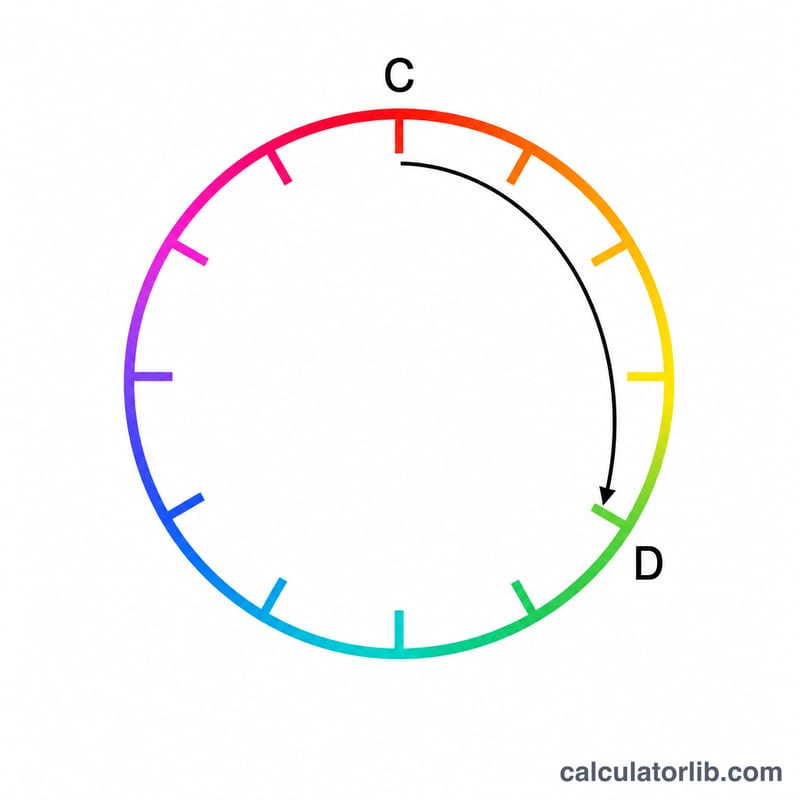
Worked example
You play C shapes (semitone 0) with the capo on fret 3. Then $$\text{new\_key} = (0 + 3) \bmod 12 = 3,$$ which is D#/Eb. So your C-shaped chords actually sound in the key of E♭. A common case: G shapes (7) with a capo on fret 2 gives \((7+2) \bmod 12 = 9 = A\).
FAQ
Does the capo change the chord shapes I finger? No — that's the point. You finger the same shapes; only the resulting pitch rises.
What does fret 0 mean? Fret 0 is no capo, so the sounding key equals your chord shape.
Why does the key sometimes wrap to C? After 12 frets you have raised the pitch a full octave, returning to the same note name.