
What Is Guitar String Tension?
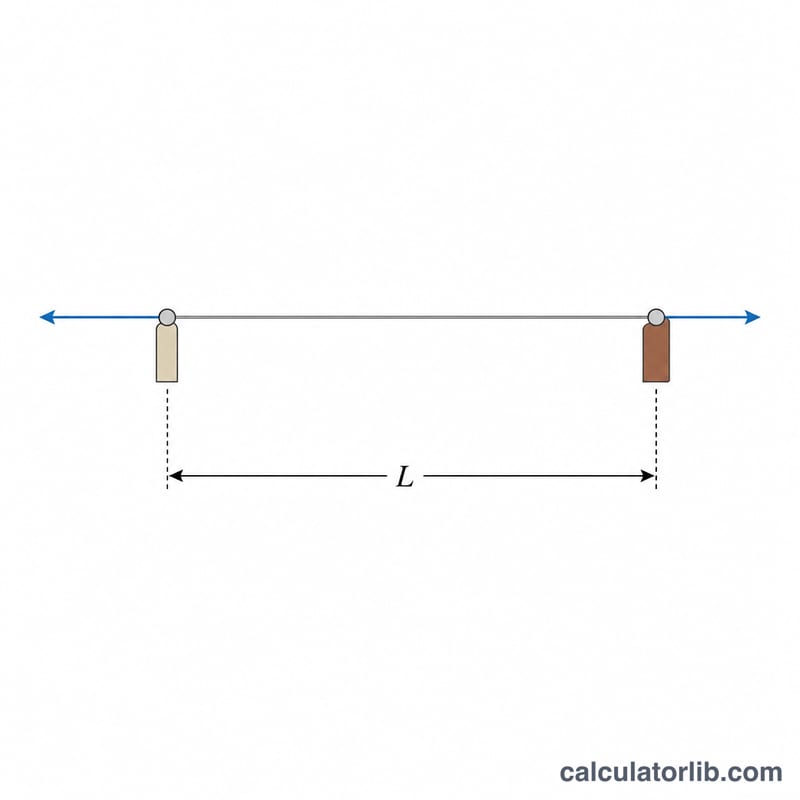
String tension is the pulling force a vibrating string exerts at a given pitch. It depends on the string's mass per unit length (unit weight), the scale length of the instrument, and the frequency you tune it to. Knowing tension helps you build balanced custom string sets, avoid floppy or overly stiff strings, and protect your guitar's neck from uneven stress.
How to Use This Calculator
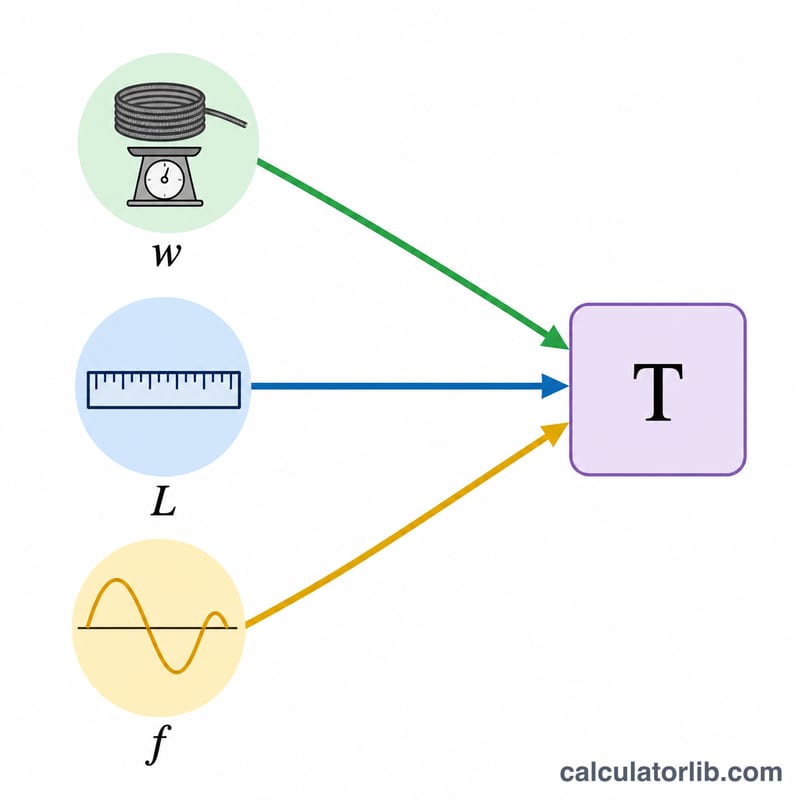
Enter three values: the unit weight of the string in pounds per inch (manufacturers publish this for each gauge), the scale length in inches (25.5" for a typical Fender, 24.75" for many Gibsons), and the target frequency in Hz for the note you want. The calculator returns the resulting tension in pounds.
The Formula Explained
The tension equation is $$T = \frac{\text{Unit Weight} \cdot \left(2 \cdot \text{Scale Length} \cdot \text{Frequency}\right)^{2}}{386.4}$$ The term \(2Lf\) is the wave speed needed for a string of length \(L\) to vibrate at frequency \(f\). Squaring it and multiplying by unit weight gives force in a mass-weight system, and dividing by \(386.4\ \text{in/s}^2\) (gravity in imperial units) converts that to pounds-force.
Worked Example
For a high E string with unit weight 0.00002215 lb/in on a 25.5" scale tuned to 329.63 Hz: \(2 \times 25.5 \times 329.63 = 16{,}811.13\). Squared \(= 282{,}613{,}997\). Times \(0.00002215 = 6{,}259.9\). Divided by \(386.4 \approx\) 16.2 lb of tension.
FAQ
Where do I find unit weight? String makers like D'Addario list unit weight per gauge in their tension charts.
What is a healthy total tension? Most six-string electric sets total around 90–120 lb; lighter or heavier depends on gauge and tuning.
Does this work for bass? Yes — use the bass scale length (e.g. 34") and the appropriate unit weight and frequency.