
What is a music interval?
A musical interval is the pitch distance between two notes, measured most precisely as a frequency ratio. In 12-tone equal temperament (12-TET) — the tuning used by pianos and most modern instruments — the octave is divided into 12 equal semitones. This calculator converts any number of semitones into its frequency ratio, its size in cents, and the resulting target frequency from a base pitch you choose.
How to use it
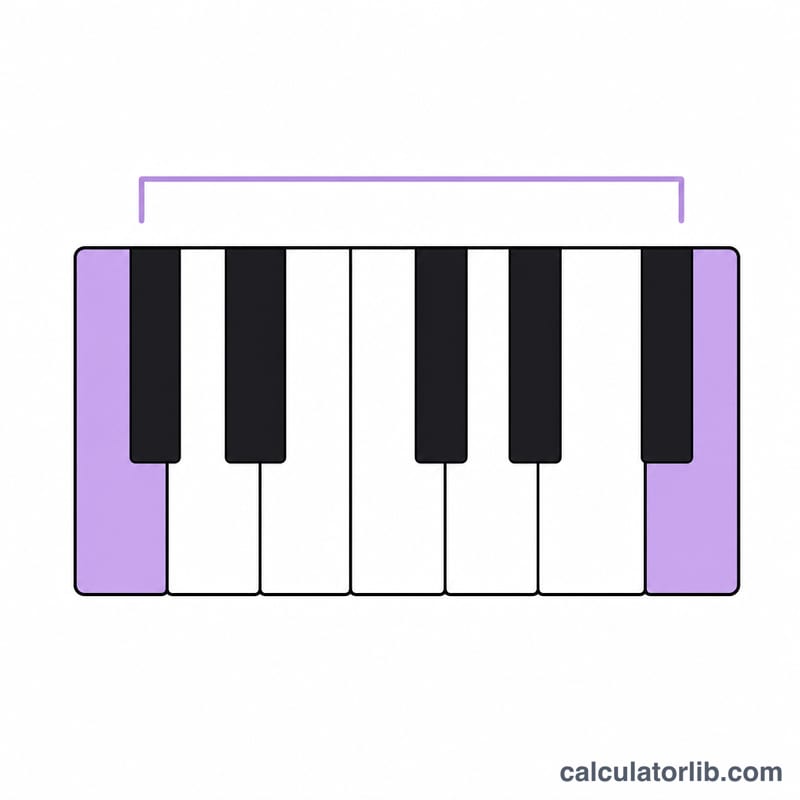
Enter the interval size in semitones (for example 7 for a perfect fifth, 12 for an octave, or -5 for a descending perfect fourth) and a base frequency in hertz (440 Hz is concert A). The calculator returns the frequency ratio, the interval size in cents, and the frequency you reach when you transpose the base pitch by that interval.
The formula explained
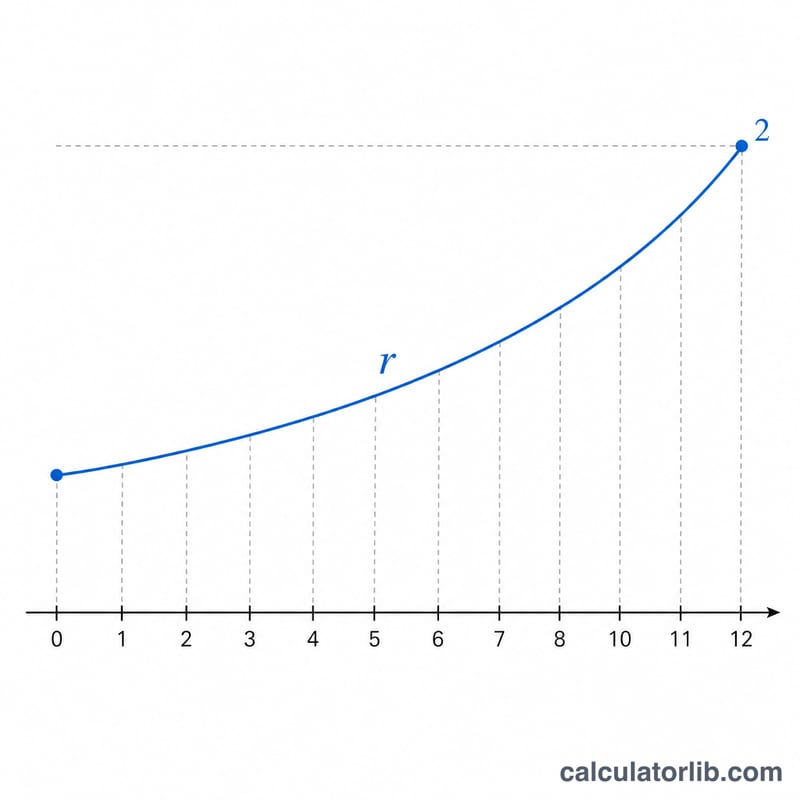
Equal temperament makes every semitone an identical ratio, so an interval of n semitones has the ratio \(r = 2^{n/12}\). Because each semitone is exactly 100 cents, the cents value is simply \(100 \times n\), which matches the general logarithmic definition $$\text{cents} = 1200 \cdot \log_2\!\left(\frac{f_2}{f_1}\right).$$ The target frequency is the base frequency multiplied by the ratio: $$f_2 = f_1 \times 2^{n/12}.$$
Worked example
For a perfect fifth (7 semitones) from A = 440 Hz: $$r = 2^{7/12} \approx 1.498307.$$ The interval is \(7 \times 100 = 700\) cents, and the target frequency is $$440 \times 1.498307 \approx 659.26 \text{ Hz}$$ (roughly E5). Note that equal temperament's fifth (1.4983) is slightly narrower than the pure just-intonation fifth of 1.5.
FAQ
What does a negative semitone value mean? A negative number is a descending interval; the ratio becomes less than 1 and the target frequency drops below the base.
Why is the equal-tempered fifth not exactly 3/2? Equal temperament compromises pure ratios so every key sounds equally in tune; the fifth is about 2 cents flat of just intonation.
How many cents are in an octave? Exactly 1200 cents, since an octave is 12 semitones at 100 cents each.