
What is the Music Transposition Calculator?
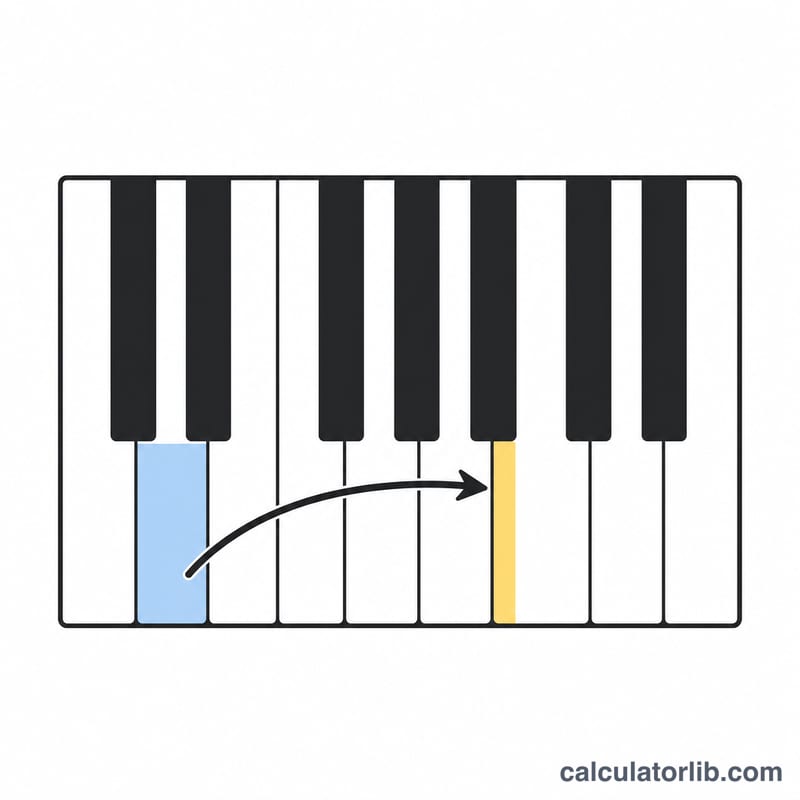
Transposition means shifting every note of a melody or chord up or down by the same musical distance, measured in semitones (half steps). This calculator takes a starting note and a number of semitones and tells you the resulting note name, its pitch-class index, and how many octaves it crosses. It works for any of the twelve chromatic pitches and for shifts in either direction.
How to use it
Pick your original note from the dropdown, then enter how many semitones to transpose. Use a positive number to move up (e.g. +2 for a whole step) and a negative number to move down (e.g. -5 to go down a perfect fourth). The result shows the new note name plus an octave-shift indicator so you know whether you have moved into a higher or lower register.
The formula explained
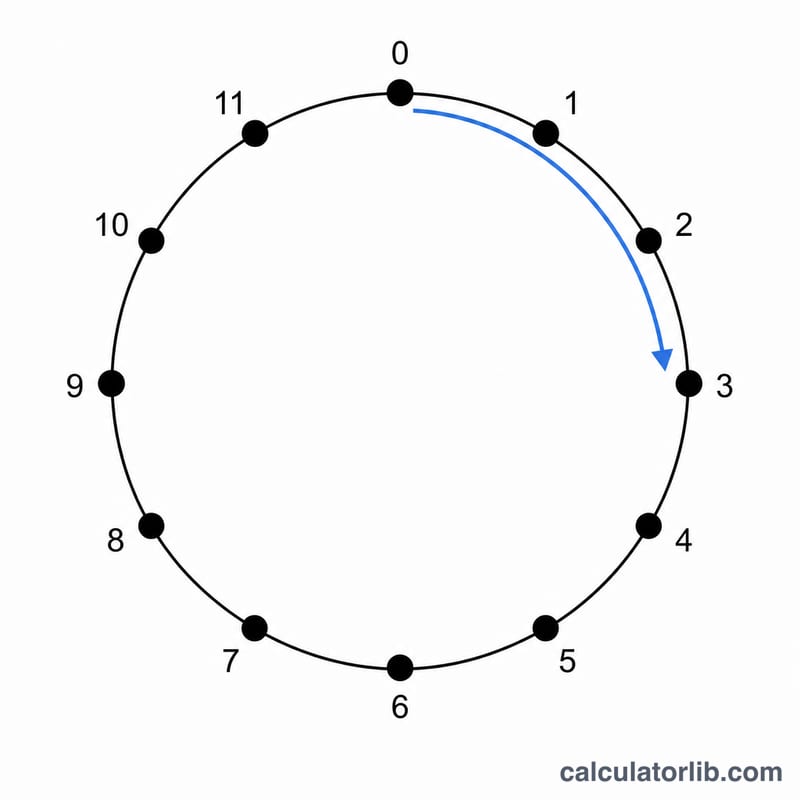
Every chromatic note is numbered 0 to 11: C=0, C#/Db=1, D=2, and so on up to B=11. Transposing simply adds the semitone offset to that index. Because an octave repeats every 12 semitones, we take the result modulo 12 to land back inside a single octave:
$$\text{new\_index} = (\text{original\_index} + \text{semitones}) \bmod 12$$
To keep negative shifts valid, the calculation normalises with \(((n + s) \bmod 12 + 12) \bmod 12\). The octave shift is the floor of \((n + s) / 12\).
Worked example
Start on A (index 9) and transpose up 4 semitones (a major third). \(9 + 4 = 13\). Then \(13 \bmod 12 = 1\), which is C#/Db. The octave shift is \(\lfloor 13 / 12 \rfloor = 1\), meaning the new note lands one octave above the starting register. So A transposed up 4 semitones is C#/Db.
FAQ
How many semitones is a perfect fifth? Seven semitones. A perfect fourth is five, a major third is four, and an octave is twelve.
What does the pitch-class index mean? It is a number 0–11 that uniquely identifies the note regardless of octave or enharmonic spelling, widely used in music theory and software.
Can I transpose down? Yes — enter a negative semitone value. The calculator wraps the result correctly so you always get a valid note name.