
What is crosstalk?
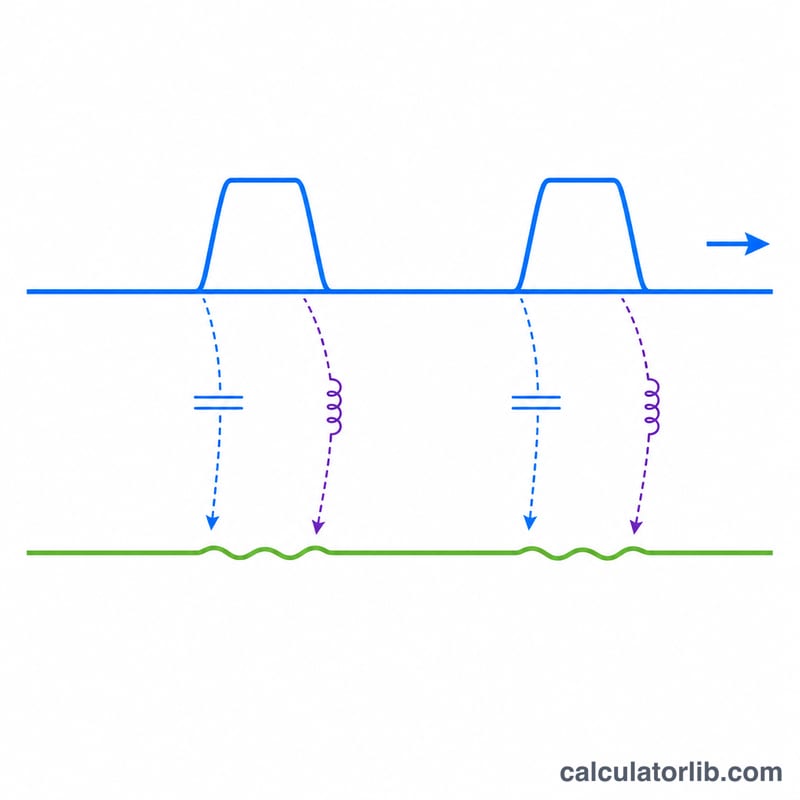
Crosstalk is the unwanted coupling of a signal from one circuit, transmission line, or conductor (the aggressor) onto an adjacent one (the victim). It is a key concern in PCB layout, cable harnesses, connectors, and high-speed digital and RF design. Expressing crosstalk in decibels (dB) gives an intuitive, logarithmic measure of how much smaller the coupled signal is compared with the original source signal.
How to use this calculator
Enter the source voltage (the aggressor signal level) and the coupled voltage (the amount measured on the victim line). The calculator returns the crosstalk in dB. A more negative number means better isolation — less coupling. For example, −40 dB indicates the coupled signal is 1% of the source.
The formula explained
The crosstalk in decibels is given by:
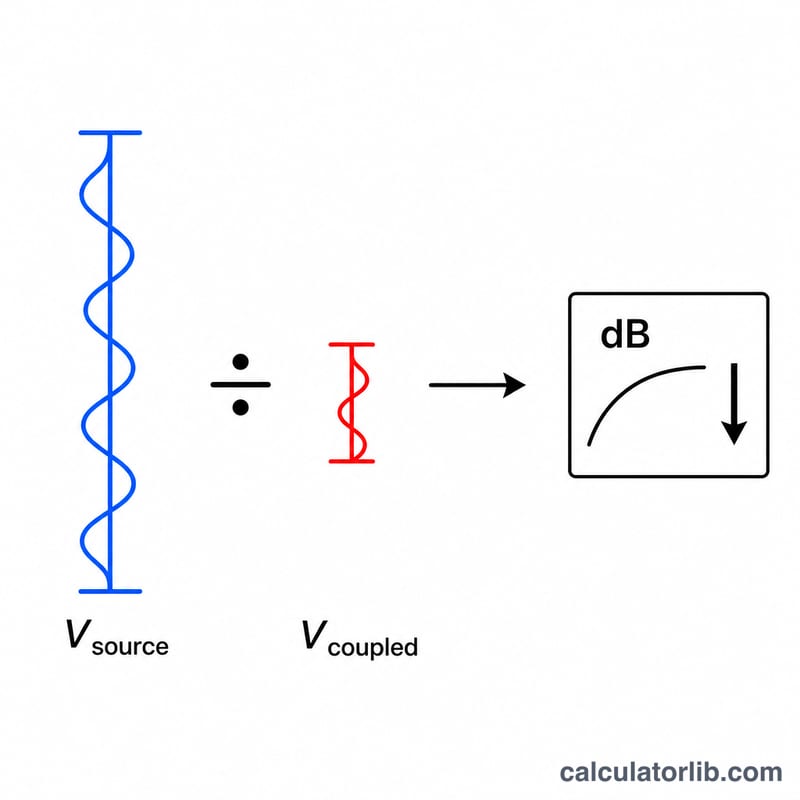
$$\text{X}_{\text{dB}} = 20 \cdot \log_{10}\!\left(\frac{V_{\text{coupled}}}{V_{\text{source}}}\right)$$
The factor of 20 is used because we are dealing with a voltage (amplitude) ratio rather than a power ratio. Since power is proportional to voltage squared, the \(10\cdot\log_{10}\) used for power becomes \(20\cdot\log_{10}\) for voltage.
Worked example
Suppose the source line carries 1 V and you measure 0.01 V coupled onto the neighboring line. The ratio is \(0.01 / 1 = 0.01\), and $$20 \cdot \log_{10}(0.01) = 20 \cdot (-2) = -40 \text{ dB}$$ The crosstalk is −40 dB, meaning 1% voltage coupling.
FAQ
Why is the result negative? When the coupled voltage is smaller than the source (the normal case), the ratio is less than 1 and its logarithm is negative, so good isolation appears as a large negative dB value.
What is a good crosstalk value? It depends on the application, but values like −30 dB to −60 dB or lower are commonly targeted for clean high-speed links — the more negative, the better.
Does this use power or voltage? This calculator uses the voltage ratio with the \(20\cdot\log_{10}\) form. If you have a power ratio, use \(10\cdot\log_{10}\) instead.