
What Is Duty Cycle?
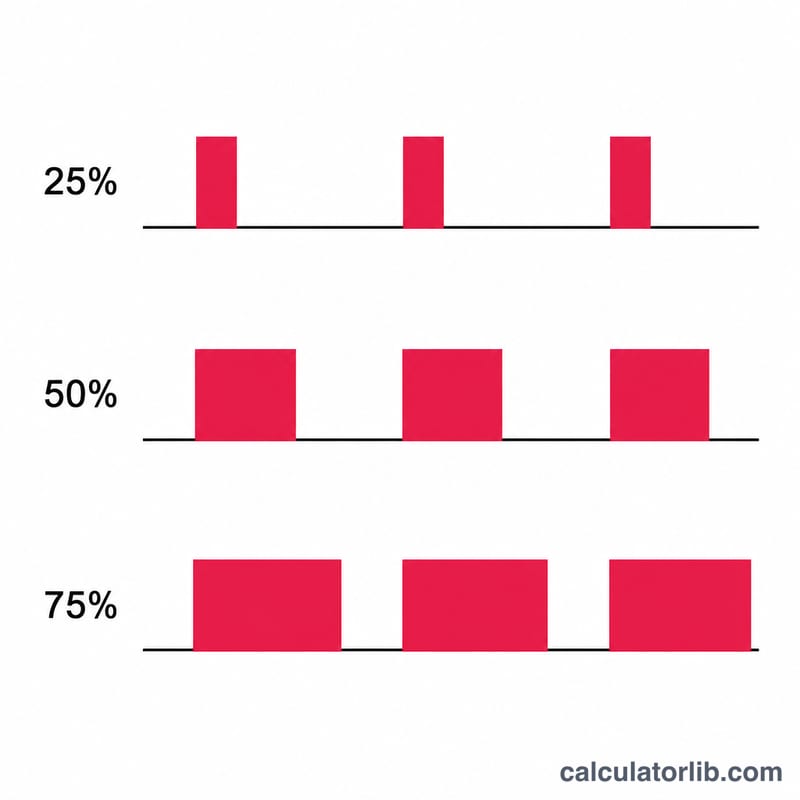
Duty cycle is the fraction of one full period during which a signal or system is active (ON), expressed as a percentage. It is a key parameter for pulse-width modulation (PWM), square waves, switching power supplies, motor control, lasers, and any pulsed signal. A 50% duty cycle means the signal is ON for exactly half of every cycle.
How to Use This Calculator
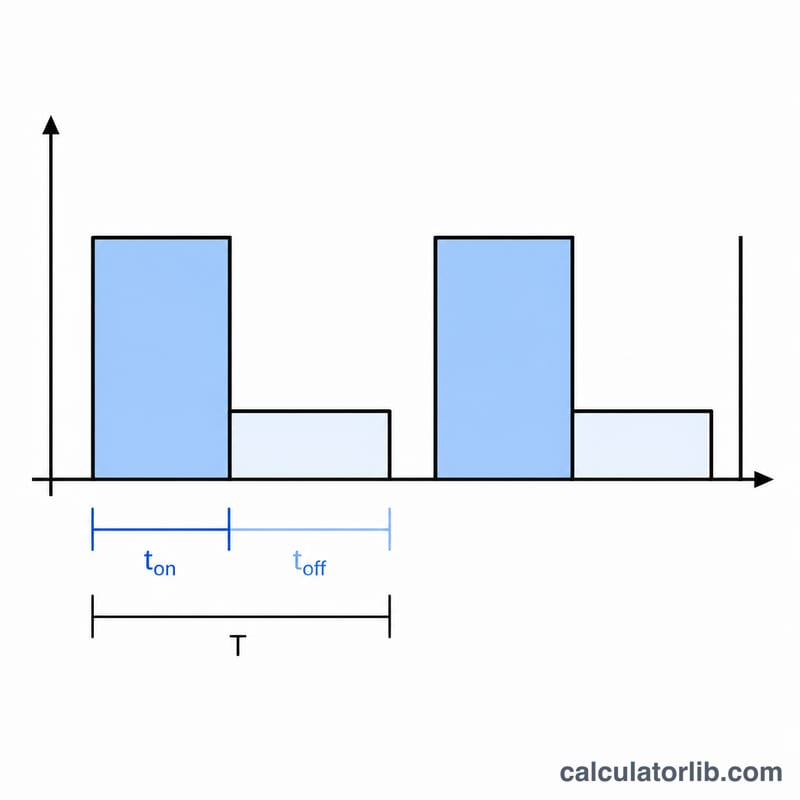
Enter the pulse on time (how long the signal stays HIGH in one cycle) and the total period (the full length of one cycle). Both should use the same time unit — seconds in this tool. The calculator returns the duty cycle as a percentage, the OFF time, and the signal frequency.
The Formula Explained
The duty cycle is calculated as:
$$\text{Duty Cycle (\%)} = \frac{\text{Pulse On Time}}{\text{Total Period}} \times 100$$
The off time is simply the period minus the on time, and the frequency is the reciprocal of the period (\(f = 1 \div T\)).
Worked Example
Suppose a PWM signal has a pulse on time of 2 seconds within a total period of 10 seconds. The duty cycle is $$(2 \div 10) \times 100 = 20\%.$$ The off time is \(10 - 2 = 8\) seconds, and the frequency is \(1 \div 10 = 0.1\) Hz.
FAQ
Can I use milliseconds or microseconds? Yes — as long as on time and period use the same unit, the duty cycle percentage is correct. Note that the frequency output assumes the period is in seconds.
What does a 100% duty cycle mean? The signal is always ON; it never turns off. A 0% duty cycle means it is always OFF.
How is duty cycle related to average voltage? For a PWM signal switching between 0 V and Vmax, the average voltage equals \(\text{duty cycle} \times V_{\max}\), which is why PWM is used to control LED brightness and motor speed.