
What Is Cycle Time?
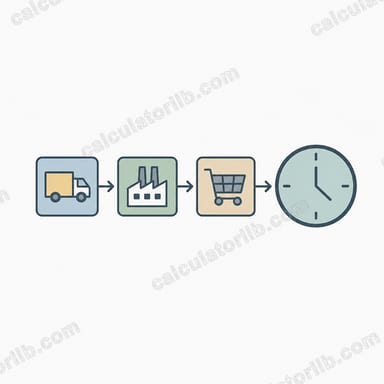
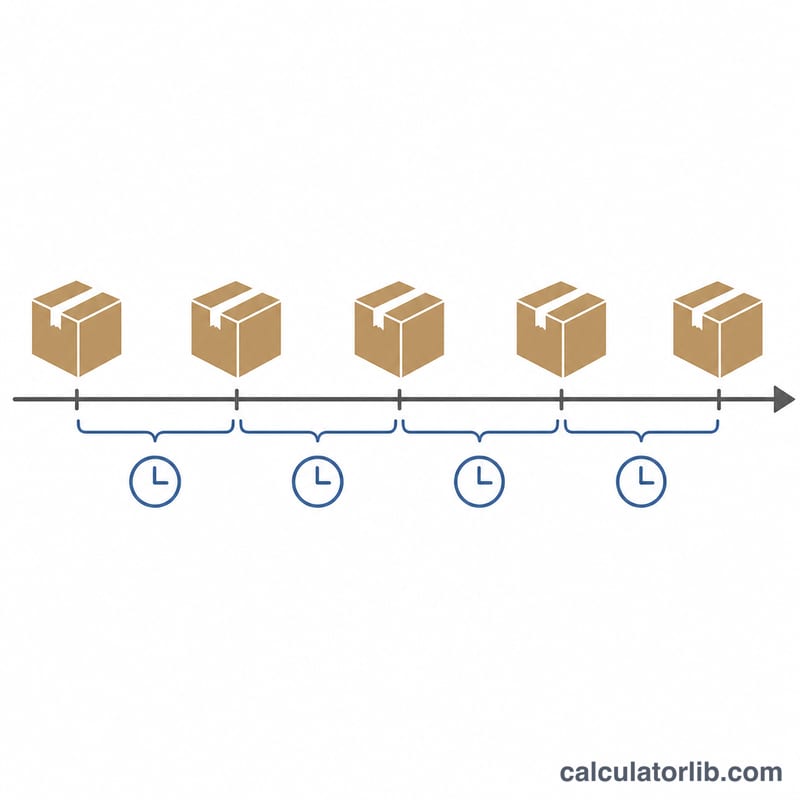
Cycle time is the average amount of time it takes to produce one unit of output. It is a core metric in lean manufacturing, process improvement and operations management because it tells you how fast a process is actually running. Lower cycle times generally mean higher productivity and shorter lead times, as long as quality stays constant.
How to Use This Calculator
Enter the net production time (the actual working time available, after subtracting breaks, changeovers and planned stops) in minutes, and the total units produced during that time. The calculator divides the time by the units to give you the cycle time per unit, then also shows the equivalent in seconds and the throughput rate in units per minute.
The Formula Explained
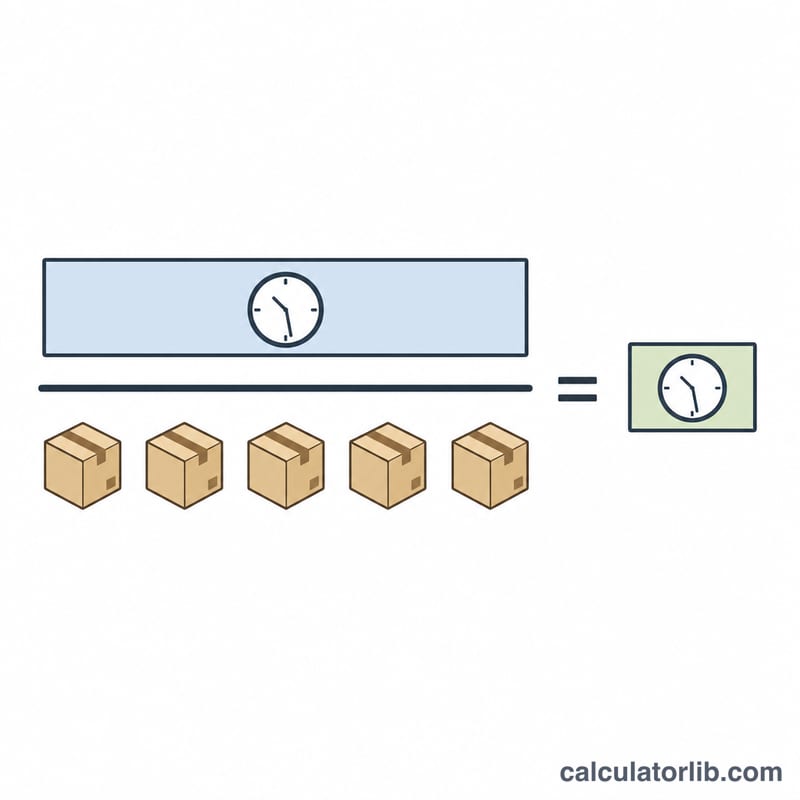
The calculation is simply:
$$\text{Cycle Time} = \frac{\text{Net Production Time}}{\text{Units Produced}}$$
If a shift runs 480 productive minutes and produces 240 units, the cycle time is \(480 \div 240 = 2\) minutes per unit. The throughput is the inverse: \(1 \div 2 = 0.5\) units per minute. Multiply cycle time by 60 to express it in seconds per unit (120 seconds).
Worked Example
A packaging line works a 7.5-hour shift with 30 minutes of breaks, leaving 420 net minutes. It produces 1,050 boxes. Cycle time = $$420 \div 1{,}050 = 0.4$$ minutes per box, which is 24 seconds per box. Throughput = \(1 \div 0.4 = 2.5\) boxes per minute.
FAQ
Is cycle time the same as takt time? No. Cycle time is how long it actually takes to make a unit; takt time is the rate at which you must produce to meet customer demand. Ideally cycle time is at or below takt time.
What counts as net production time? Only the time the process is genuinely available to run — total scheduled time minus planned downtime such as breaks, meetings and changeovers.
Should I use total or good units? For pure cycle time you can use total units. To reflect quality, use only good (defect-free) units, which slightly increases the effective cycle time.