What is the Drive Time Calculator?
The Drive Time Calculator estimates how long a journey will take based on the distance you need to cover and the average speed you expect to maintain. It works for any units as long as distance and speed match — miles with mph, or kilometers with km/h. It is a universal physics tool, not tied to any country, and is perfect for planning road trips, deliveries, or commutes.
How to use it
Enter the total trip distance, your expected average speed, and choose your unit system. The calculator divides distance by speed and converts the decimal result into a clean hours-and-minutes display, plus exact totals in hours and minutes.
The formula explained
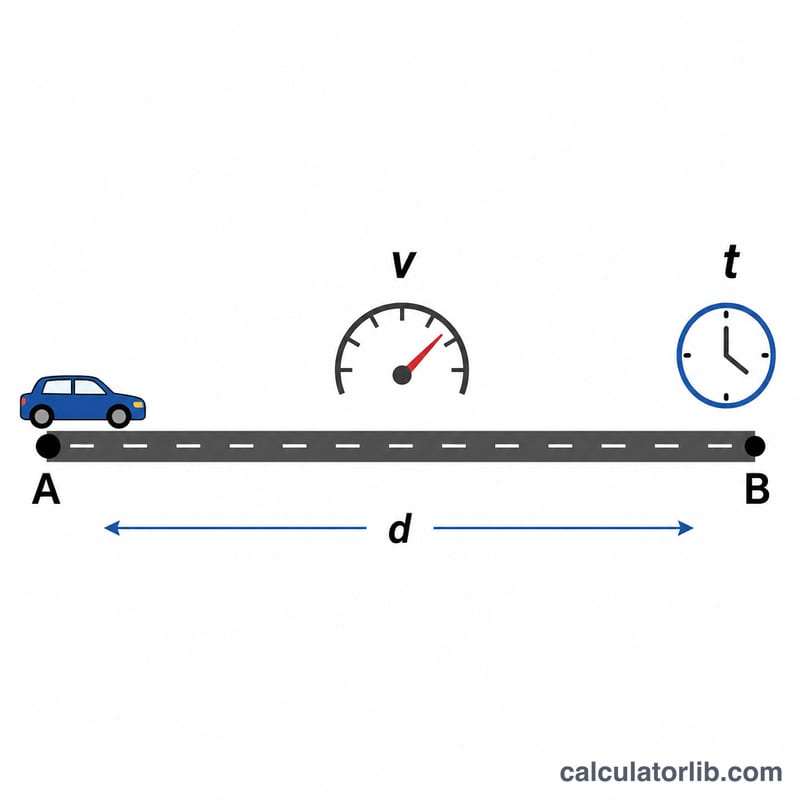
The core relationship is time = distance ÷ average speed.
$$\text{Drive Time (hours)} = \frac{\text{Distance}}{\text{Average Speed}}$$The result is in hours when speed is per hour. To split it into hours and minutes, take the whole number as hours and multiply the remaining fraction by 60 to get minutes.
Worked example
Suppose you drive 150 miles at an average speed of 50 mph. Time = 150 ÷ 50 = 3 hours exactly, or 180 total minutes.
$$\text{Time} = \frac{150}{50} = 3 \text{ hours} = 180 \text{ minutes}$$If instead you average 60 mph over 150 miles, time = 2.5 hours = 2 hours 30 minutes = 150 minutes.
$$\text{Time} = \frac{150}{60} = 2.5 \text{ hours} = 2 \text{ hours } 30 \text{ minutes} = 150 \text{ minutes}$$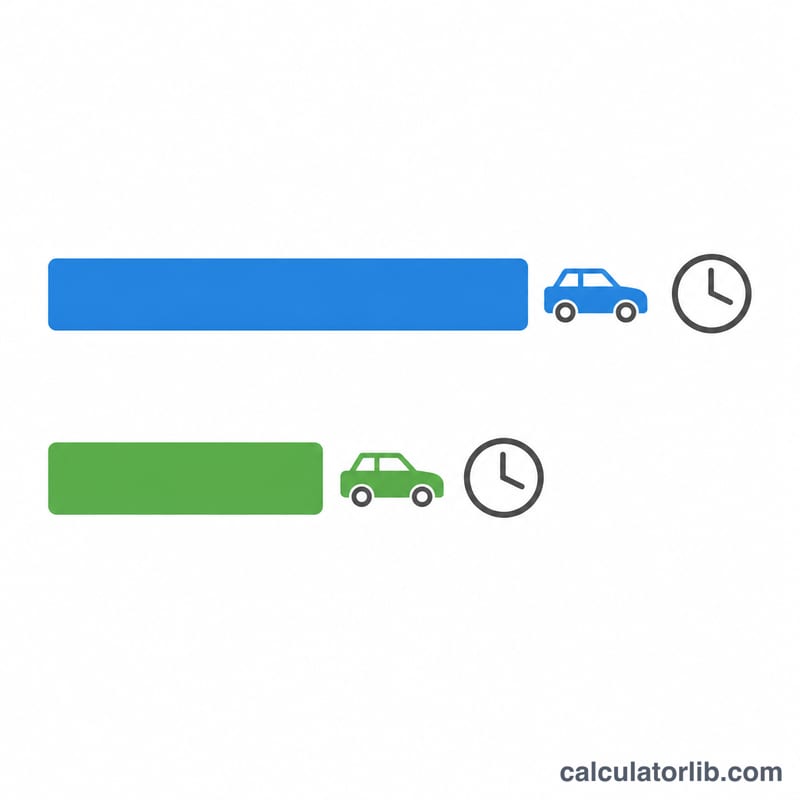
Speed and Distance Unit Conversions
Distance and speed must be entered in matching units — miles with mph, or kilometres with km/h. The factors below are exact or exact-to-the-digits shown; the mile-to-kilometre relationship is defined exactly as 1 international mile = 1.609344 km.
| From | To | Multiply by |
|---|---|---|
| 1 mile | kilometres | 1.609344 (exact) |
| 1 kilometre | miles | 0.621371 |
| 1 mph | km/h | 1.609344 (exact) |
| 1 km/h | mph | 0.621371 |
| 1 mph | m/s | 0.44704 (exact) |
| 1 km/h | m/s | 0.277778 (= 1/3.6) |
| 1 knot | km/h | 1.852 (exact) |
| 1 knot | mph | 1.15078 |
Common speed limits, both ways
Values are rounded to the nearest whole unit. The mph figures are typical of the United States, the United Kingdom and Ireland; the km/h figures are typical of most other countries.
| Imperial | Metric equivalent | Metric | Imperial equivalent |
|---|---|---|---|
| 25 mph | ≈ 40 km/h | 50 km/h | ≈ 31 mph |
| 55 mph | ≈ 89 km/h | 100 km/h | ≈ 62 mph |
| 65 mph | ≈ 105 km/h | 130 km/h | ≈ 81 mph |
| 70 mph | ≈ 113 km/h | — | — |
Decimal hours to minutes
The formula returns hours as a decimal; multiply the decimal part by 60 to read it as minutes.
| Decimal hours | Minutes |
|---|---|
| 0.1 h | 6 min |
| 0.25 h | 15 min |
| 0.5 h | 30 min |
| 0.75 h | 45 min |
| 1.0 h | 60 min |
Example: \(0.3077 \times 60 = 18.5\) minutes, which rounds to 18 minutes.
Typical Average Speeds by Road Type
The single most important input is the average speed — the speed that, held constant, would cover the distance in the same time. It is always lower than the posted limit or your cruising speed, because it absorbs acceleration, deceleration, signals, junctions and traffic. The ranges below are general planning figures for choosing a realistic value.
| Road type | Typical sustained average | Metric |
|---|---|---|
| Urban / city streets with signals | 15–25 mph | 25–40 km/h |
| Suburban arterials | 25–35 mph | 40–56 km/h |
| Rural two-lane highway | 45–55 mph | 72–89 km/h |
| Interstate / motorway, free flow | 60–70 mph | 97–113 km/h |
| Interstate / motorway, moderate congestion | 40–55 mph | 64–89 km/h |
| Long trips, door-to-door incl. fuel and rest stops | 50–60 mph | 80–97 km/h |
For context: posted maximum limits on rural Interstates in the United States generally range from 65 to 80 mph depending on the state, and typical motorway limits in Europe range from 100 to 130 km/h depending on the country (Germany additionally has stretches of Autobahn with only an advisory speed). Sustained averages sit below these ceilings because of on- and off-ramp transitions, slower traffic, weather, road works and any stop you make.
How to choose a value
- For a short local trip, use the urban or suburban row — a 6-mile cross-town errand at 20 mph is 18 minutes, not the 7 minutes a 50 mph limit would suggest.
- For a mixed trip, split it: run the calculator once for the highway leg and once for the city legs at each end, then add the two times.
- For a long day of driving, use the door-to-door row (50–60 mph / 80–97 km/h) — it already reflects roughly one stop every two hours. Alternatively, use a free-flow speed and add stop time explicitly.
- Recompute with a speed 10 mph (15 km/h) lower to see your worst-case arrival time; that spread is a more useful planning number than a single estimate.
These ranges are general planning guidance only. They are not legal limits and are not a recommendation to drive at any particular speed: always obey posted signage, local law and conditions, and reduce speed for weather, visibility, load and traffic.
FAQ
Does this account for traffic or stops? No — it assumes a constant average speed. Use a realistic average that already reflects expected slowdowns and breaks for better accuracy.
Can I use kilometers? Yes. Select the kilometers option and enter speed in km/h; the math is identical.
Why is my "average speed" lower than my cruising speed? Average speed includes acceleration, deceleration, traffic, and stops, so it is typically well below your top highway speed.