
What This Calculator Does
The Drive Time With Rest Stops Calculator estimates how long a road trip will really take by combining your driving time with the time spent on rest breaks. Online maps usually show only continuous driving time, but a realistic plan must account for fuel stops, meals, bathroom breaks, and stretching your legs. This tool adds those minutes back in so you can plan an arrival time you can actually keep.
How to Use It
Enter the total trip distance, your expected average speed, the number of rest stops you plan to make, and how many minutes each stop will last. The calculator converts everything to hours and returns your total trip time in both an "hours and minutes" format and a decimal hours figure, along with a breakdown of driving versus resting.
The Formula Explained
The math is straightforward: total time equals distance divided by speed, plus the number of stops multiplied by minutes per stop and divided by 60 to convert minutes into hours.
$$T = \frac{\text{Distance (mi)}}{\text{Speed (mph)}} + \frac{\text{Stops} \times \text{Min/Stop}}{60}$$
Using a single average speed keeps the estimate simple. If your route mixes highway and city driving, pick a blended average that reflects the whole trip.
Worked Example
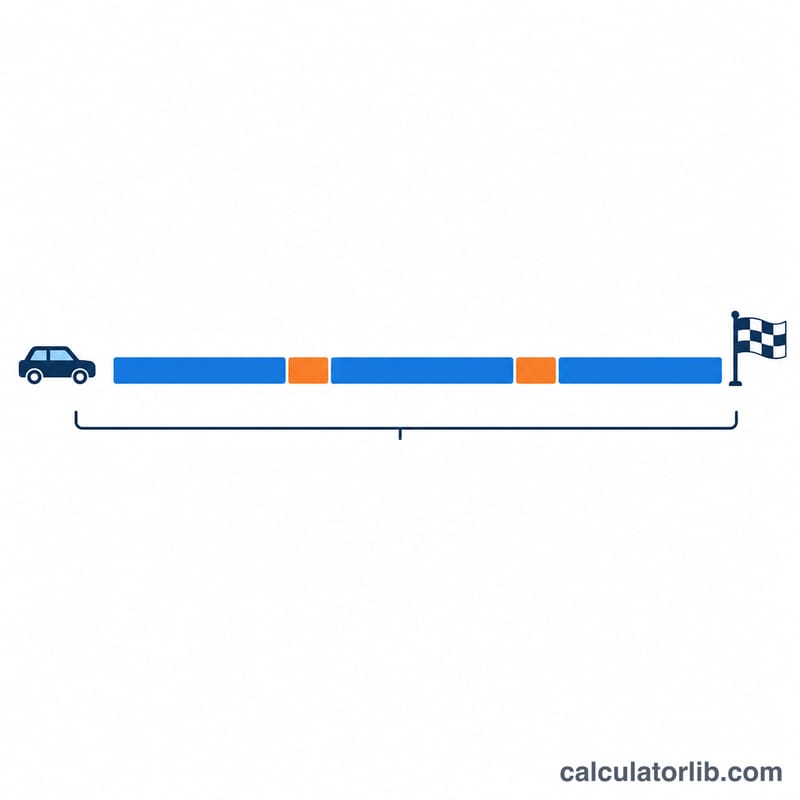
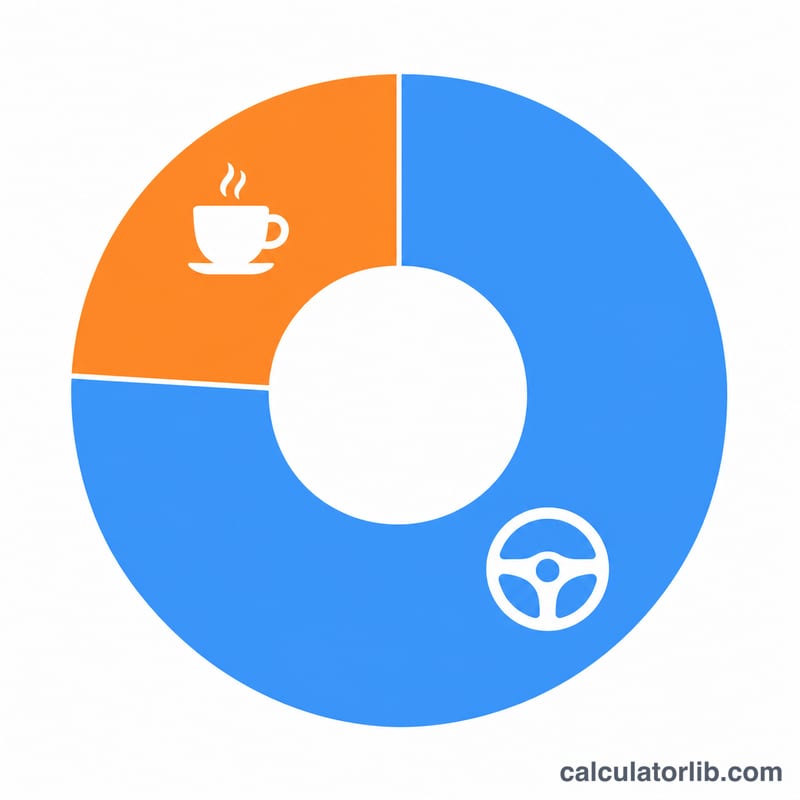
Suppose you are driving 300 miles at an average of 60 mph, with 2 rest stops of 15 minutes each. Driving time is \(300 \div 60 = 5\) hours. Rest time is \((2 \times 15) \div 60 = 0.5\) hours. Total trip time is \(5 + 0.5 = 5.5\) hours, or 5 hours 30 minutes.
FAQ
What average speed should I use? Use a realistic blended figure. Long highway trips might average 60–70 mph, while routes with towns and traffic may average 45–55 mph.
Should I count fuel stops? Yes — include any planned fuel, food, or break time as a "rest stop" with its expected duration.
Does it handle metric units? Yes, as long as distance and speed use the same unit system (e.g. kilometers and km/h), the result is correct.