
What This Calculator Does
When friends travel together, one person often books the hotel, another buys gas, a third covers dinner. By the end of the trip nobody knows who owes what. This Group Trip Cost Split Calculator adds up every payment, divides the total equally between everyone, and then works out the simplest set of transfers so everybody ends up having paid the same amount.
How to Use It
Set the number of people in your group, then enter how much each person actually paid toward shared costs. Leave anyone who paid nothing at zero. Hit calculate and you'll see the equal share per person, the total trip cost, and a list of payments — "Person A pays Person B $X" — that settles everyone up with the fewest transactions.
The Formula Explained
First we compute each person's fair share: \(\text{Share} = \text{Total Paid} \div N\). Then each person's balance is \(\text{Balance} = \text{what they paid} - \text{share}\). A positive balance means they overpaid and are owed money; a negative balance means they underpaid and owe money. A greedy matching algorithm repeatedly sends money from the largest debtor to the largest creditor until every balance is zero, which keeps the number of transfers small.
$$\text{Share} = \frac{\text{Total}}{\text{People}}, \qquad \text{Balance}_i = \text{Paid}_i - \text{Share}$$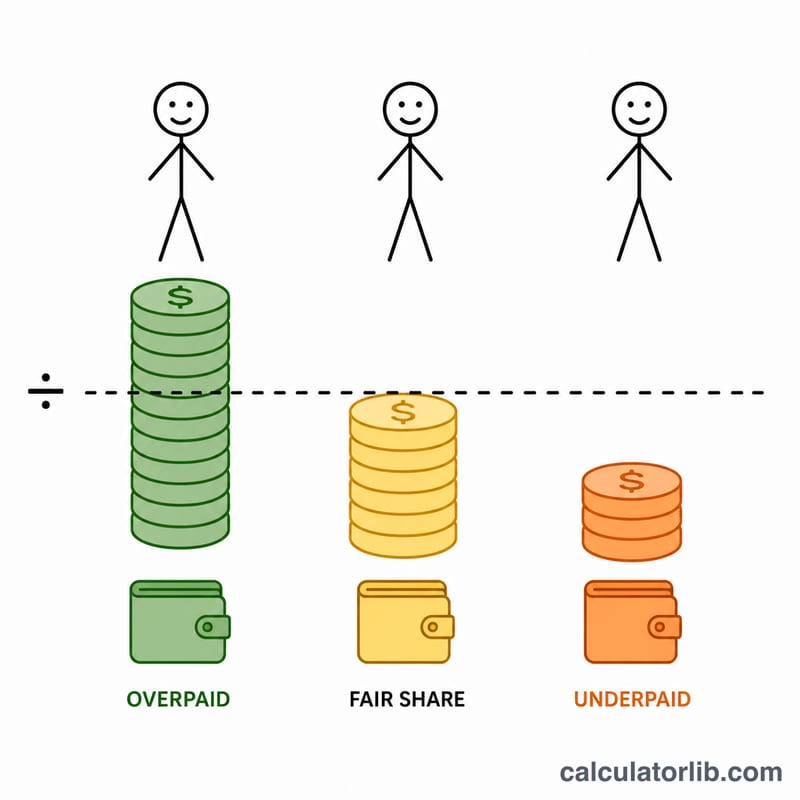
Worked Example
Three friends go away. Person 1 paid $120, Person 2 paid $30, Person 3 paid $0. The total is $150, so each owes $50. Balances are +$70, −$20, −$50. Person 3 pays Person 1 $50 and Person 2 pays Person 1 $20 — now everyone has effectively paid $50.
$$\text{Share} = \frac{150}{3} = 50$$$$\text{Balance}_1 = 120 - 50 = +70, \quad \text{Balance}_2 = 30 - 50 = -20, \quad \text{Balance}_3 = 0 - 50 = -50$$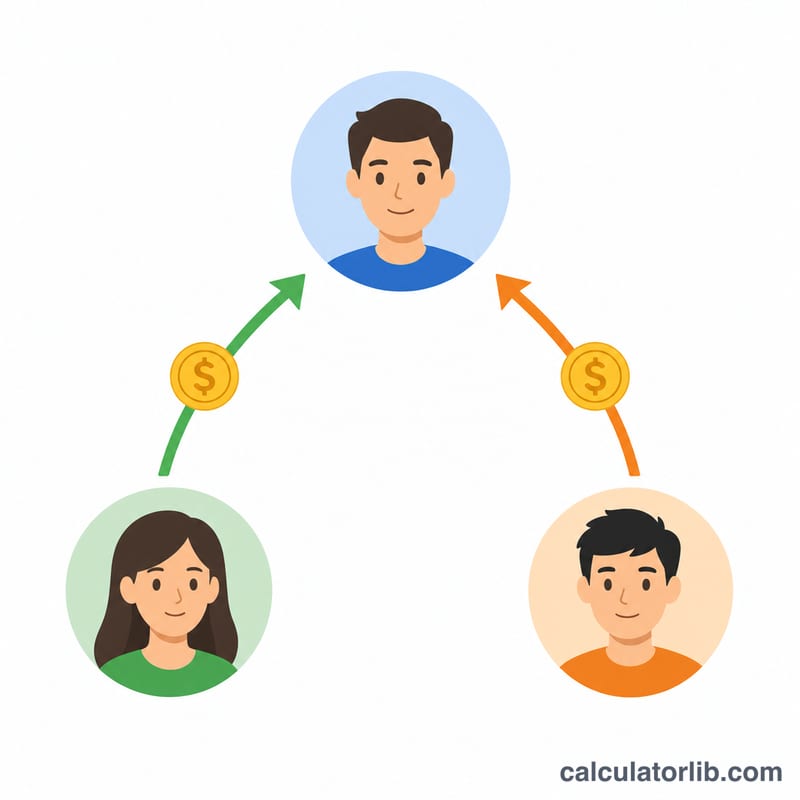
FAQ
Does this split costs unequally? No — this version divides the total equally among everyone. Each person ends up contributing the same amount.
What currency does it use? It's currency-agnostic; just use the same currency for every entry.
Why is the number of transfers minimized? Fewer payments means less hassle. The greedy algorithm matches biggest creditor with biggest debtor to reduce how many times money changes hands.