What is the Trip Budget Calculator?
The Trip Budget Calculator helps you estimate the total cost of a vacation or business trip before you book. Instead of guessing, you break your spending into the four categories that dominate any travel budget — transport, lodging, food, and activities — and the tool adds them up into a single, realistic total. It also breaks that total down per traveler and per day so you can sanity-check whether the trip fits your budget.
How to use it
Enter your one-off transport or flight cost, your lodging price per night along with the number of nights, your food spend per day along with the number of days, and any lump sum for activities, tours, or souvenirs. Add the number of travelers to see the cost per person. Press calculate and you'll get the total plus a category-by-category breakdown.
The formula explained
The math is simple addition with two multiplications:
$$\text{Total} = \text{Transport} + (\text{Lodging} \times \text{Nights}) + (\text{Food} \times \text{Days}) + \text{Activities}$$
Lodging is multiplied by nights because hotels charge per night, while food is multiplied by days because you eat every day you're away — these counts often differ by one (e.g. 6 days but 5 nights). Per-person cost divides the total by the number of travelers.

Worked example
Suppose flights cost $400, a hotel is $120 per night for 5 nights, food runs $50 per day for 6 days, and activities total $200, split between 2 travelers.
$$\text{Total} = 400 + (120 \times 5) + (50 \times 6) + 200 = 400 + 600 + 300 + 200 = \mathbf{\$1{,}500}$$ Per traveler that's $750, and per day it's $250.

Interpreting Your Trip Cost Breakdown
The calculator adds four categories: transport, lodging, food and activities. Lodging is the nightly rate times the number of nights, and food is the daily amount times the number of days. The result is an estimate built only from the numbers you enter. It is not a quote or a guarantee.
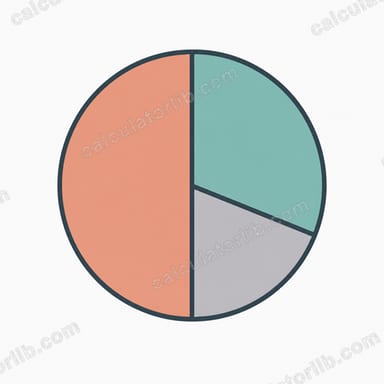
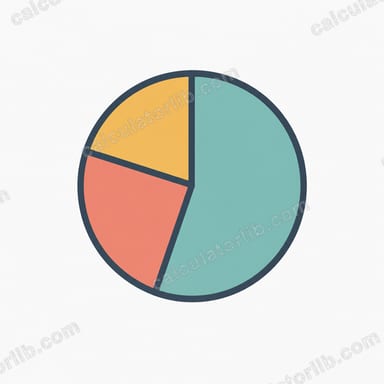
Reading the category shares
Divide each category by the total to see where the money goes:
\(\text{Share} = \frac{\text{Category cost}}{\text{Total}} \times 100\%\)
For example, take transport of $600, lodging of $120 per night for 5 nights, food of $50 per day for 6 days, and activities of $300:
- Transport: $600 (33.3% of the total)
- Lodging: \(120 \times 5 = 600\), so $600 (33.3%)
- Food: \(50 \times 6 = 300\), so $300 (16.7%)
- Activities: $300 (16.7%)
The total is \(600 + 600 + 300 + 300 =\) $1800. A category with a large share, such as transport on a long-haul trip or lodging in a high-priced city, is where a change in plans moves the total most.
Why per-day cost is total divided by trip days
Per-day cost spreads the whole trip over its length:
\(\text{Per-day cost} = \frac{\text{Total}}{D}\)
In the example, \(\frac{1800}{6} = 300\), so the trip costs about $300 per day. Fixed costs such as flights are included in this figure, so it falls as you add days. A short trip therefore looks expensive per day even when the daily spending is modest. Use it to compare trips of different lengths or to check a daily target.
Per-person cost and group size
Per-person cost is the total divided by the number of travelers:
\(\text{Per-person cost} = \frac{\text{Total}}{\text{Travelers}}\)
In the example, 2 travelers give \(\frac{1800}{2} = 900\) each. Lodging is often shared, because one room or rental can hold several people for the same nightly rate. That makes the per-person figure drop as the group grows. Costs that scale with headcount do not shrink this way: individual tickets, meals and many activity fees.
The formula does not multiply any category by the number of travelers. Enter transport, food and activities as totals for the whole group. For example, if food is $25 per person per day for 2 people, enter $50. Entering per-person amounts would understate the total.
Limits of the estimate
- The result depends entirely on your inputs. Prices, taxes, fees and tips can differ from what you assume.
- It does not convert currencies. Enter every amount in a single currency, and allow for exchange rates and card fees separately.
- It leaves out items you do not enter, such as travel insurance, visas, baggage fees, local transport and an emergency buffer.
This is general information for planning, not financial advice.
FAQ
Should I count nights or days for lodging? Use nights for lodging — a trip that spans 6 calendar days usually has only 5 hotel nights.
What goes in "activities / other"? Any lump-sum spending: tours, tickets, car rental, travel insurance, souvenirs, and a contingency buffer.
Does this include currency conversion? No. Enter all values in a single currency; the calculator simply sums the numbers you provide.