
What Is a Budget Calculator?
A budget calculator helps you see where your money goes each month. By entering your income and your main spending categories, it instantly shows how much you have left over and what percentage of your income you are able to save. This is a universal tool that works with any currency — just use the same currency for every field.
How to Use It
Enter your total monthly income, then fill in each expense category: housing, food, transport, utilities, and a catch-all "other" for everything else. Leave any field blank or zero if it does not apply. The calculator adds up your expenses, subtracts them from your income, and reports your remaining balance and savings rate.
The Formula Explained
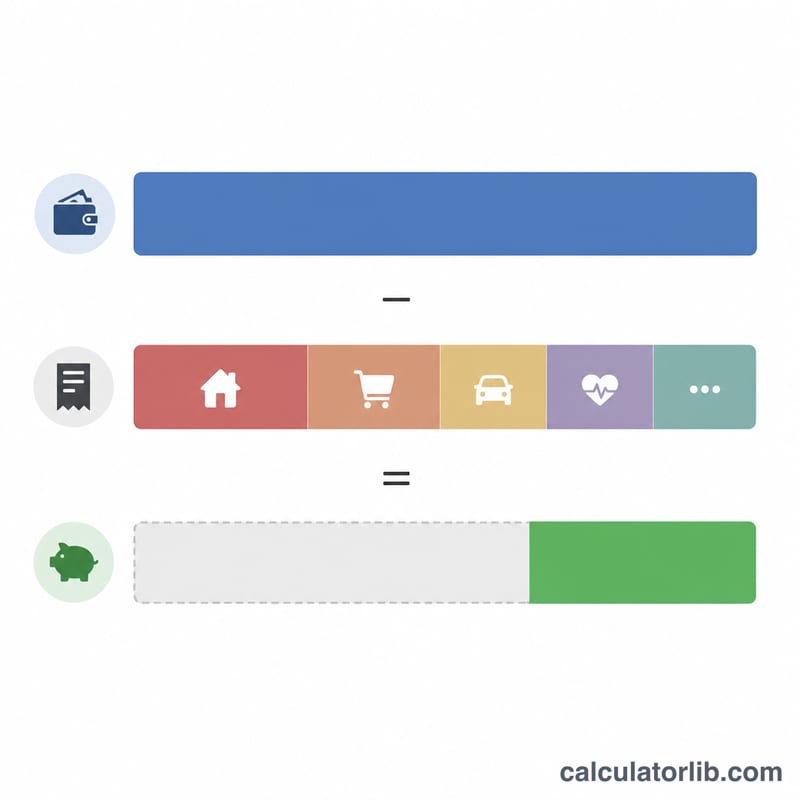
The math is simple. First, total expenses are summed: $$\text{Expenses} = \text{Housing} + \text{Food} + \text{Transport} + \text{Utilities} + \text{Other}$$ Then the money left over is $$\text{Remaining} = \text{Income} - \text{Expenses}$$ Finally, your savings rate is \((\text{Remaining} \div \text{Income}) \times 100\), which tells you what fraction of every dollar you keep. A higher savings rate means more financial breathing room.
Worked Example
Suppose your income is 4,000 and your expenses are: housing 1,200, food 500, transport 300, utilities 200, and other 400. Total expenses are 2,600. $$\text{Remaining} = 4{,}000 - 2{,}600 = 1{,}400$$ $$\text{Savings Rate} = (1{,}400 \div 4{,}000) \times 100 = 35\%$$ That means you keep 35 cents of every dollar you earn.
Interpreting Your Savings Rate
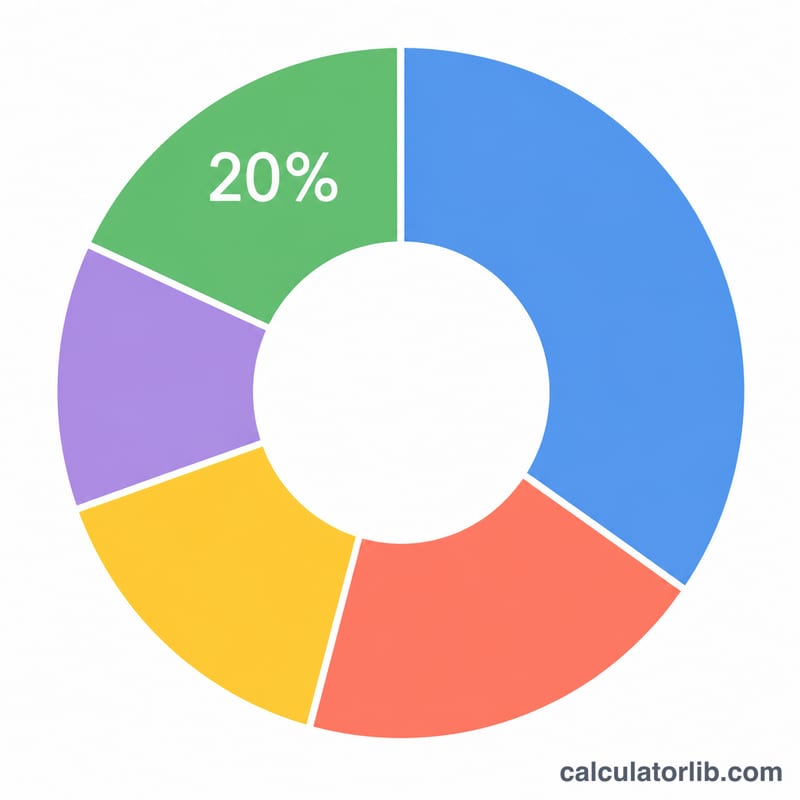
Your savings rate is the share of income left over after all expenses, expressed as a percentage: \(\text{Savings Rate} = \frac{\text{Income} - \text{Expenses}}{\text{Income}} \times 100\%\). The brackets below reflect commonly cited financial guidelines for what each range tends to indicate.
| Savings rate | What it generally indicates |
|---|---|
| Negative | Deficit spending — expenses exceed income, meaning savings are being drawn down or debt is growing. Not sustainable over time. |
| 0–10% | Low margin. Spending nearly matches income, leaving little cushion for emergencies or long-term goals. |
| 10–20% | Moderate. A workable rate that builds savings steadily; the lower bound (~15%) is a frequently cited minimum for retirement contributions. |
| 20% and above | Meets or exceeds the 50/30/20 rule's savings target. Generally considered a healthy rate that supports emergency funds, retirement, and other goals. |
| 40%+ | Aggressive saving, often associated with early-retirement (FIRE) strategies, which can dramatically shorten the time needed to reach financial independence. |
Higher is generally better, but the "right" rate depends on income level, cost of living, debt, and life stage. This is general information based on widely published budgeting frameworks, not personalized financial advice.
Savings Rate Across Different Budgets
The table below compares three realistic monthly budgets. Total expenses sum housing, food, transport, utilities, and other; the remaining balance is income minus expenses, and the savings rate is that balance as a percentage of income.
| Profile | Income | Housing | Food | Transport | Utilities | Other | Total expenses | Remaining | Savings rate |
|---|---|---|---|---|---|---|---|---|---|
| Tight | $3,000 | $1,200 | $500 | $400 | $250 | $550 | $2,900 | $100 | 3.3% |
| Balanced | $5,000 | $1,500 | $650 | $500 | $350 | $1,000 | $4,000 | $1,000 | 20% |
| High-saver | $7,000 | $1,700 | $700 | $500 | $400 | $1,200 | $4,500 | $2,500 | 35.7% |
The balanced profile lands exactly on the 50/30/20 rule's 20% savings target. The high-saver keeps lifestyle costs flat as income rises — avoiding "lifestyle inflation" — which pushes the savings rate above 35%. The tight budget, by contrast, leaves almost no margin, highlighting how a small income increase or expense cut can meaningfully change the result.
FAQ
What is a good savings rate? Many financial advisors suggest aiming for 20% or more, but any positive rate is progress. The right target depends on your goals and cost of living.
What if my remaining balance is negative? A negative result means you are spending more than you earn. Look for categories to trim or ways to increase income.
Does this work for any currency? Yes. The calculator is currency-agnostic — just keep every entry in the same currency.