
What this calculator does
The Pregnancy Weight Gain Calculator estimates how much weight you should ideally have gained by a given week of pregnancy, based on your pre-pregnancy body mass index (BMI). The recommended ranges follow the Institute of Medicine (IOM, 2009) guidelines, which are widely used in the US and many other countries for single (non-twin) pregnancies. Always discuss your individual targets with your healthcare provider.
How to use it
Enter your pre-pregnancy weight in kilograms, your height in centimetres, and your current gestational week (1–40). The tool computes your BMI, classifies it, shows the recommended total gain range for full term, and prorates that target to your current week.
The formula explained
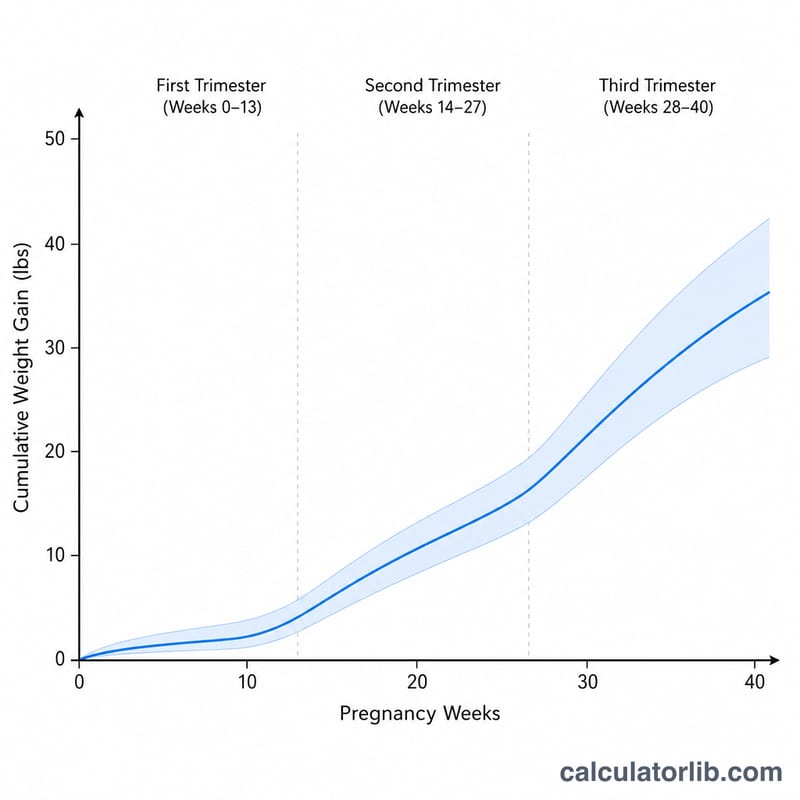
BMI is weight divided by height in metres squared. Each BMI category has a recommended total gain range: underweight 12.5–18 kg, normal 11.5–16 kg, overweight 7–11.5 kg, and obese 5–9 kg. A modest first-trimester gain (~1.5 kg) is assumed by week 13. After that, the remaining gain is spread evenly:
$$\text{weekly rate} = \dfrac{\text{target total} - \text{first-trimester gain}}{40 - 13}$$Your recommended gain to date is the first-trimester gain plus the weekly rate times the weeks since week 13.
Worked example
A woman weighs 60 kg and is 165 cm tall, at week 20. \(\text{BMI} = 60 \div 1.65^2 = 22.04\) (normal weight), so the target range is 11.5–16 kg with a midpoint of 13.75 kg. Weekly rate:
$$\text{weekly rate} = \dfrac{13.75 - 1.5}{27} = 0.4537 \text{ kg/week}$$By week 20:
$$1.5 + 0.4537 \times (20 - 13) = 1.5 + 3.176 = 4.68 \text{ kg}$$FAQ
Is this for twins? No — it uses single-pregnancy ranges. Twin pregnancies have higher targets.
What if I gained more or less? These are guidelines, not strict limits. Small differences are normal; raise concerns with your provider.
Which BMI is used? Your pre-pregnancy BMI determines the category, not your current weight.