What Is the Weight Gain Calorie Calculator?
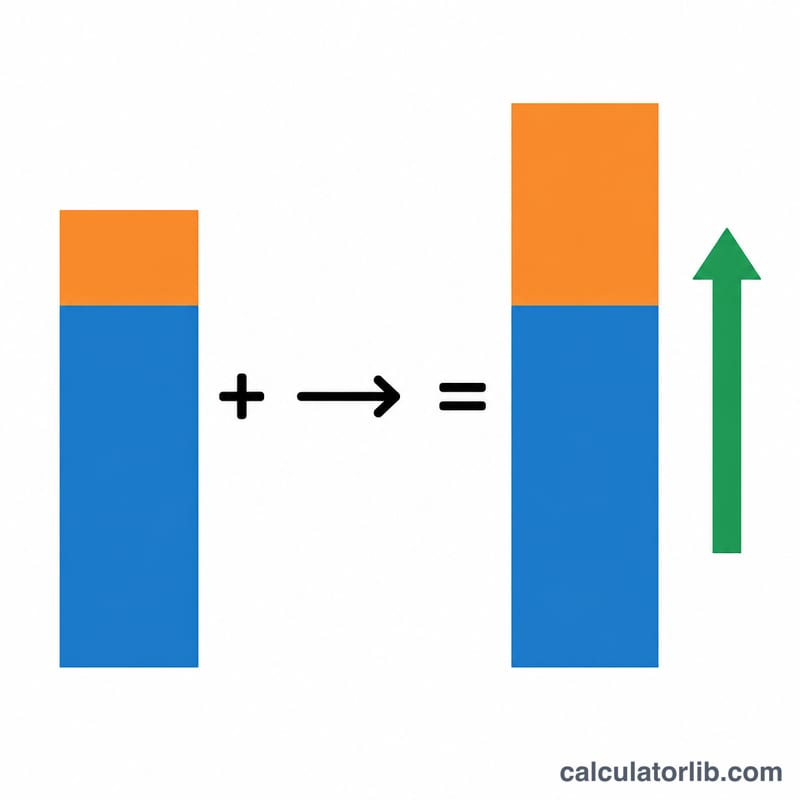
This calculator estimates how many calories you should eat per day to gain weight at a target rate. It combines your maintenance calories (TDEE) with a daily calorie surplus based on how fast you want to gain. It is a general-purpose nutrition tool and is not specific to any country.
How to Use It
Enter your gender, weight (kg), height (cm), age, and activity level. Then set your desired weekly weight gain in pounds. The calculator first finds your Basal Metabolic Rate (BMR), multiplies it by your activity factor to get your Total Daily Energy Expenditure (TDEE), and adds the surplus needed to reach your goal.
The Formula Explained
We use the Mifflin-St Jeor equation for BMR. For men: \(\text{BMR} = 10\cdot\text{weight} + 6.25\cdot\text{height} - 5\cdot\text{age} + 5\). For women: \(\text{BMR} = 10\cdot\text{weight} + 6.25\cdot\text{height} - 5\cdot\text{age} - 161\). \(\text{TDEE} = \text{BMR} \times \text{activity factor}\). Since roughly 3,500 calories equal one pound of body mass, the daily surplus:
$$\text{surplus} = \frac{\text{desired\_gain\_lb\_per\_week} \times 3500}{7}$$Daily intake = TDEE + surplus.
Worked Example
A sedentary (1.2) woman weighing 60 kg, 165 cm tall, age 30, wanting 1 lb/week:
$$\text{BMR} = 10\cdot60 + 6.25\cdot165 - 5\cdot30 - 161 = 600 + 1031.25 - 150 - 161 = 1320.25$$$$\text{TDEE} = 1320.25 \times 1.2 = 1584.3$$$$\text{Surplus} = 1 \times \frac{3500}{7} = 500$$$$\text{Daily intake} = 1584.3 + 500 = 2084.3 \text{ calories/day}$$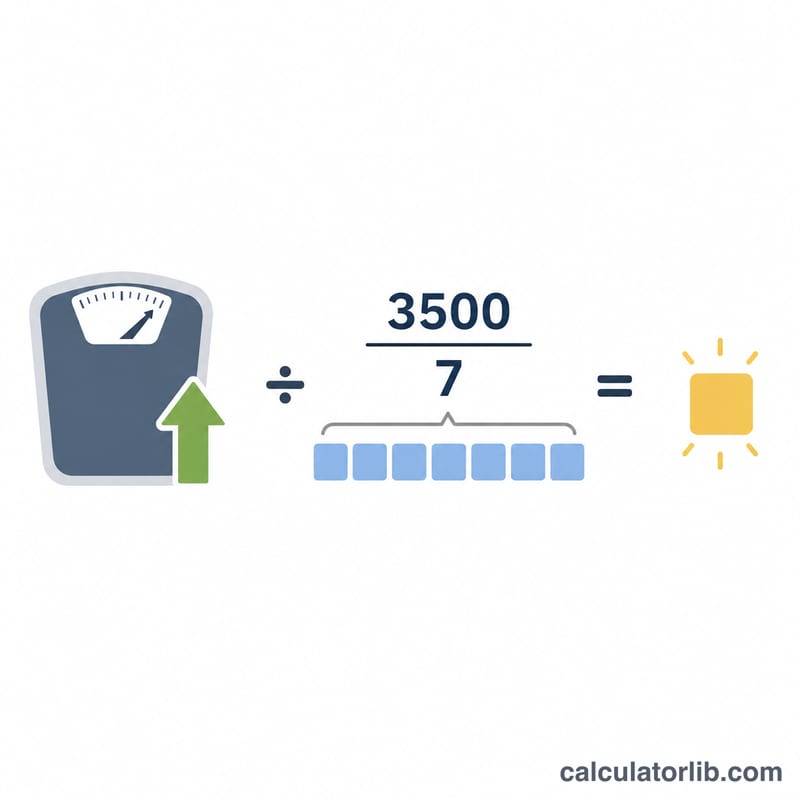
Activity Level Multipliers
The calculator multiplies your BMR (estimated with the Mifflin-St Jeor equation) by an activity factor to estimate total daily energy expenditure (TDEE). These are the standard activity factors used with the Harris-Benedict and Mifflin-St Jeor equations.
| Activity level | Multiplier | Description |
|---|---|---|
| Sedentary | 1.2 | Little or no exercise, mostly desk-based or seated daily life |
| Lightly active | 1.375 | Light exercise or sport 1-3 days per week |
| Moderately active | 1.55 | Moderate exercise or sport 3-5 days per week |
| Very active | 1.725 | Hard exercise or sport 6-7 days per week |
| Extra active | 1.9 | Very hard daily exercise, twice-daily training, or a physically demanding job |
If you are between two levels, choosing the lower one is usually the safer starting point. You can then adjust based on how your weight actually changes.
Daily Calories at Different Weight Gain Rates
The table below uses a fixed example TDEE of 2,000 kcal per day. The daily surplus is calculated as \(\text{rate (lb/week)} \times 3500 \div 7\), and the daily intake is the TDEE plus that surplus.
| Gain rate (lb/week) | Weekly surplus (kcal) | Daily surplus (kcal) | Daily intake (kcal) |
|---|---|---|---|
| 0.25 | 875 | 125 | 2,125 |
| 0.5 | 1,750 | 250 | 2,250 |
| 1 | 3,500 | 500 | 2,500 |
| 1.5 | 5,250 | 750 | 2,750 |
For example, at 0.5 lb/week: \(0.5 \times 3500 \div 7 = 250\) kcal per day, so \(2000 + 250 = 2250\) kcal per day. Your own TDEE will differ, so the intake changes, but the surplus for a given rate stays the same.
Interpreting Your Result
The number the calculator gives is an estimated daily calorie intake for gaining weight at the rate you chose. It is the sum of two parts: your estimated TDEE (BMR × activity factor) and a daily surplus equal to \(\text{gain (lb/wk)} \times 3500 \div 7\).
- The 3,500 kcal/lb rule is an approximation. It treats a pound of body weight as roughly 3,500 kcal, but real tissue gain depends on the mix of tissue gained, water, and glycogen.
- Actual gain varies. Metabolic adaptation (your energy expenditure can rise as you eat more), body composition, daily activity, and how consistently you hit your intake all affect the outcome.
- Gains are a mix of lean mass and fat. The proportion depends on factors such as training, protein intake, the size of the surplus, and training experience. A calculator cannot predict this split.
- Mifflin-St Jeor is an estimate. It is based on population averages, so individual BMR can differ from the predicted value, and the activity multiplier adds further uncertainty.
Treat the result as a starting point. Track your body weight over several weeks and compare it with your target rate, then adjust intake as needed. This is general information and not medical or nutritional advice.
FAQ
Why pounds and not kilograms for the gain? The 3,500 calories-per-pound rule is the most widely cited estimate, so we keep the goal in pounds for accuracy.
Is 1 lb/week safe? A gain of 0.25–1 lb/week is a common, manageable target for lean mass gains. Faster rates increase fat gain.
Are these numbers exact? No. They are estimates. Track your weight weekly and adjust intake up or down by 100–200 calories as needed.