
What this calculator does
Carrying twins increases the recommended amount of weight you should gain during pregnancy compared with a single baby. This calculator uses your pre-pregnancy body mass index (BMI) to estimate the total and weekly weight-gain range commonly recommended for twin pregnancies, based on Institute of Medicine (IOM) guideline ranges used in the United States. It is for general educational use only — always follow the advice of your own obstetric care provider.
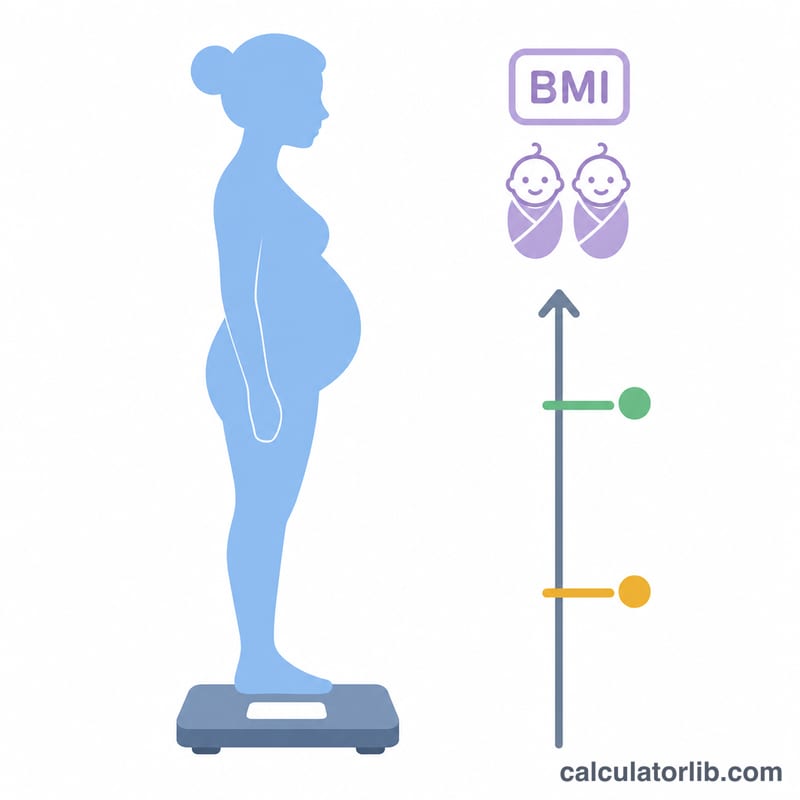
How to use it
Enter your weight just before pregnancy in kilograms and your height in centimetres. The tool computes your BMI, places you in a category (normal, overweight, or obese), and shows the recommended total gain in pounds plus an approximate weekly target spread across 40 weeks.
The formula explained
First we compute BMI as weight in kilograms divided by height in metres squared. The recommended total twin-pregnancy gain by category is: normal weight (BMI under 25) 37–54 lb, overweight (BMI 25–29.9) 31–50 lb, and obese (BMI 30+) 25–42 lb. The weekly figure simply divides each end of the range by 40 weeks.
$$\text{BMI} = \frac{\text{Weight (kg)}}{\left(\dfrac{\text{Height (cm)}}{100}\right)^2} \;\Rightarrow\; \text{Gain (lb)} = \begin{cases} 37 - 54 & \text{BMI} < 25 \\ 31 - 50 & 25 \le \text{BMI} < 30 \\ 25 - 42 & \text{BMI} \ge 30 \end{cases}$$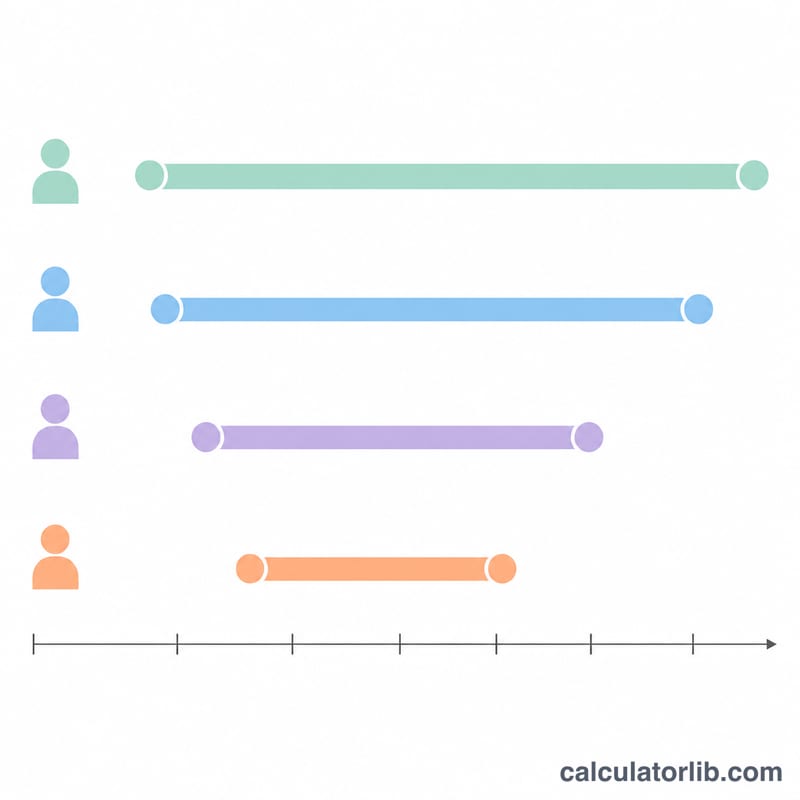
Worked example
A woman weighing 60 kg at 165 cm has a height of 1.65 m, so
$$\text{BMI} = \frac{60}{1.65 \times 1.65} = 22.0$$That is normal weight, giving a recommended total gain of 37–54 lb, or roughly 0.93–1.35 lb per week over 40 weeks.
FAQ
Is more weight gain normal with twins? Yes — twin pregnancies require more energy and tissue growth, so guidelines recommend higher gain than singletons.
Why pounds? The IOM twin guidelines are published in pounds; you can multiply by 0.4536 to convert to kilograms.
Does this apply to underweight women? Specific ranges for underweight twin pregnancies are not well established; this tool groups BMI under 25 as normal — discuss your individual target with your provider.