
What this tracker does
This tool compares your actual pregnancy weight gain against the gain recommended for your stage of pregnancy. Recommendations are based on the U.S. Institute of Medicine (IOM, 2009) guidelines, which set different targets according to your pre-pregnancy Body Mass Index (BMI). It is intended for guidance only and does not replace advice from your doctor or midwife.
How to use it
Select your pre-pregnancy BMI category, enter your current week of pregnancy, your pre-pregnancy weight, and your current weight (all in kilograms). The calculator returns the recommended gain for your current week, your actual gain, and the deviation between them.
The formula explained
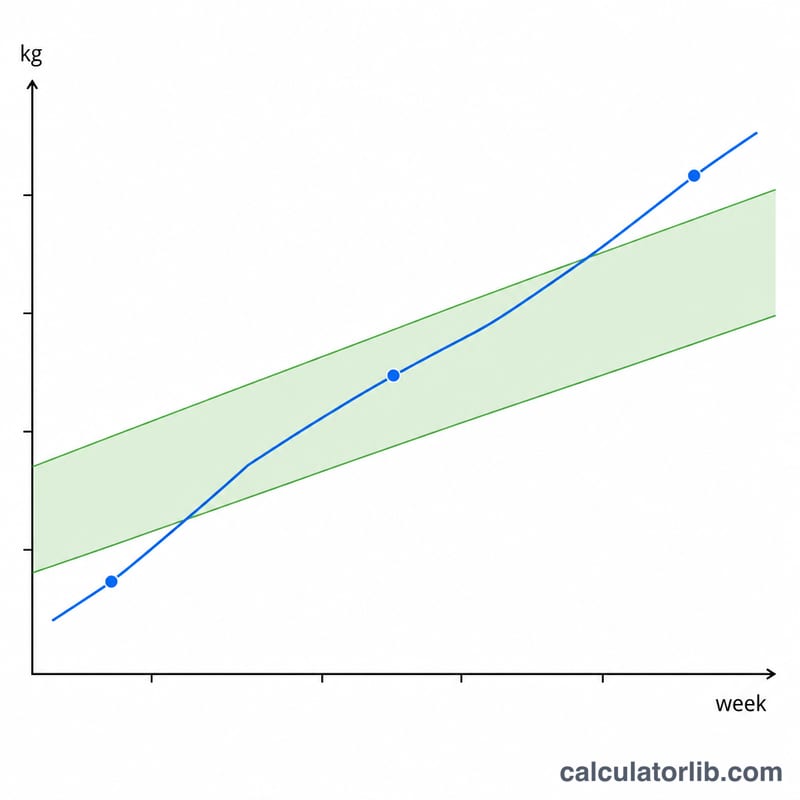
The first trimester contributes a small fixed base gain. From week 13 onward, weight is expected to rise at a steady weekly rate: expected = base + rate × (week − 13). Your deviation is simply actual − expected. A positive deviation means you are gaining faster than recommended; a negative value means slower.
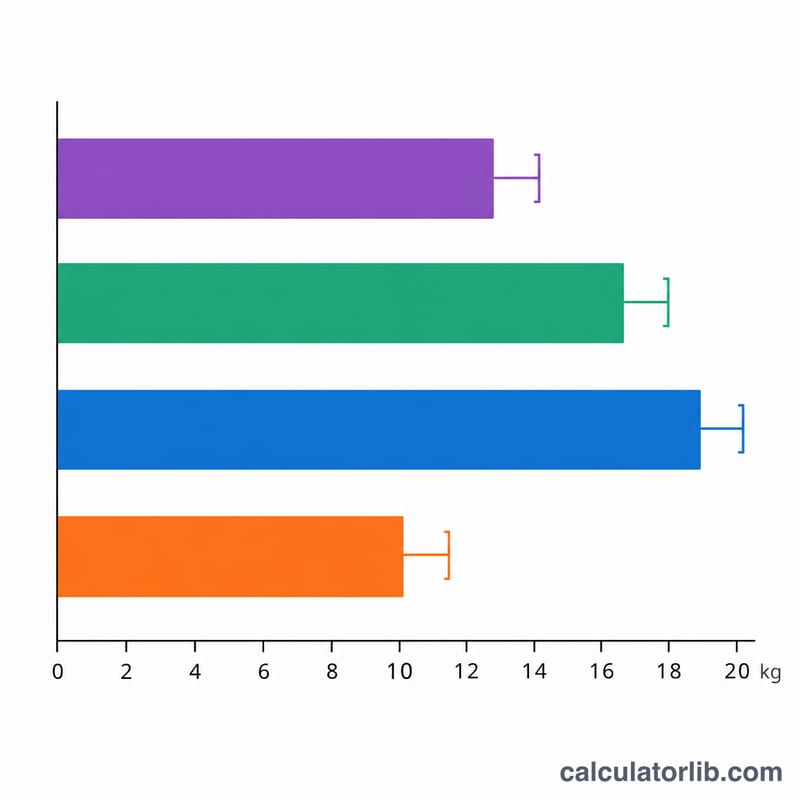
The base gains and weekly rates used are: Underweight base 2.0 kg, 0.51 kg/wk; Normal 1.6 kg, 0.42 kg/wk; Overweight 1.0 kg, 0.28 kg/wk; Obese 0.5 kg, 0.22 kg/wk.
Worked example
A woman with normal pre-pregnancy BMI at week 20 weighed 60 kg before pregnancy and now weighs 65 kg. Expected gain = $$1.6 + 0.42 \times (20 - 13) = 1.6 + 2.94 = 4.54 \text{ kg}.$$ Actual gain = $$65 - 60 = 5 \text{ kg}.$$ Deviation = $$5 - 4.54 = 0.46 \text{ kg}$$ — slightly above target.
FAQ
Is this accurate for twins? No. These figures apply to singleton pregnancies; multiple pregnancies have higher recommended ranges.
What if I'm in the first trimester? Before week 13 the tool scales the base gain proportionally to your week.
Should I worry about being off target? Small deviations are normal. Discuss persistent or large differences with your healthcare provider.