
What Is the Sampling Distribution of the Sample Mean?
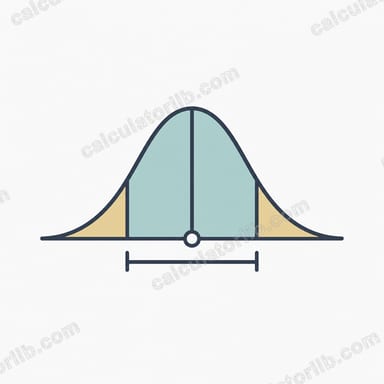
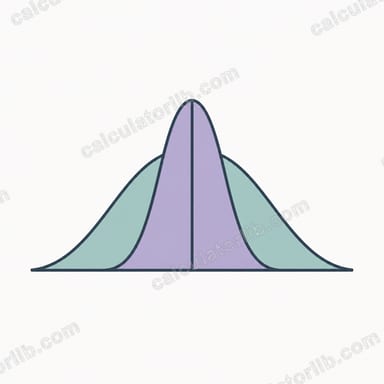
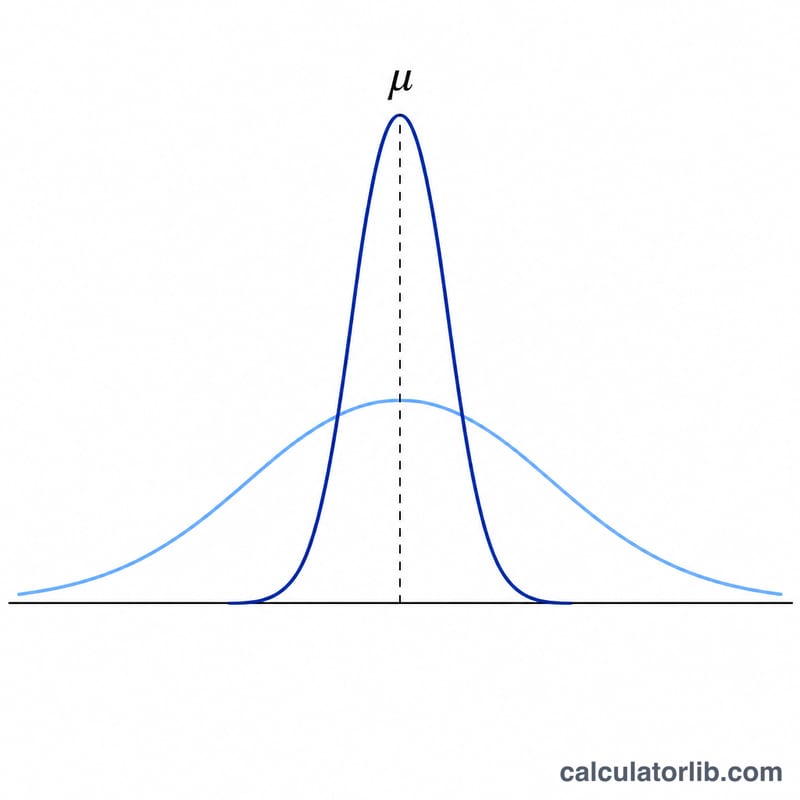
When you repeatedly draw random samples of size n from a population and compute each sample's mean, those means form their own distribution — the sampling distribution of the sample mean. This calculator finds its center (the mean) and its spread (the standard error) from three inputs: the population mean μ, the population standard deviation σ, and the sample size n.
How to Use This Calculator
Enter the population mean (μ), the population standard deviation (σ), and your sample size (n). The tool returns the mean of the sampling distribution (μx̄), the standard error (σx̄), and the variance of the sample mean (σx̄²). The standard error tells you how much sample means typically vary from the true population mean.
The Formula Explained
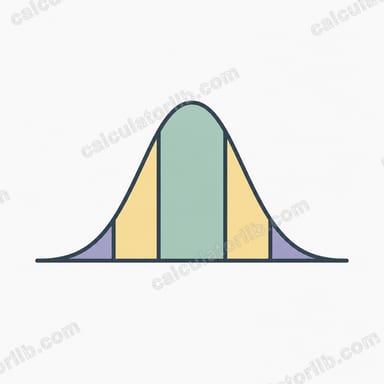
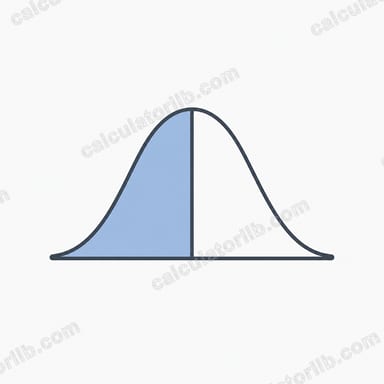
The mean of the sampling distribution always equals the population mean: \(\mu_{\bar{x}} = \mu\). The spread shrinks as samples get larger: \(\sigma_{\bar{x}} = \sigma/\sqrt{n}\). Because we divide by the square root of n, doubling the sample size does not halve the standard error — you must quadruple n to cut the standard error in half. By the Central Limit Theorem, for large n this distribution is approximately normal regardless of the population's shape.
$$\mu_{\bar{x}} = \text{Mean } \mu \qquad \sigma_{\bar{x}} = \frac{\text{Std Dev } \sigma}{\sqrt{\text{Sample Size } n}}$$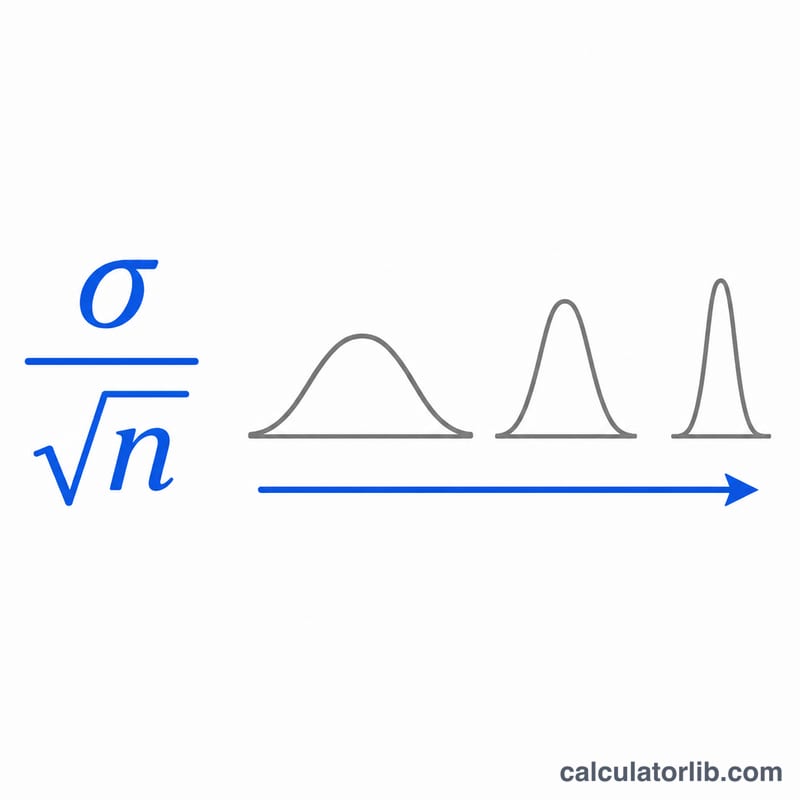
Worked Example
Suppose μ = 100, σ = 15, and n = 25. Then \(\mu_{\bar{x}} = 100\), and
$$\sigma_{\bar{x}} = \frac{15}{\sqrt{25}} = \frac{15}{5} = 3$$The variance is \(\sigma_{\bar{x}}^{2} = 3^{2} = 9\). So sample means of 25 observations cluster around 100 with a standard error of 3.
FAQ
Why does the standard error get smaller with larger samples? Larger samples average out random fluctuations, so their means are more tightly packed around the true mean.
Does the population need to be normal? Not for the formulas here. The mean and standard error are exact for any population. Normality of the sampling distribution holds approximately for large n via the Central Limit Theorem.
What if I only have the sample standard deviation? If σ is unknown, use the sample standard deviation s as an estimate; the standard error becomes \(s/\sqrt{n}\), often used with the t-distribution.