
What Is the Sample Mean?
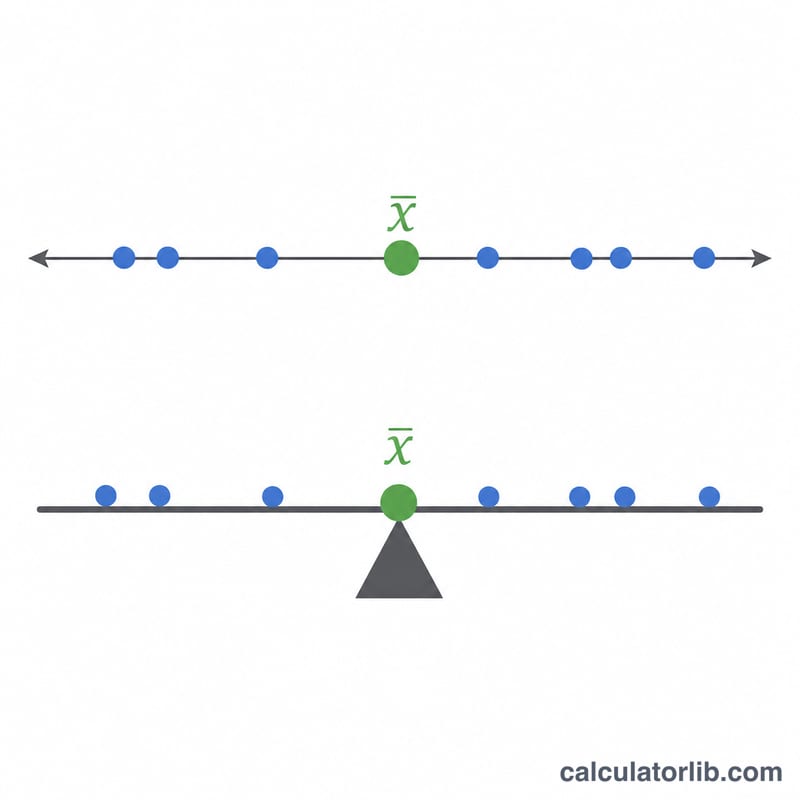
The sample mean, written as \(\bar{x}\) ("x-bar"), is the arithmetic average of a set of observed values. It is one of the most fundamental measures of central tendency in statistics, giving you a single number that represents the typical value of your data. This calculator works for any list of numbers — test scores, prices, measurements, survey responses, and more.
How to Use This Calculator
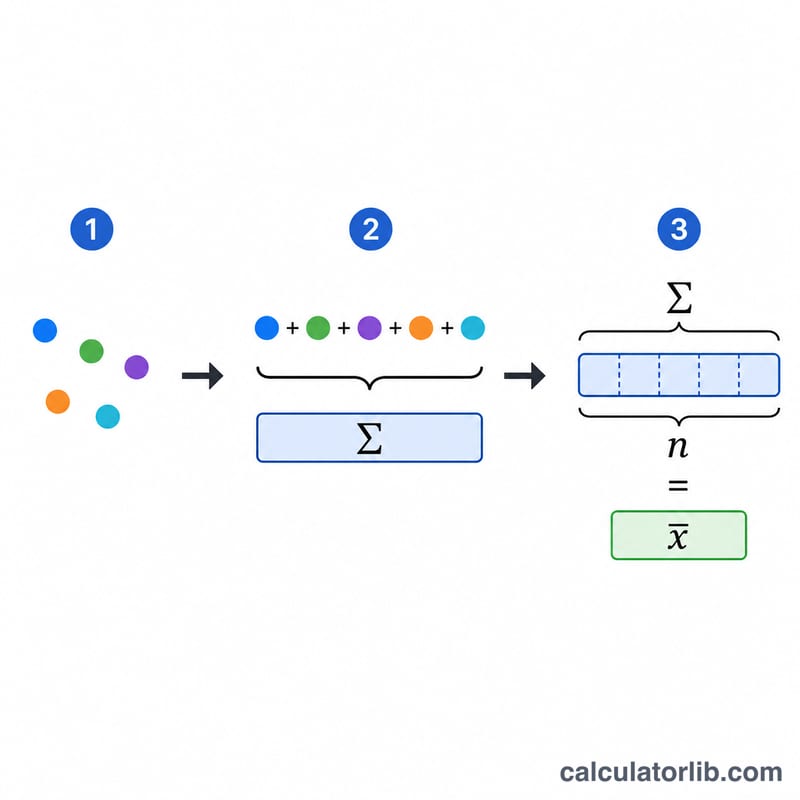
Type your data values into the box, separated by commas or spaces (for example 4, 8, 15, 16, 23, 42). The calculator adds up all the values to get the sum (\(\sum x_i\)), counts how many values you entered (\(n\)), and divides the sum by the count to produce the mean. The result also shows the sum and count so you can verify the computation.
The Formula Explained
The formula is
$$\bar{x} = \frac{1}{n}\sum_{i=1}^{n} x_i = \frac{\sum \text{Data values}}{\text{Count of values}}$$where \(\sum x_i\) is the sum of every value in the data set and \(n\) is the number of values. Add all the numbers together, then divide by how many there are. The same formula applies whether you are computing a sample mean or a population mean — only the symbol (\(\bar{x}\) vs \(\mu\)) and the interpretation differ.
Worked Example
Suppose your data is 4, 8, 15, 16, 23, 42. The sum is
$$4 + 8 + 15 + 16 + 23 + 42 = 108$$There are \(n = 6\) values. The mean is
$$108 \div 6 = 18$$So the average of this data set is 18.
FAQ
Is the mean the same as the average? Yes — "average" most commonly refers to the arithmetic mean, which is exactly what this calculator computes.
What's the difference between sample mean and population mean? The arithmetic is identical. A sample mean (\(\bar{x}\)) is computed from a subset of data, while a population mean (\(\mu\)) uses every member of the population.
Does it handle negative or decimal numbers? Yes. You can enter negatives and decimals; they are summed and averaged correctly.