
What this calculator does
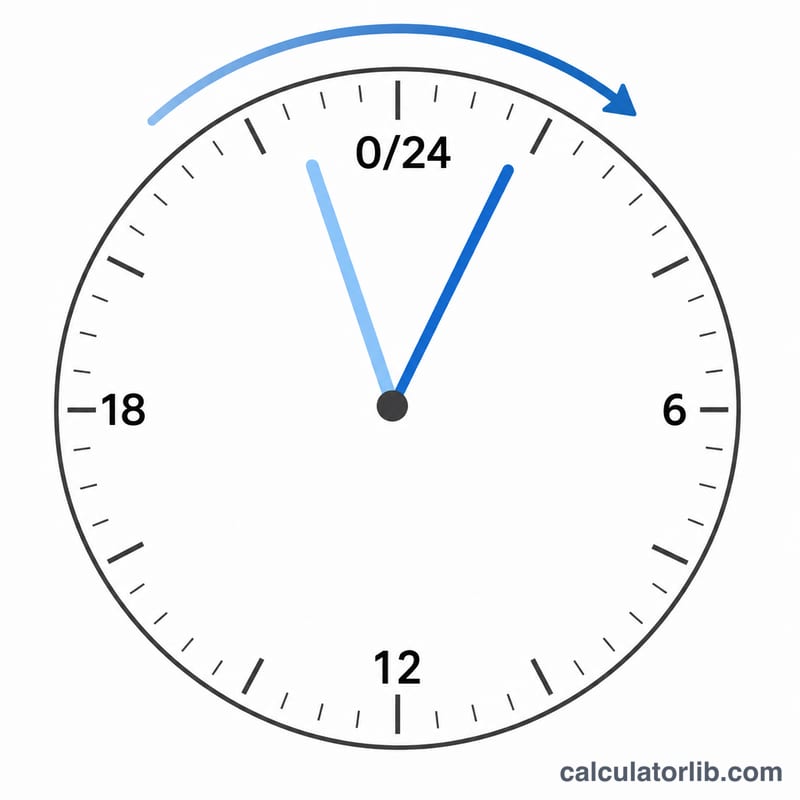
This tool adds or subtracts a number of hours from any starting time and returns the resulting clock time in 24-hour format. It handles fractional hours (such as 1.5 hours) and automatically wraps around midnight, so 22:00 plus 5 hours correctly becomes 03:00 the next day. It is a universal time-math tool with no country or time-zone assumptions.
How to use it
Enter your start hour (0–23) and minute (0–59), choose whether to add or subtract, then type the number of hours to shift. You may use decimals — 0.25 equals 15 minutes, 0.5 equals 30 minutes. Click calculate to see the new time, the hour and minute components, and the total minutes since midnight.
The formula explained
The start time is first converted to minutes since midnight: \(\text{time}_{min} = \text{hour} \times 60 + \text{minute}\). The offset in hours is converted to minutes (hours × 60) and added (or subtracted). Finally we take the value modulo 1440 — the number of minutes in a day — to keep the answer within a single 24-hour clock. If subtraction produces a negative number, we add 1440 so the result stays between 0 and 1439.
$$\text{result} = (\text{time}_{min} \pm \text{hours} \times 60) \bmod 1440$$$$HH = \lfloor \text{result}/60 \rfloor,\quad MM = \text{result} \bmod 60$$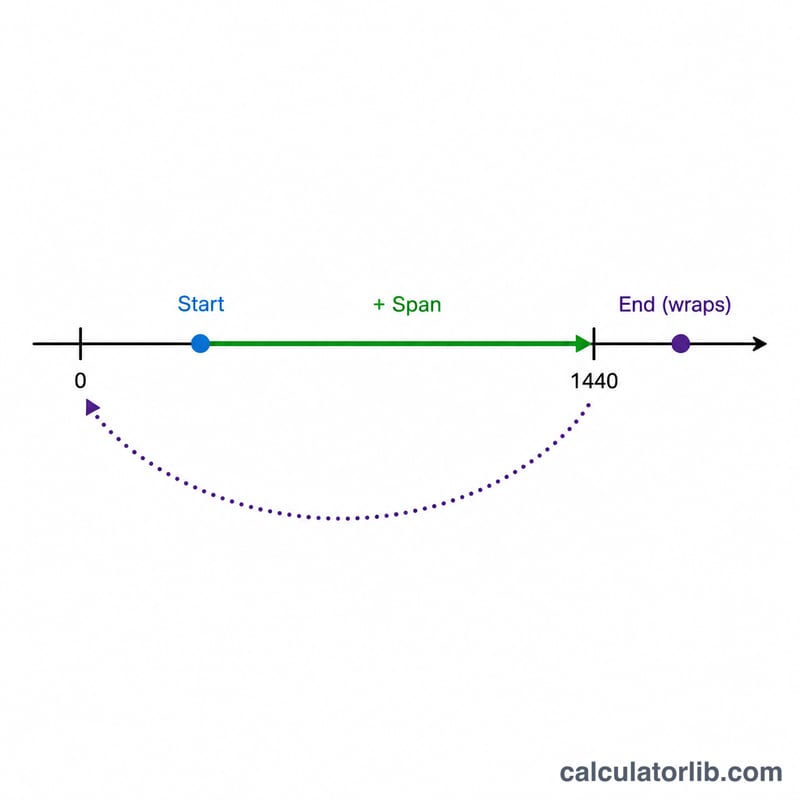
Worked example
Start at 09:30 and add 5 hours. In minutes: \(9 \times 60 + 30 = 570\). Add \(5 \times 60 = 300\), giving 870. \(870 \bmod 1440 = 870\). Converting back: \(870 \div 60 = 14\) hours, remainder 30 minutes → 14:30.
Scenario Comparison
The table below shows a range of additions and subtractions, including cases that wrap across midnight. "Crossed Midnight?" indicates whether the result falls on a different calendar day than the start time.
| Start Time | Operation | Hours | Result | Crossed Midnight? |
|---|---|---|---|---|
| 09:30 | Add | 5 | 14:30 | No |
| 22:00 | Add | 5 | 03:00 | Yes (next day) |
| 02:00 | Subtract | 5 | 21:00 | Yes (previous day) |
| 12:00 | Add | 12 | 00:00 | Yes (next day) |
| 08:15 | Add | 1.75 | 10:00 | No |
Notice that 12:00 + 12 hours lands exactly on 00:00, which is treated as the start of the next day (1440 minutes wraps to 0).
FAQ
Does it cross midnight? Yes. Adding past 24:00 or subtracting below 00:00 wraps automatically using the modulo operation.
Can I use minutes instead of whole hours? Yes — enter a decimal such as 1.25 hours for 1 hour 15 minutes.
Why 1440? A day has \(24 \times 60 = 1440\) minutes, the period of a 24-hour clock.