
What Is the Add Time Calculator?
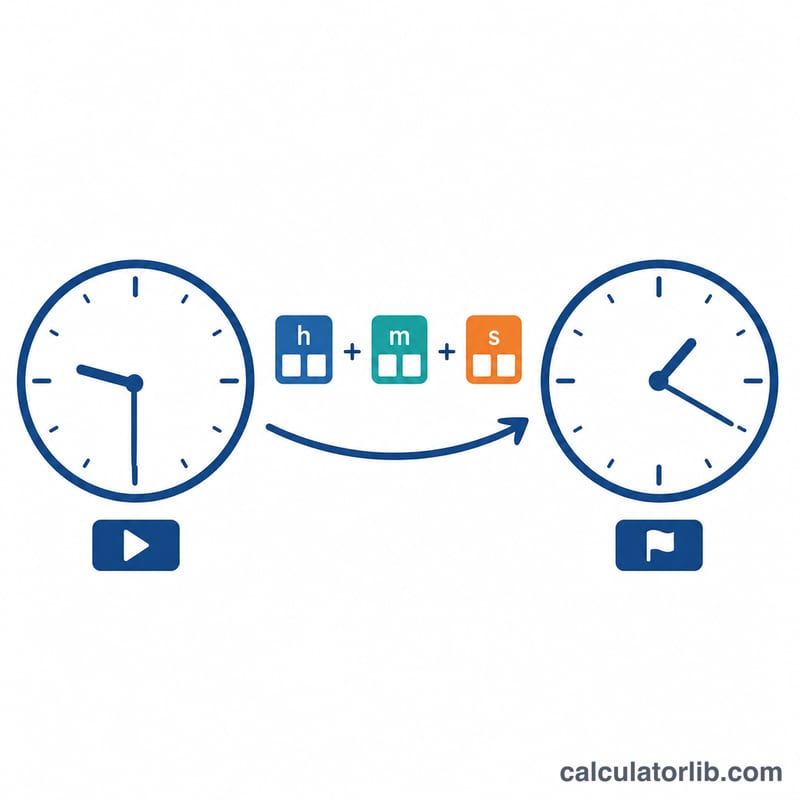
The Add Time Calculator lets you add a duration — any number of hours, minutes and seconds — to a starting clock time. It returns the resulting time on a 24-hour clock and tells you how many whole days rolled over, which is handy when the total crosses midnight one or more times.
How to Use It
Enter your start time as hours (0–23), minutes (0–59) and seconds (0–59). Then enter the amount of time you want to add as hours, minutes and seconds. Click calculate to see the resulting time, the number of days carried over, and the total elapsed seconds from midnight.
The Formula Explained
Everything is converted to seconds first. The start time becomes \(h\times3600 + m\times60 + s\), and the same is done for the added duration. The two are summed to give the total seconds.
$$T = (h_s\cdot3600 + m_s\cdot60 + s_s) + (h_a\cdot3600 + m_a\cdot60 + s_a)$$
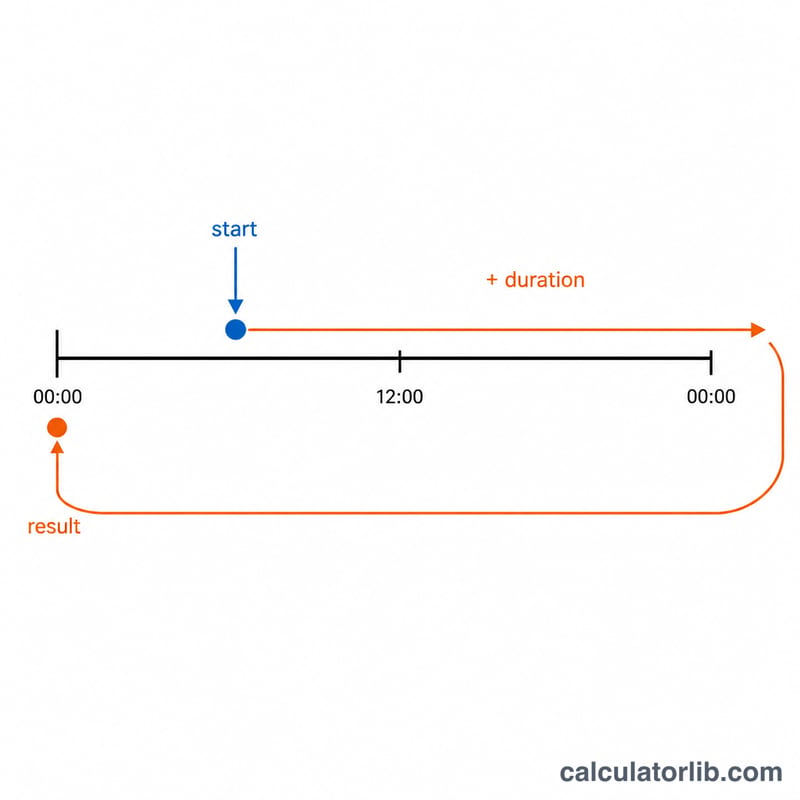
To express that as a clock time, we take the total modulo 86,400 (the number of seconds in a day). The integer number of full days is found by dividing the total by 86,400 and rounding down.
$$\text{Result} = (\text{start} + \text{duration}) \bmod 86400\ \text{seconds}$$
Worked Example
Start at 22:30:00 and add 4 hours 45 minutes. Start = \(22\times3600 + 30\times60 = 81{,}000\) s. Added = \(4\times3600 + 45\times60 = 17{,}100\) s. Total = \(98{,}100\) s. Days carried = \(\lfloor 98{,}100 / 86{,}400 \rfloor = 1\). Remainder = \(98{,}100 - 86{,}400 = 11{,}700\) s = 3:15:00. So the result is 03:15:00, one day later.
Time Unit Conversion Reference
The Add Time Calculator works internally by converting every quantity to seconds, adding them, and taking the result modulo 86400 (the number of seconds in one day). The table below lists the second-equivalents of the durations you will most often type into the form. Each value follows directly from the relationships \(1\text{ min}=60\text{ s}\), \(1\text{ h}=3600\text{ s}\), and \(1\text{ day}=86400\text{ s}\).
| Duration | In minutes | In seconds |
|---|---|---|
| 1 minute | 1 | 60 |
| 30 minutes | 30 | 1,800 |
| 1 hour | 60 | 3,600 |
| 90 minutes | 90 | 5,400 |
| 6 hours | 360 | 21,600 |
| 12 hours | 720 | 43,200 |
| 24 hours (1 day) | 1,440 | 86,400 |
| 48 hours (2 days) | 2,880 | 172,800 |
| 72 hours (3 days) | 4,320 | 259,200 |
To convert a duration the other way — for example to express a count of seconds back as hours, minutes and seconds — you can use a dedicated HH:MM:SS converter. As a worked check, \(5400\) seconds equals \(5400 \div 3600 = 1.5\) hours, i.e. 5,400 seconds for 1 h 30 min.
FAQ
Does it handle crossing midnight? Yes — any overflow past 24 hours wraps around and the "days carried over" row shows how many full days passed.
Can I add more than 24 hours? Absolutely. Add any number of hours; the calculator normalizes the result and reports the day count.
Is it 12-hour or 24-hour? Results are shown on a 24-hour clock (00:00:00 to 23:59:59).