What is the Days to Years Calculator?
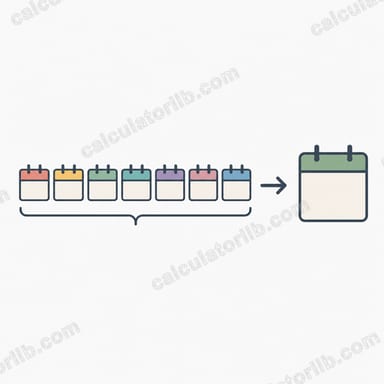
The Days to Years Calculator converts a quantity of days into the equivalent number of years. It is handy for working out ages, project durations, anniversaries, loan terms, or any situation where a span measured in days needs to be expressed in years. The tool uses the average year length of 365.25 days, which smooths out the extra leap day that occurs roughly every four years.
How to Use It
Enter the number of days you want to convert and the calculator instantly returns the value in years. You can use whole numbers like 730 or larger figures such as 10,000. The result is shown to four decimal places so you can see fractional years precisely.
The Formula Explained
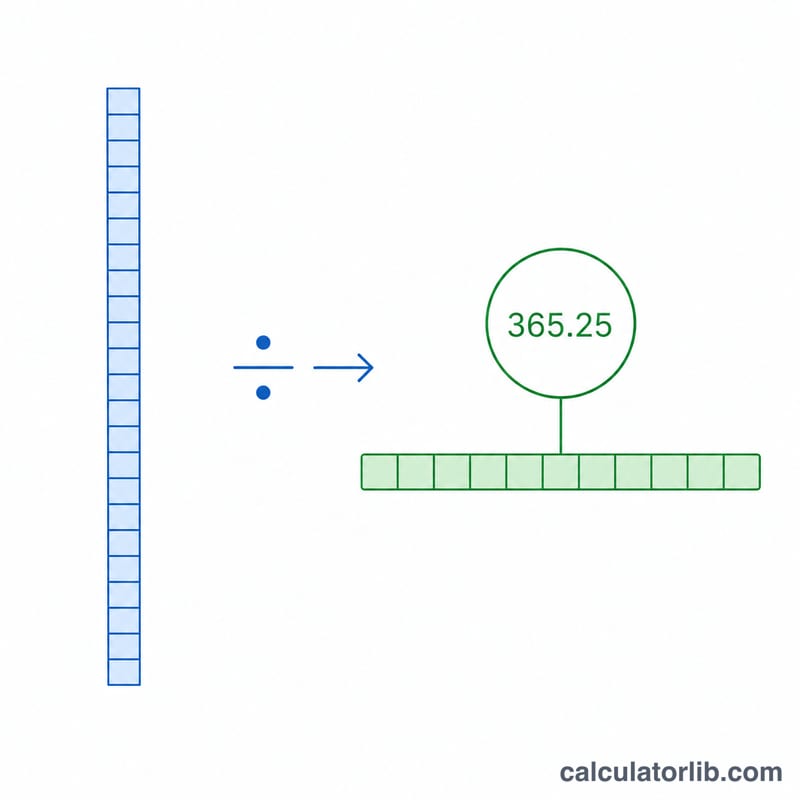
The conversion is a simple division:
$$\text{years} = \frac{\text{days}}{365.25}$$A common year has 365 days, but every four years a leap year adds one extra day. Averaged over a four-year cycle, each year contains 365.25 days. Dividing by this average gives a result that stays accurate over long spans, unlike dividing by a plain 365.
Worked Example
Suppose you have 3,652 days. Dividing by 365.25 gives $$3{,}652 \div 365.25 = 9.9986 \text{ years},$$ which is just under a full decade — exactly what you would expect, since ten years contains 3,652.5 days on average.
Year Lengths and Constants Used
"One year" is not a single fixed number of days — it depends on which definition you use. This converter uses the Julian year of exactly 365.25 days, the standard average that spreads one leap day evenly across every four years. All values below are given in days (d) of exactly 86,400 seconds.
| Constant | Length in days | Notes |
|---|---|---|
| Julian year (used by this calculator) | 365.25 | Average of 3 common years + 1 leap year: \((365+365+365+366)/4\) |
| Common year | 365 | Any calendar year without a 29 February |
| Leap year | 366 | Contains 29 February |
| Gregorian mean calendar year | 365.2425 | Leap rule: years divisible by 4 are leap, except century years, which must be divisible by 400 (1900 was not a leap year; 2000 was) |
| Mean tropical year (equinox to equinox) | ≈ 365.2422 | The astronomical year the Gregorian calendar approximates; drifts slowly over millennia |
| Mean month (this convention) | 30.4375 | \(365.25 \div 12\) |
| Mean month (Gregorian convention) | ≈ 30.436875 | \(365.2425 \div 12\) |
| Week | 7 | 52 weeks = 364 days, i.e. slightly less than a year |
The conversion itself is simply
$$\text{Years} = \frac{\text{Number of Days}}{365.25}$$Julian vs. Gregorian difference. The Julian average (365.25 d) is longer than the Gregorian mean calendar year (365.2425 d) by
$$365.25 - 365.2425 = 0.0075\ \text{days per year}$$That is about 0.75 day per century (3 days per 400 years) — the exact amount the Gregorian reform removed by skipping three leap days every four centuries. For everyday spans of days, months or a few decades this difference is far below one day and can be ignored; it only becomes visible over multi-century intervals. The Gregorian mean year is itself about 0.0003 day longer than the mean tropical year, an error of roughly one day in 3,000 years.
Which formula do you need?
Dividing by 365.25 gives an average-length duration, not a calendar age. If you need “how many whole years between two dates” (for a contract anniversary or an age), count calendar years instead: the answer can differ from the division by a day or so. Example: 1,461 days is exactly 4 years in this tool. On the calendar, 1 March 2023 to 1 March 2027 is also 1,461 days, because the span contains one 29 February; 1 March 2097 to 1 March 2101 is only 1,460 days, because 2100 is not a leap year.
Use the division for estimates, rates and long durations; use date-to-date counting when a deadline depends on a specific calendar date.
Conventions and edge cases
Each case below was run through this calculator; the result column is what it actually returns.
| Case | Input | Result | Note |
|---|---|---|---|
| 1,461 days (a four-year cycle) | 1461 | 4 years | A year is taken as 365.25 days. |
| Negative duration (−30 days) | -30 | −0.0821 years | |
| Zero duration | 0 | 0 years |
Checked on 2026-11-08
FAQ
Why 365.25 and not 365? Using 365.25 averages in the leap day, giving more accurate results across multiple years.
Can I enter decimals? Yes. You can enter fractional days such as 100.5, and the calculator handles them correctly.
How do I convert years back to days? Multiply the years by 365.25 to reverse the calculation.