What Is the Months to Days Calculator?
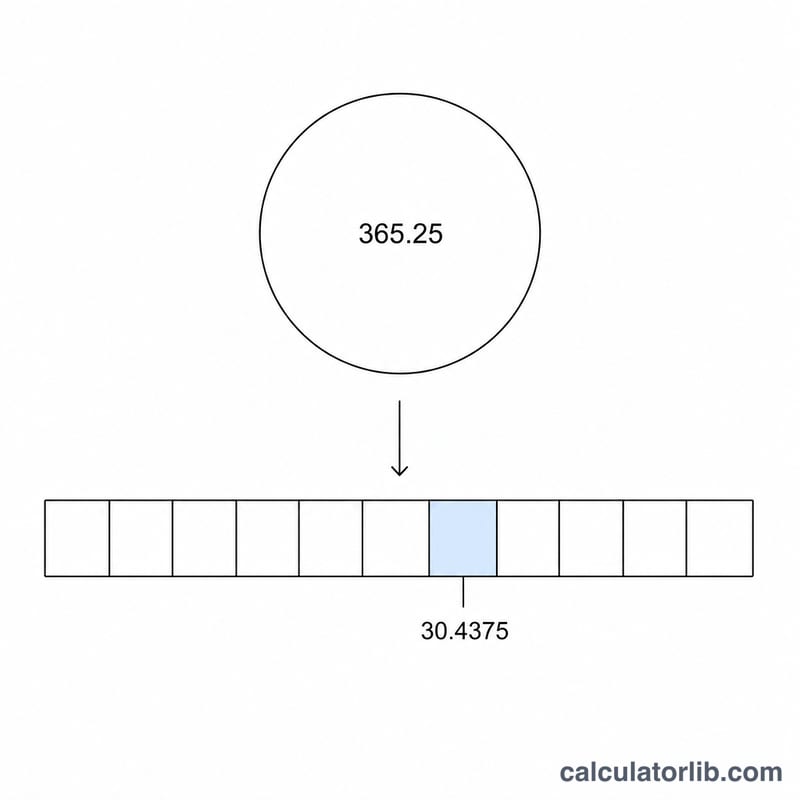
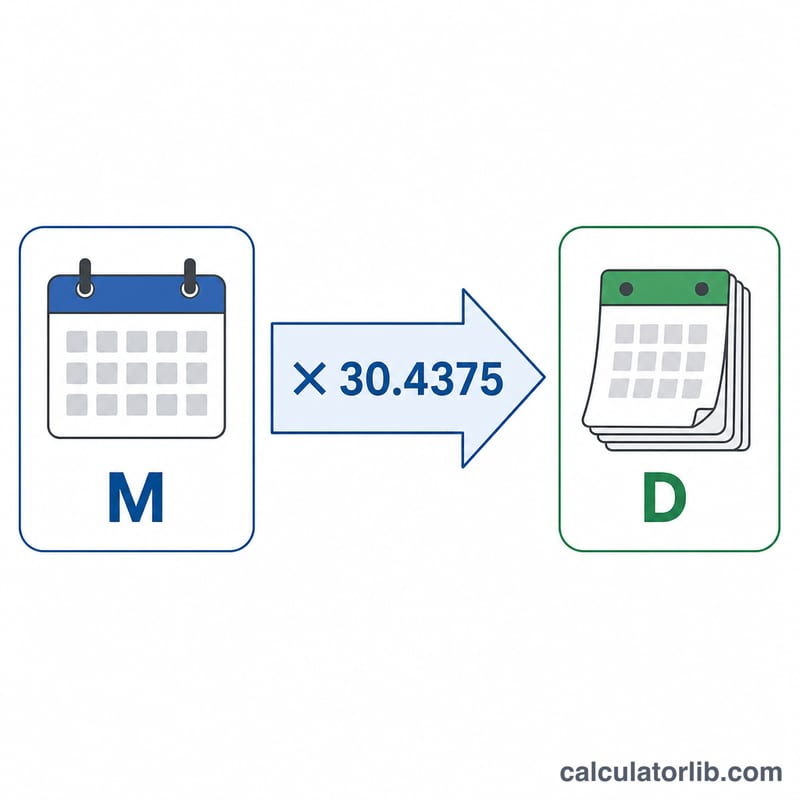
This calculator converts a number of months into an equivalent number of days. Because months vary in length (28 to 31 days), it uses the average month length of 30.4375 days, which comes from dividing the average year length (365.25 days, accounting for leap years) by 12. This gives a fair, year-aware estimate rather than assuming every month has exactly 30 or 31 days.
How to Use It
Enter the number of months you want to convert and the calculator instantly returns the equivalent days. You can use whole numbers like 6 or decimals like 2.5. This is handy for planning loan terms, subscription periods, project timelines, pregnancy estimates, or any situation where a duration is given in months but you need it in days.
The Formula Explained
The conversion is simple multiplication:
$$\text{days} = \text{months} \times 30.4375$$
The constant \(30.4375 = 365.25 \div 12\). The 365.25 reflects the Gregorian calendar's average year (365 days plus a quarter-day per year for leap years), making this more accurate over long spans than using 30 days per month.
Worked Example
Suppose you want to convert 6 months into days. Multiply: $$6 \times 30.4375 = 182.625 \text{ days}$$ roughly 182 to 183 days. For 12 months you get \(12 \times 30.4375 = 365.25\) days — exactly one average year, confirming the formula is internally consistent.
Actual Days in Each Calendar Month
The calculator uses a single average month length of 30.4375 days, but no real calendar month is exactly that long. In the Gregorian calendar — the civil calendar used in most of the world — month lengths alternate between 28, 29, 30 and 31 days:
| # | Month | Days (common year) | Days (leap year) |
|---|---|---|---|
| 1 | January | 31 | 31 |
| 2 | February | 28 | 29 |
| 3 | March | 31 | 31 |
| 4 | April | 30 | 30 |
| 5 | May | 31 | 31 |
| 6 | June | 30 | 30 |
| 7 | July | 31 | 31 |
| 8 | August | 31 | 31 |
| 9 | September | 30 | 30 |
| 10 | October | 31 | 31 |
| 11 | November | 30 | 30 |
| 12 | December | 31 | 31 |
| Total | 365 | 366 |
The leap-year rule
A Gregorian year is a leap year (February has 29 days) if the year number is divisible by 4, except century years, which must also be divisible by 400:
- 2024, 2028, 2032 — divisible by 4 → leap years.
- 1900, 2100, 2200 — divisible by 100 but not by 400 → not leap years.
- 1600, 2000, 2400 — divisible by 400 → leap years.
Quarter and half-year day counts
Because month lengths are uneven, calendar quarters are not equal in length. Counts below are for quarters aligned to the calendar year (January start):
| Span | Months | Days (common year) | Days (leap year) |
|---|---|---|---|
| Q1 | Jan–Mar | 90 | 91 |
| Q2 | Apr–Jun | 91 | 91 |
| Q3 | Jul–Sep | 92 | 92 |
| Q4 | Oct–Dec | 92 | 92 |
| First half | Jan–Jun | 181 | 182 |
| Second half | Jul–Dec | 184 | 184 |
| Full year | Jan–Dec | 365 | 366 |
365 vs 365.25 vs 366 days
- 365 days — a common (non-leap) calendar year.
- 366 days — a leap year.
- 365.25 days — the average year length of the older Julian calendar (one leap day every 4 years). Dividing it by 12 gives the constant this calculator uses: \(365.25 \div 12 = 30.4375\) days per month.
- 365.2425 days — the true average length of a Gregorian calendar year, because three leap days are skipped every 400 years. Per month that is \(365.2425 \div 12 \approx 30.4369\) days, about 0.0006 days (roughly 50 seconds) shorter than 30.4375. Over a century the two constants differ by well under a day, which is why 30.4375 is a convenient and widely used round figure.
Interpreting Your Result: Average vs Exact Days
The number this calculator returns is an average-based estimate, not a count of real calendar days between two dates. It answers the question "about how many days is N months?" using the formula
$$\text{Days} = \text{Months} \times 30.4375$$So one month converts to 30.4375 days and six months to 182.625 days, from \(6 \times 30.4375 = 182.625\).
How large is the error for one month?
For a single month the estimate can be off by up to about 2.4 days:
| Real month | Actual days | Average estimate | Difference |
|---|---|---|---|
| February (common year) | 28 | 30.4375 | +2.4375 days (overestimate) |
| February (leap year) | 29 | 30.4375 | +1.4375 days |
| April, June, Sep, Nov | 30 | 30.4375 | +0.4375 days |
| Jan, Mar, May, Jul, Aug, Oct, Dec | 31 | 30.4375 | −0.5625 days |
How the error behaves over longer spans
- Short spans (1–3 months): the error does not cancel out. It depends entirely on which months you land on. Jan–Mar of a common year is 90 real days, while \(3 \times 30.4375 = 91.3125\) — an overestimate of about 1.3 days. Jul–Sep is 92 real days, an underestimate of about 0.7 days.
- Exactly 12 months: \(12 \times 30.4375 = 365.25\), which is 0.25 days above a 365-day common year and 0.75 days below a 366-day leap year.
- Many years: the long-run error stays small but grows slowly, because 30.4375 is based on the Julian average of 365.25 days rather than the Gregorian 365.2425. Over 100 years the accumulated difference is roughly three quarters of a day.
In short: the relative error shrinks as the span grows, but the absolute error never disappears, and for any specific pair of dates it can still be a day or two.
Why some finance figures differ: 30/360 conventions
Certain bond, mortgage and interest calculations — notably the 30/360 day-count conventions used in parts of the US and European fixed-income markets — deliberately treat every month as exactly 30 days and every year as 360 days. Under that convention 6 months is 180 days and 12 months is 360 days, not 182.625 and 365.25. Other conventions (actual/365, actual/actual) use real calendar days instead. These are contractual accounting rules, not measurements of time, so a figure produced here will not match a bank or bond statement that applies 30/360. Always use the day-count convention specified in the relevant contract or standard.
When to use an exact date difference instead
Use a real calendar date-difference calculation — counting actual days from a start date to an end date — whenever a specific date matters:
- Contracts and notice periods: a "three month" notice or lease term is normally defined by calendar dates, not by 91.3 days.
- Billing and subscription cycles: monthly charges recur on a date (e.g. the 15th), so cycle lengths genuinely vary between 28 and 31 days.
- Deadlines, filings and legal limitation periods: these are counted in exact days or exact calendar months, and rounding can push you past a cut-off.
- Interest, penalties and payroll accruals: use the day-count rule stated in the agreement or applicable regulation.
- Medication, gestation and clinical schedules: clinicians work from specific dates and defined week counts.
The average conversion is well suited to planning and rough timelines: sizing a project in days, comparing "18 months" against "600 days", estimating shelf life or savings horizons, converting ages or durations for a quick sanity check, or any situation where a day or two either way has no consequence.
This section is factual information about calendar arithmetic and day-count conventions. It is general information only and is not financial, legal or medical advice; for decisions that depend on a precise date, check the exact dates against the relevant contract, regulation or professional guidance.
FAQ
Why 30.4375 and not 30? Using 30 ignores the longer months and leap years. 30.4375 is the true average and keeps long conversions accurate.
Can I enter decimals? Yes. Enter 1.5 for a month and a half, or 0.5 for half a month.
Is this exact for a specific calendar date range? No — it is an average. For an exact count between two real dates, use a date-difference calculator instead.