
What This Calculator Does
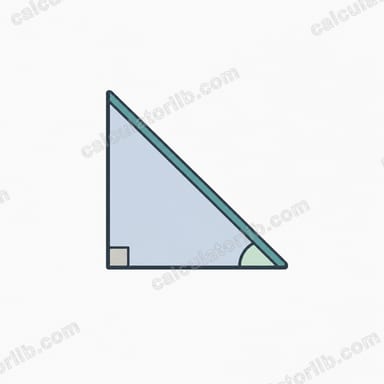
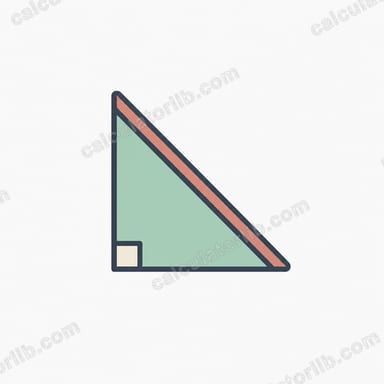
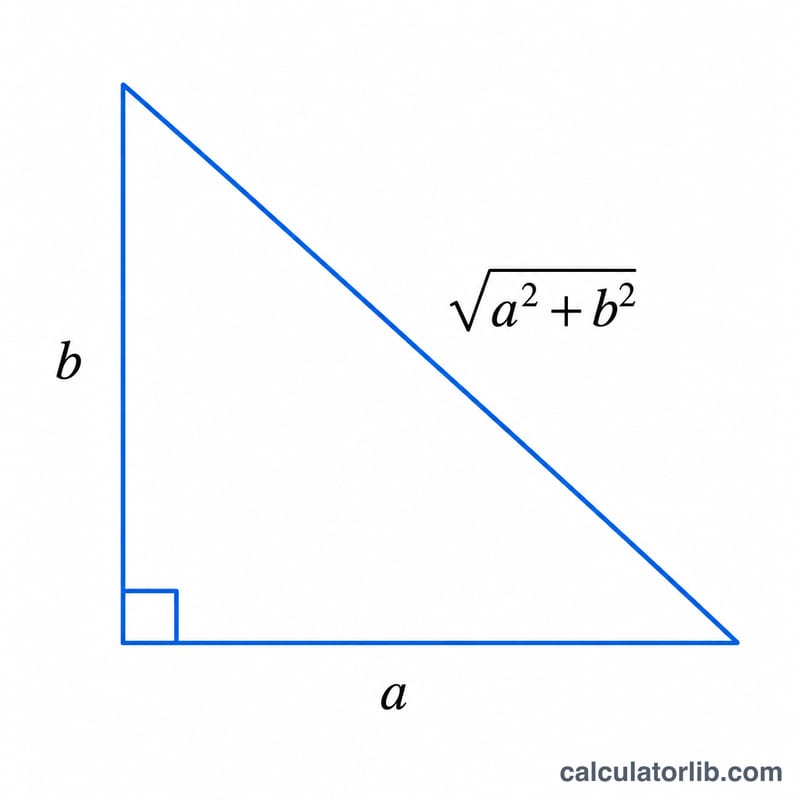
This tool calculates the perimeter of a right triangle when you know the lengths of its two legs — the two sides that meet at the 90° angle. It first computes the hypotenuse using the Pythagorean theorem, then adds all three sides together to give you the total perimeter.
How to Use It
Enter the length of leg a and leg b in any consistent unit (cm, m, inches, etc.). The calculator returns the hypotenuse and the perimeter in the same unit. Because a right triangle only requires the two legs to be fully defined, no other inputs are needed.
The Formula Explained
The perimeter P is the sum of all three sides: \(P = a + b + c\), where c is the hypotenuse. The hypotenuse comes from the Pythagorean theorem, \(c = \sqrt{a^{2} + b^{2}}\). Substituting gives the single formula $$P = a + b + \sqrt{a^{2} + b^{2}}$$
Worked Example
Suppose a = 3 and b = 4. The hypotenuse is $$\sqrt{3^{2} + 4^{2}} = \sqrt{9 + 16} = \sqrt{25} = 5$$ The perimeter is therefore \(3 + 4 + 5 = \mathbf{12}\). This is the classic 3-4-5 right triangle.
FAQ
Do the legs have to be whole numbers? No. You can enter decimals such as 2.5 or 6.75; the result is computed at full precision.
What unit does the result use? The same unit you enter. If both legs are in meters, the perimeter is in meters.
Which side is the hypotenuse? The hypotenuse is the side opposite the right angle and is always the longest side of a right triangle.