
What Is the Perimeter of a Triangle?
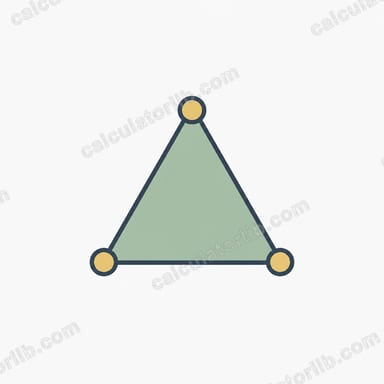
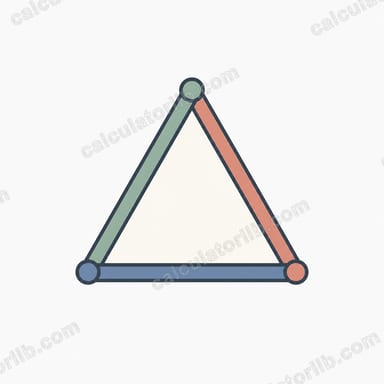
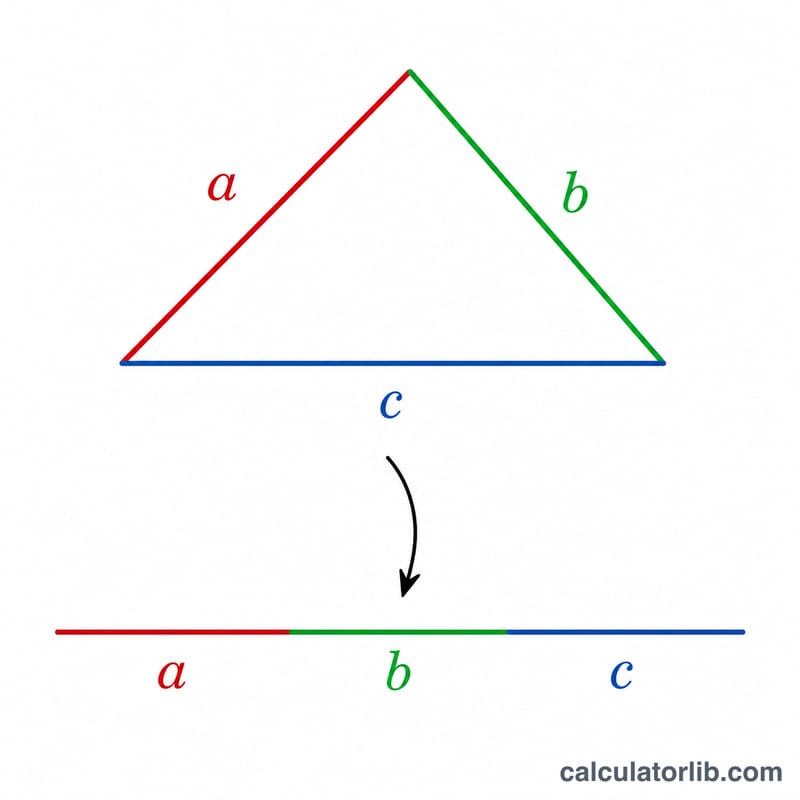
The perimeter of a triangle is the total distance around its outer edge — simply the sum of the lengths of its three sides. Whether you are working with a scalene, isosceles, or equilateral triangle, the rule is the same: add up all three sides. This calculator gives you the perimeter instantly and also reports the semi-perimeter, a handy quantity used elsewhere in geometry.
How to Use This Calculator
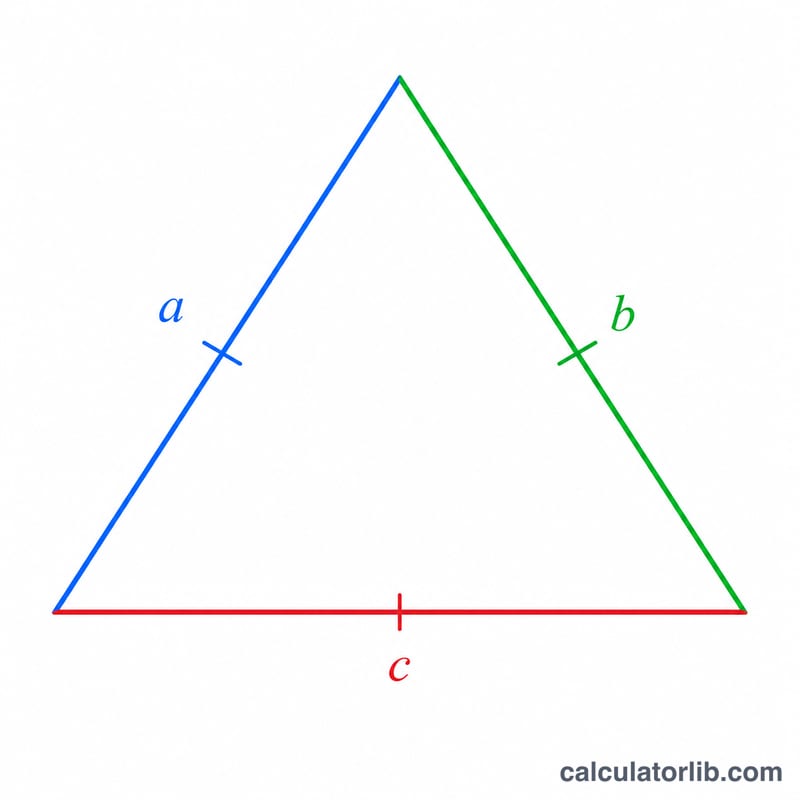
Enter the three side lengths — a, b, and c — using any consistent unit (centimeters, inches, meters, etc.). The result is returned in that same unit. The tool adds the sides together to give the perimeter and divides by two to give the semi-perimeter. There is no need to convert units as long as all three values share the same measurement.
The Formula Explained
The perimeter formula is $$P = a + b + c$$, where \(a\), \(b\) and \(c\) are the side lengths. The semi-perimeter is $$s = \frac{a + b + c}{2}$$. The semi-perimeter is especially useful because it appears in Heron's formula, which computes a triangle's area from its three sides: $$\text{Area} = \sqrt{s(s-a)(s-b)(s-c)}$$
Worked Example
Suppose a triangle has sides of 3, 4 and 5 units. The perimeter is $$P = 3 + 4 + 5 = 12 \text{ units}.$$ The semi-perimeter is $$s = \frac{12}{2} = 6 \text{ units}.$$ This is the well-known 3-4-5 right triangle, whose area by Heron's formula is \(\sqrt{6\cdot3\cdot2\cdot1} = \sqrt{36} = 6\) square units.
FAQ
Do all sides need the same unit? Yes. Mixing units gives a meaningless result. Convert everything to one unit first.
What if my values cannot form a triangle? The calculator still adds the numbers, but for a valid triangle each side must be shorter than the sum of the other two (the triangle inequality).
Does this work for equilateral triangles? Absolutely — just enter the same value three times, and the perimeter equals three times that side length.