What Is Heron's Formula?
Heron's formula lets you compute the area of a triangle when you know the lengths of all three sides — no angles or height required. Named after Heron of Alexandria, it is one of the most elegant results in geometry and works for any valid triangle, whether acute, right, or obtuse.
How to Use This Calculator
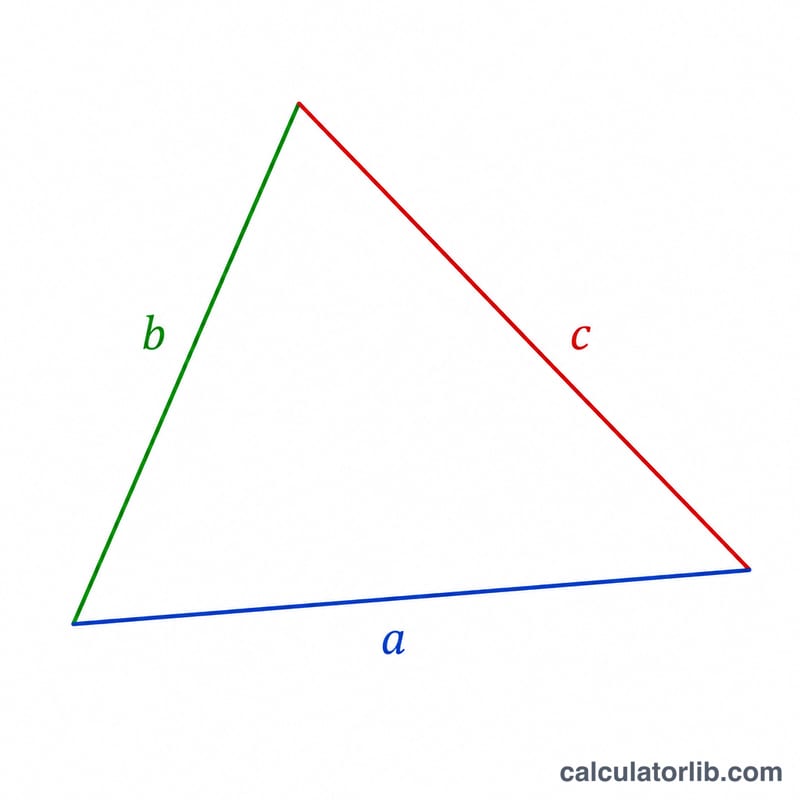
Enter the three side lengths a, b, and c in the same unit (cm, m, inches, etc.). The calculator first computes the semi-perimeter \(s\), then applies Heron's formula to return the area. The result is given in square units of whatever unit you entered. For the sides to form a real triangle, each side must be shorter than the sum of the other two (the triangle inequality).
The Formula Explained
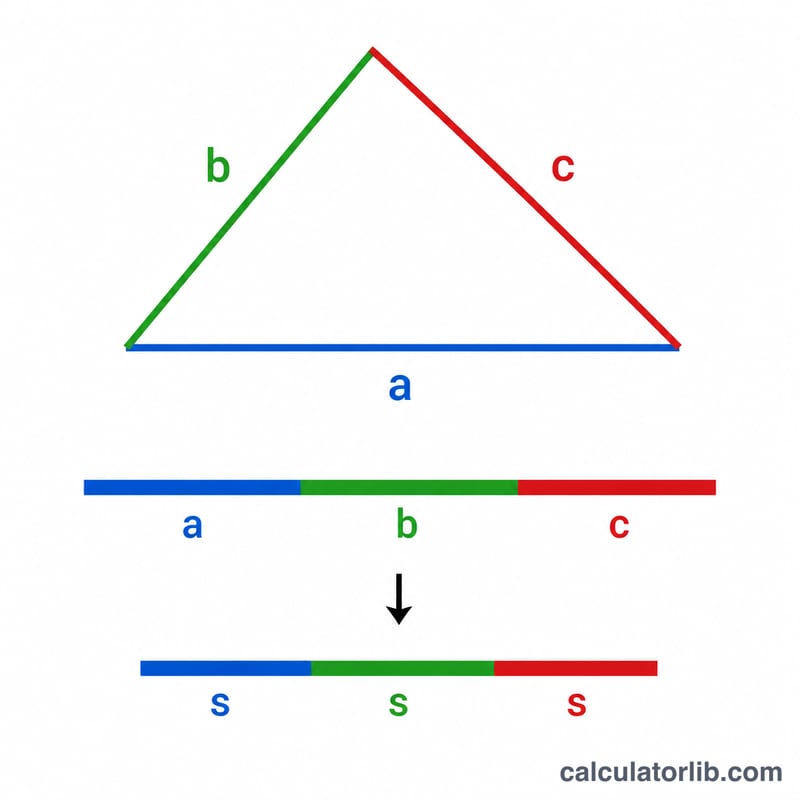
First find the semi-perimeter: $$s = \frac{a + b + c}{2}$$ Then the area is $$\text{Area} = \sqrt{s\,(s-a)(s-b)(s-c)}$$ The clever part is that the expression under the square root is always non-negative for a valid triangle and equals zero when the points are collinear (a degenerate triangle).
Worked Example
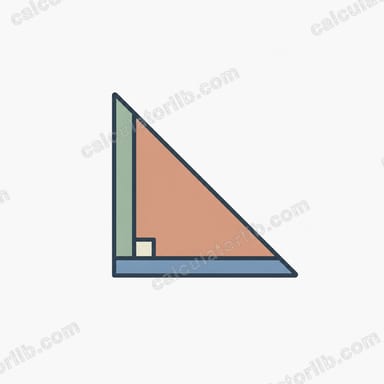
Take a triangle with sides \(a = 3\), \(b = 4\), \(c = 5\). The semi-perimeter is $$s = \frac{3 + 4 + 5}{2} = 6$$ Then $$\text{Area} = \sqrt{6 \times (6-3) \times (6-4) \times (6-5)} = \sqrt{6 \times 3 \times 2 \times 1} = \sqrt{36} = 6 \text{ square units}$$ This is the familiar 3-4-5 right triangle, and indeed \(\tfrac{1}{2} \times 3 \times 4 = 6\) confirms the answer.
Comparing Different Triangle Types
| Sides (a, b, c) | Triangle type | Semi-perimeter s | Perimeter | Area (square units) |
|---|---|---|---|---|
| 3, 4, 5 | Right | 6 | 12 | 6 |
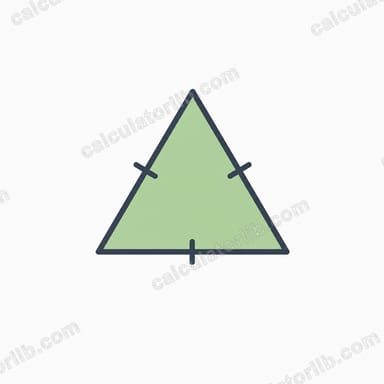
| 5, 5, 5 | Equilateral | 7.5 | 15 | ≈ 10.83 |
| 5, 5, 8 | Isosceles | 9 | 18 | 12 |
| 7, 8, 9 | Scalene (acute) | 12 | 24 | ≈ 26.83 |
| 1, 1, 1.99 | Near-degenerate (very flat isosceles) | 1.995 | 3.99 | ≈ 0.0994 |
| 1, 2, 3 | Invalid (degenerate) | 3 | 6 | 0 |
Notes: for 5, 5, 8 the product is \(9 \cdot 4 \cdot 4 \cdot 1 = 144\), so the area is exactly 12. For 1, 1, 1.99 the term \(s-c = 0.005\) is tiny, which makes the area very small. For 1, 2, 3 we get \(s-c = 0\), so the area is 0: the three points lie on one line and no real triangle exists.
FAQ
Do I need to know the angles? No — Heron's formula uses only the three side lengths.
What if I get zero or no result? The three sides don't form a valid triangle; one side is too long relative to the other two.
What units does the area use? Square units of whatever unit you used for the sides — enter all sides in the same unit.