What is the Right Triangle Side and Angle Calculator?
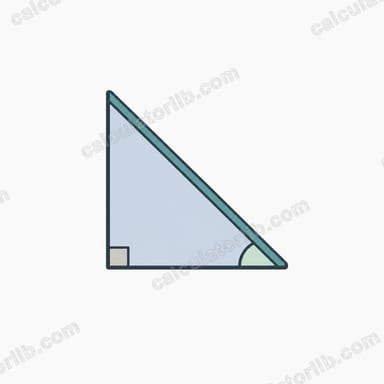
This calculator solves a right triangle when you know its two legs (the sides that form the 90° angle). From legs a and b it instantly returns the hypotenuse c, both acute angles A and B, the area, and the perimeter. It is a universal geometry tool that works in any units (cm, m, inches, feet) as long as both legs use the same unit.
How to use it
Enter the length of side a (the leg opposite angle A) and side b (the leg opposite angle B), then read off the results. There is no need to enter the right angle — it is always 90° by definition of a right triangle.
The formulas explained
The hypotenuse comes from the Pythagorean theorem, $$c = \sqrt{\text{a}^{2} + \text{b}^{2}}$$ The acute angles come from basic trigonometry: $$A = \tan^{-1}\!\left(\frac{\text{a}}{\text{b}}\right)$$ because the tangent of an angle equals opposite over adjacent. Since the three interior angles of any triangle sum to 180° and one is 90°, the remaining angle is $$B = 90^{\circ} - A$$ The area of a right triangle is half the product of its legs, \(\tfrac{1}{2}\cdot\text{a}\cdot\text{b}\), and the perimeter is \(\text{a} + \text{b} + c\).

Worked example
Take the classic 3-4-5 triangle with a = 3 and b = 4. The hypotenuse is $$\sqrt{9 + 16} = \sqrt{25} = 5$$ Angle \(A = \tan^{-1}(3/4) \approx 36.87^{\circ}\), and angle \(B = 90 - 36.87 = 53.13^{\circ}\). The area is $$\tfrac{1}{2} \times 3 \times 4 = 6$$ and the perimeter is \(3 + 4 + 5 = 12\).

Common Pythagorean Triples and Special Right Triangles
A Pythagorean triple is a set of three positive integers satisfying \(a^2 + b^2 = c^2\). In the table, angle A is opposite leg a and angle B is opposite leg b, so \(A = \arctan(a/b)\) and \(B = 90^\circ - A\). Area is \(\tfrac{1}{2}ab\) and perimeter is \(a + b + c\).
| Legs a, b | Hypotenuse c | Angle A | Angle B | Area | Perimeter |
|---|---|---|---|---|---|
| 3, 4 | 5 | 36.87° | 53.13° | 6 | 12 |
| 5, 12 | 13 | 22.62° | 67.38° | 30 | 30 |
| 8, 15 | 17 | 28.07° | 61.93° | 60 | 40 |
| 7, 24 | 25 | 16.26° | 73.74° | 84 | 56 |
| 20, 21 | 29 | 43.60° | 46.40° | 210 | 70 |
Special right triangles
| Triangle | Side ratio | Angles | Notes |
|---|---|---|---|
| 45-45-90 (isosceles right) | \(1 : 1 : \sqrt{2}\) | 45°, 45°, 90° | Legs are equal; hypotenuse = leg × \(\sqrt{2}\) ≈ leg × 1.4142. |
| 30-60-90 | \(1 : \sqrt{3} : 2\) | 30°, 60°, 90° | The short leg is half the hypotenuse; the long leg = short leg × \(\sqrt{3}\) ≈ short leg × 1.7321. |
Any multiple of a triple (for example 6-8-10 or 9-12-15) is also a right triangle with the same angles.
How Changing the Legs Changes the Results
The table compares several leg combinations. Values are rounded to two decimals where they are not exact. Angle A is opposite leg a; angle B is opposite leg b.
| Scenario | Legs a, b | Hypotenuse c | Angle A | Angle B | Area | Perimeter |
|---|---|---|---|---|---|---|
| Equal legs | 5, 5 | 7.07 | 45.00° | 45.00° | 12.5 | 17.07 |
| Long thin triangle | 2, 10 | 10.20 | 11.31° | 78.69° | 10 | 22.20 |
| Base 3-4-5 | 3, 4 | 5 | 36.87° | 53.13° | 6 | 12 |
| Scaled 6-8-10 (×2) | 6, 8 | 10 | 36.87° | 53.13° | 24 (×4) | 24 (×2) |
| Decimal legs | 2.5, 6 | 6.5 | 22.62° | 67.38° | 7.5 | 15 |
What the comparison shows
- Equal legs always give 45° angles and \(c = a\sqrt{2}\). Here \(c = \sqrt{25 + 25} = \sqrt{50} \approx 7.07\).
- Very unequal legs push one angle toward 0° and the other toward 90°. With a = 2 and b = 10, \(A = \arctan(2/10) \approx 11.31^\circ\), and c (10.20) is only slightly longer than the long leg.
- Scaling every side by a factor k leaves the angles unchanged, multiplies the perimeter by k and the area by \(k^2\). Doubling 3-4-5 to 6-8-10 doubles the perimeter (12 → 24) and quadruples the area (6 → 24).
- Decimal legs work the same way: \(c = \sqrt{2.5^2 + 6^2} = \sqrt{6.25 + 36} = \sqrt{42.25} = 6.5\). The 2.5-6-6.5 triangle is a scaled 5-12-13 triangle (×0.5), so its angles match 22.62° and 67.38°.
FAQ
Which leg is a and which is b? It does not matter for the hypotenuse, area, or perimeter. The labels only determine which acute angle is called A versus B.
What units does it use? Any unit you like — just keep both legs in the same unit. The hypotenuse and perimeter come out in that unit and the area in its square.
Can I enter decimals? Yes, any positive decimal value works for either leg.