
What this calculator does
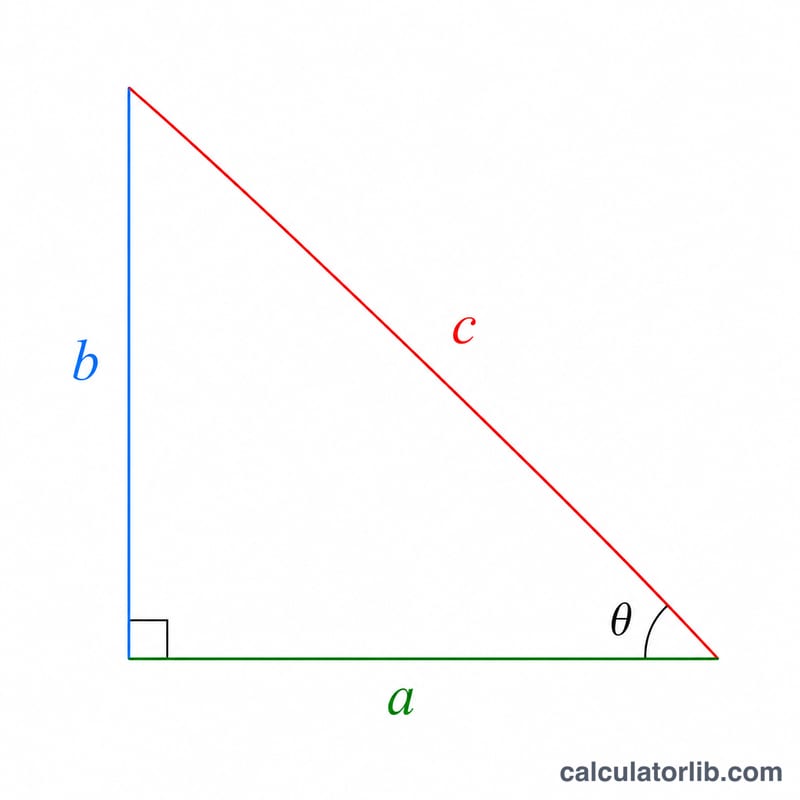
This tool solves a right triangle when you know its height b (the vertical side opposite the angle) and its hypotenuse c (the longest side, opposite the right angle). It returns the inclination angle theta in decimal degrees and in degrees-minutes-seconds (D° M′ S″), plus the base a (the adjacent horizontal side). It is pure trigonometry, so it works the same in any country and with any consistent length unit.
Naming convention
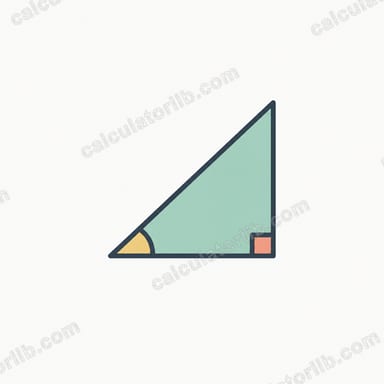
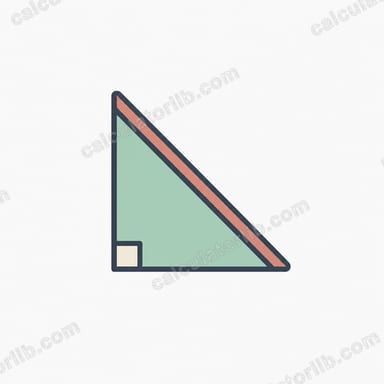
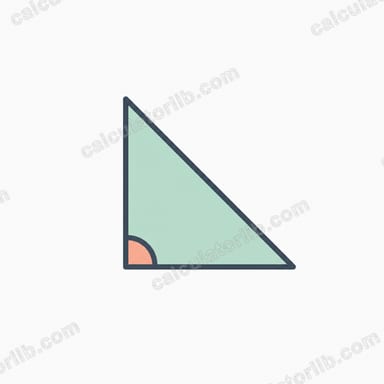
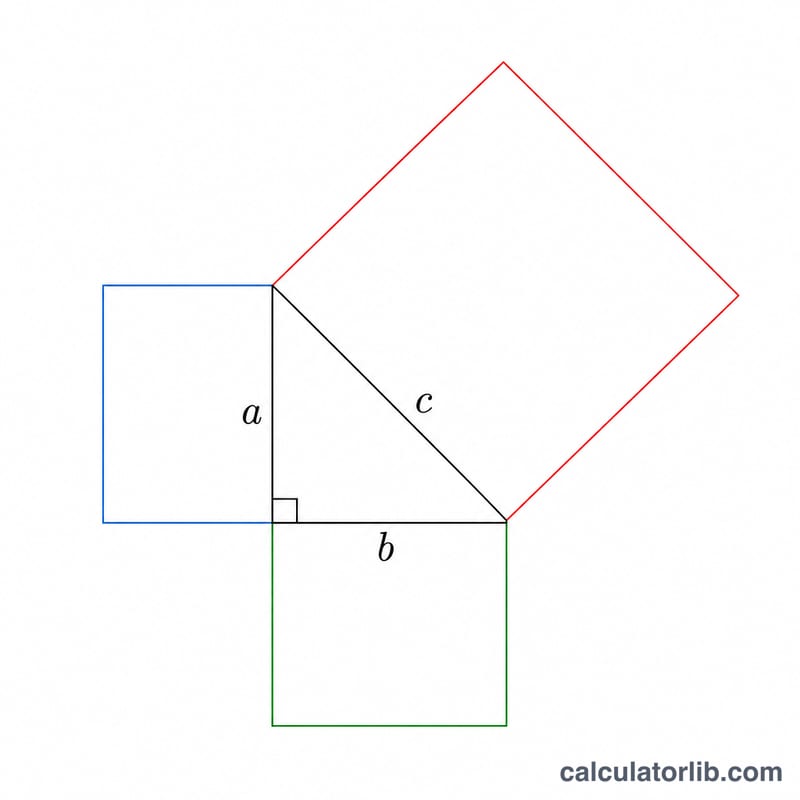
The right angle sits between the base a and the height b. The hypotenuse c connects their free ends. The angle theta is measured at the bottom vertex, between the base a and the hypotenuse c, giving \(\cos\theta = a/c\), \(\sin\theta = b/c\) and \(\tan\theta = b/a\). Pythagoras ties them together: \(a^2 + b^2 = c^2\).
How to use it
Enter the height b and the hypotenuse c in the same unit (both in meters, both in feet, etc.). For a valid triangle the hypotenuse must be positive and at least as long as the height. Press calculate to get the angle and the base. The base is reported in the same unit as your inputs.
The formula
The ratio b/c equals the sine of theta, so \(\theta = \arcsin(b/c)\). Converting to degrees multiplies the radian result by \(180/\pi\). The base comes straight from Pythagoras:
$$a = \sqrt{c^2 - b^2}$$which also equals \(c\cdot\cos\theta\).
Worked example
With height b = 1 and hypotenuse c = 2, the ratio is 0.5, so \(\theta = \arcsin(0.5) = 30^\circ\) (30° 0′ 0.00″) and the base \(a = \sqrt{4 - 1} = \sqrt{3} \approx 1.7320508\). A second case: b = 3, c = 5 gives \(\theta \approx 36.8699^\circ\) (36° 52′ 11.63″) and \(a = \sqrt{25 - 9} = 4\).
FAQ
Why must the hypotenuse be the largest side? In a right triangle the hypotenuse is always opposite the right angle and is the longest side, so b cannot exceed c; otherwise \(\arcsin(b/c)\) is undefined.
What happens at the extremes? If b = 0 the angle is 0° and the base equals c. If b = c the angle is 90° and the base is 0 (a degenerate triangle).
How are seconds rounded? The degrees-minutes-seconds form rounds the seconds to two decimal places, carrying over into minutes or degrees if rounding reaches 60.