
What this calculator does
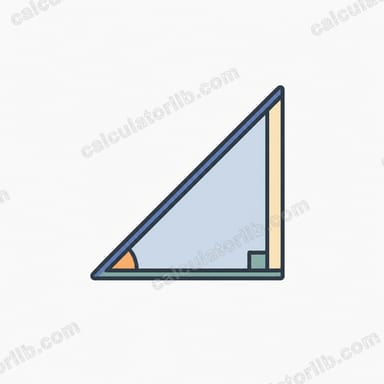
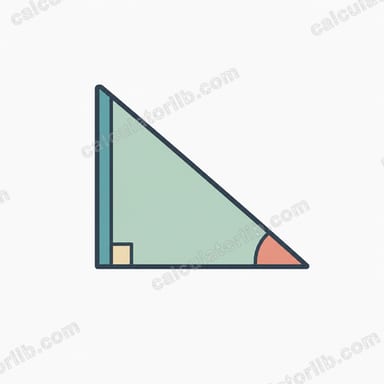
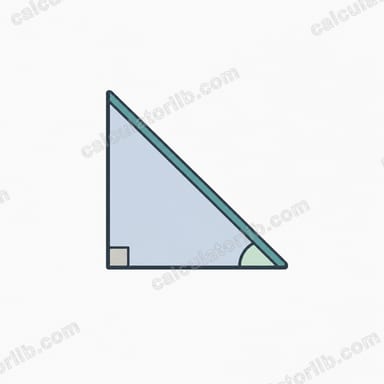
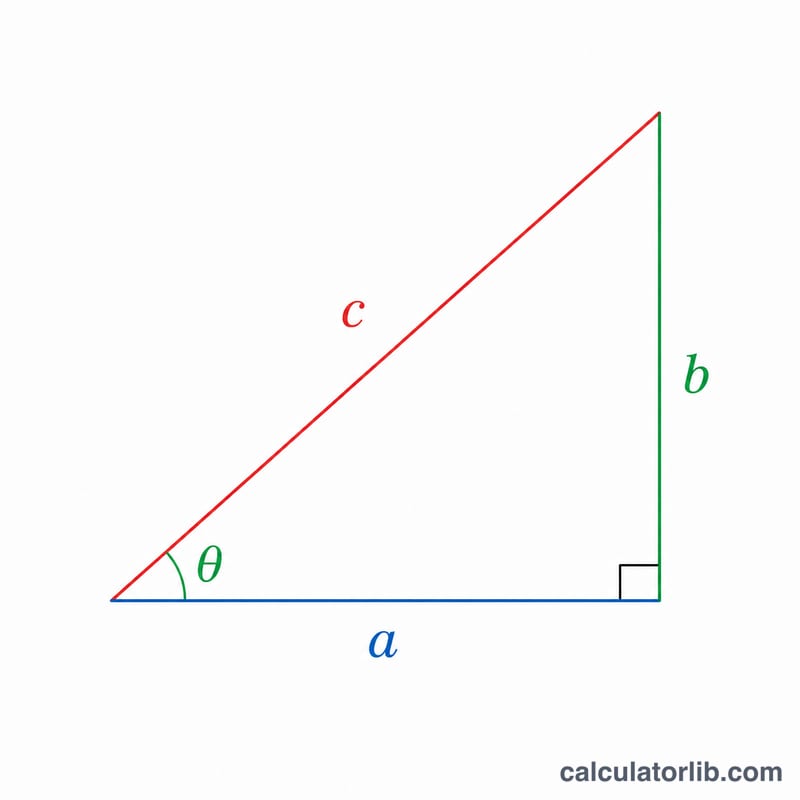
This tool solves a right triangle when you know one acute angle and the height (the side opposite that angle). The angle theta sits between the hypotenuse c and the base a. The height b stands vertically opposite theta, and the base a runs horizontally adjacent to it. From these two pieces of information the calculator returns the adjacent base a and the hypotenuse c.
The formulas
The three fundamental right-triangle ratios are \(\cos\theta = a / c\), \(\sin\theta = b / c\), and \(\tan\theta = b / a\). Rearranging the two that contain the known height b gives the answers directly:
$$a = \frac{\text{Height }b}{\tan\theta} \qquad c = \frac{\text{Height }b}{\sin\theta}$$Because this calculator works in degree mode, the angle is first converted to radians \((\theta_{rad} = \theta \cdot \pi / 180)\) before the trigonometric functions are applied.
How to use it
Enter the height b as a plain magnitude (any consistent length unit). Enter the angle theta in degrees. You may type a decimal value such as 30, or use degrees-minutes-seconds separated by apostrophes, for example 45'12'6 which means 45 degrees, 12 minutes and 6 seconds. The base and hypotenuse come back in the same unit as the height.
Worked example
With \(b = 1\) and \(\theta = 30\) degrees:
$$\tan 30^\circ = 0.5773502692 \quad\Rightarrow\quad a = \frac{1}{0.5773502692} = 1.7320508$$(which is the square root of 3).
$$\sin 30^\circ = 0.5 \quad\Rightarrow\quad c = \frac{1}{0.5} = 2$$The triangle therefore has base 1.7320508 and hypotenuse 2.
FAQ
Why must the angle be between 0 and 90 degrees? Only acute angles give a valid right-triangle interior angle. At \(\theta = 0\) both tan and sin are zero, so the base and hypotenuse are undefined (division by zero). At \(\theta = 90\) the base collapses to zero and the hypotenuse equals the height.
Can I enter the angle in radians? No, this version expects degrees, matching the source category of trigonometric functions in degrees.
What units are used? The height is a unitless magnitude. The base and hypotenuse are returned in whatever unit you used for the height.