
What this calculator does
This tool evaluates the bound-state electron wavefunction of a hydrogen-like atom, the exact solution of the time-independent Schrodinger equation for a single electron orbiting a point nucleus of charge Z. The full wavefunction separates into a radial part and an angular part: \(\Psi(r, \theta, \phi) = R_{nl}(r)\,Y_l^m(\theta, \phi)\). It works for hydrogen (\(Z = 1\)) and the He+ ion (\(Z = 2\)). Distances are expressed in Bohr radii (\(a = 1\)), so \(\Psi\) comes out in atomic-like units of \(a^{-3/2}\).
How to use it
Pick the nuclear charge \(Z\), then enter the three quantum numbers: the principal quantum number \(n\) (1, 2, 3, ...), the orbital quantum number \(l\) (0 to \(n-1\)), and the magnetic quantum number \(m\) (\(-l\) to \(+l\)). Finally enter the point in space where you want the wavefunction: the radial distance \(r\) in Bohr radii, the polar angle \(\theta\) in degrees (0 to 180), and the azimuthal angle \(\phi\) in degrees (0 to 360). The calculator returns the magnitude, real part and imaginary part of \(\Psi\), plus \(r\) times \(\Psi\) for radial-density visualization.
The formula explained
The radial function \(R_{nl}(r)\) is built from a normalization constant, a decaying exponential \(e^{-Zr/(na)}\), a power factor \(\rho^l\) with \(\rho = 2Zr/(na)\), and an associated Laguerre polynomial \(L_{n-l-1}^{2l+1}(\rho)\) evaluated as a finite sum. The angular function \(Y_l^m\) uses the associated Legendre function \(P_l^m(\cos\theta)\) and the complex phase \(e^{im\phi}\). For \(m = 0\) the result is purely real; for \(m \neq 0\) it carries a phase, so we report real part, imaginary part and magnitude. Note that \(|\Psi|^2\) (the probability density) does not depend on \(\phi\).
$$ \psi_{nlm}(r,\theta,\phi) = R_{nl}(r)\,Y_l^m(\theta,\phi) $$ $$ \text{where}\quad \left\{ \begin{aligned} R_{nl} &= -\sqrt{\left(\frac{2Z}{na}\right)^3 \frac{(n-l-1)!}{2n\,(n+l)!}}\; e^{-\frac{Zr}{na}} \rho^{\,l}\, L_{n-l-1}^{2l+1}(\rho) \\ \rho &= \frac{2\,\text{Z}\,\text{r}}{\text{n}\,\text{a}} \\ Y_l^m &= \sqrt{\frac{(2l+1)}{4\pi}\frac{(l-|m|)!}{(l+|m|)!}}\; P_l^{|m|}(\cos\theta)\, e^{im\phi} \end{aligned} \right. $$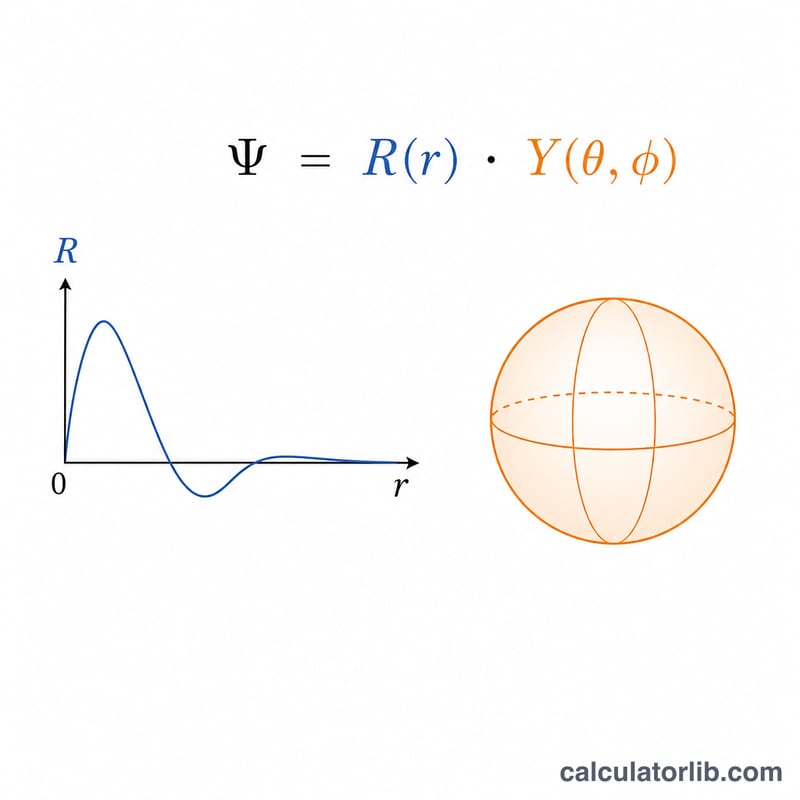
Worked example (1s ground state)
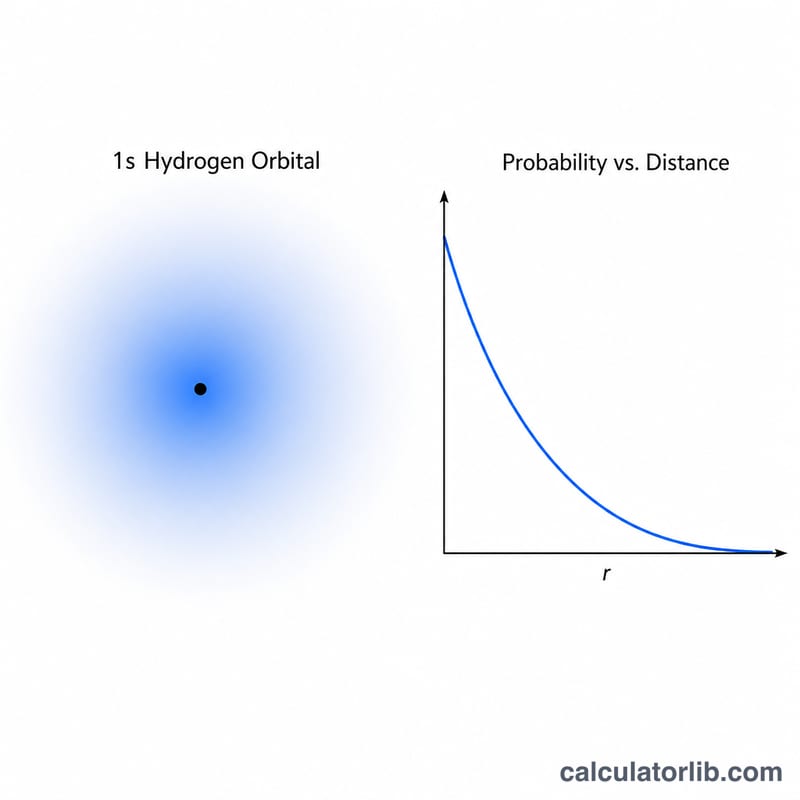
Set \(Z = 1\), \(n = 1\), \(l = 0\), \(m = 0\), \(r = 1\), \(\theta = 0\), \(\phi = 0\). Then \(\rho = 2\), the radial prefactor is \(\sqrt{8 \cdot 1 / (2 \cdot 1)} = 2\) (with the leading minus, \(-2\)), \(e^{-1} = 0.367879\), the Laguerre polynomial \(L_0^1(2) = 1\), so \(R_{10}(1) = -0.735759\). The harmonic \(Y_0^0 = \sqrt{1 / (4\pi)} = 0.282095\). Multiplying gives \(\Psi = -0.207538\), with magnitude \(0.207538\) - matching the textbook 1s value \((1/\sqrt{\pi})\, e^{-r}\) at \(r = 1\).
FAQ
Why is my result sometimes negative? This calculator uses the common leading-minus sign convention on \(R_{nl}\). Physical observables such as \(|\Psi|^2\) are unaffected by the overall sign.
What units is \(\Psi\) in? With the Bohr radius set to \(a = 1\), \(\Psi\) is in units of \(a^{-3/2}\). To get SI values, multiply \(r\) by \(a_0 = 5.29177\text{e-}11 \text{ m}\) and scale \(\Psi\) by \(a_0^{-3/2}\).
Why does a higher-l state vanish at r = 0? The \(\rho^l\) factor forces \(R_{nl}\) to zero at the origin whenever \(l > 0\); only s-states (\(l = 0\)) have nonzero density at the nucleus.