
What is the Hydrogen Ion Concentration Calculator?
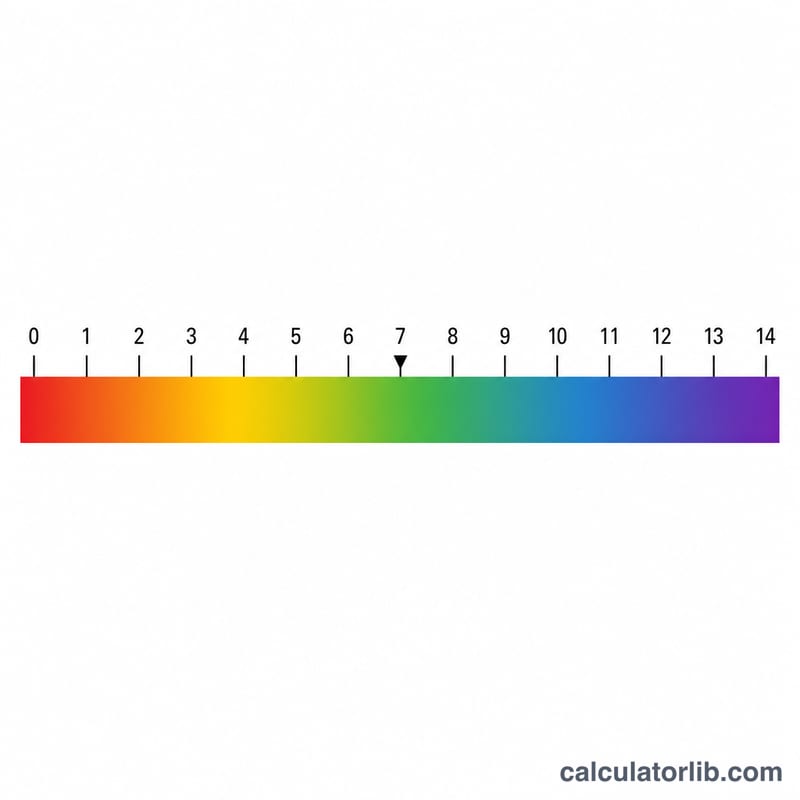
This tool converts between pH and the hydrogen ion concentration \([\text{H}^+]\) of an aqueous solution. pH is a logarithmic measure of acidity: the more hydrogen ions in solution, the lower the pH and the stronger the acid. The relationship is exact and universal for any temperature where the standard scale applies, so the same formula works in chemistry classes, water-quality testing, and laboratory work worldwide.
How to use it
Choose your conversion direction. Select pH → [H⁺] and enter a pH value (typically 0–14) to find the molar hydrogen ion concentration. Or select [H⁺] → pH and enter a concentration in mol/L to find the pH. The calculator also reports the complementary pOH and [OH⁻] using the water relation \(\text{pH} + \text{pOH} = 14\) at 25 °C.
The formula explained
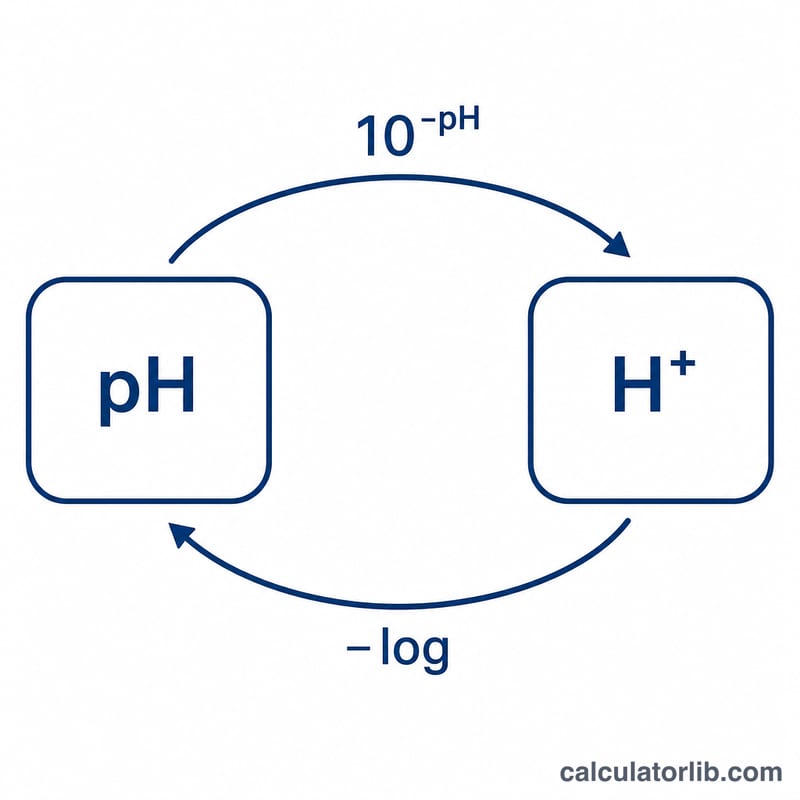
pH is defined as the negative base-10 logarithm of the hydrogen ion activity, approximated by concentration:
$$\text{pH} = -\log_{10}[\text{H}^+]$$Rearranging gives the inverse:
$$[\text{H}^+] = 10^{-\text{pH}}$$A one-unit drop in pH means a tenfold increase in hydrogen ion concentration. Pure neutral water at 25 °C has \([\text{H}^+] = 1\times10^{-7}\) mol/L, giving \(\text{pH} = 7\).
Worked example
Suppose a solution has pH 3. Then
$$[\text{H}^+] = 10^{-3} = 0.001 \text{ mol/L}$$The \(\text{pOH} = 14 - 3 = 11\), and \([\text{OH}^-] = 10^{-11} \approx 1\times10^{-11}\) mol/L. The solution is strongly acidic because its hydrogen ion concentration is 10,000 times higher than neutral water.
FAQ
Can pH be negative? Yes. Very concentrated strong acids can have \([\text{H}^+]\) greater than 1 mol/L, giving a negative pH. The calculator accepts these values.
Why does pOH appear? In water, \(\text{pH} + \text{pOH} = 14\) at 25 °C, so reporting pOH and [OH⁻] gives a complete acid–base picture.
Is concentration the same as activity? Strictly, pH uses ion activity, but for dilute solutions activity ≈ concentration, which is the assumption used here.