
What Is the Protein Concentration Calculator?
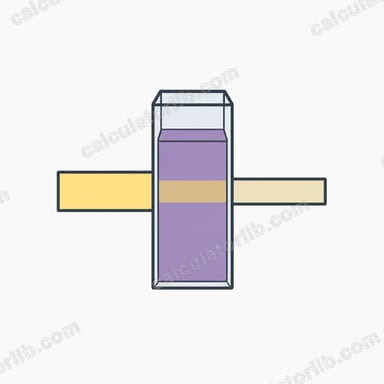
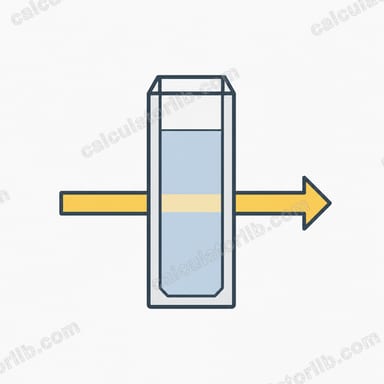
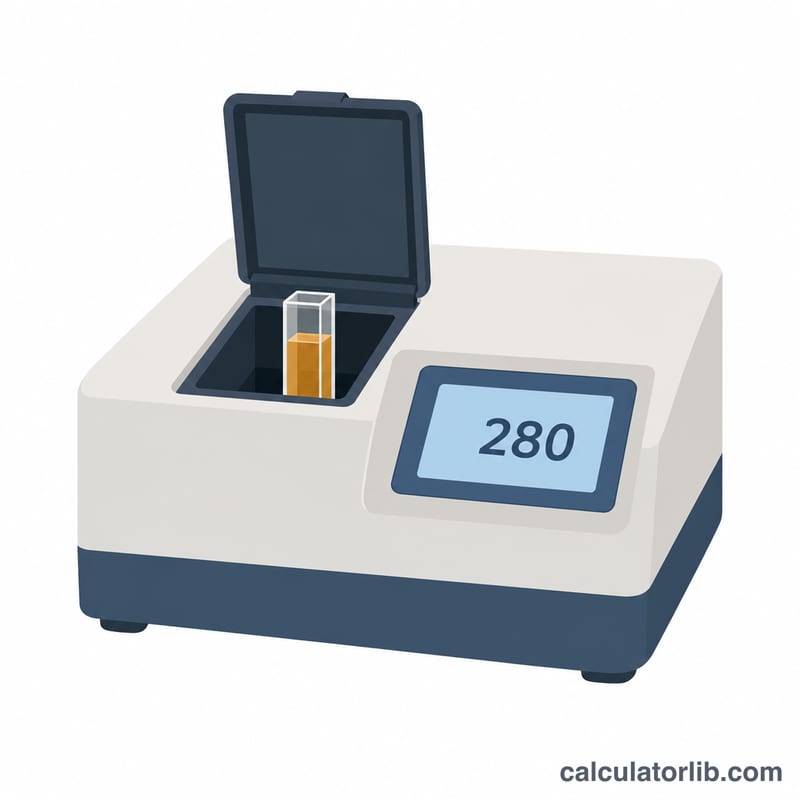
This calculator estimates the concentration of a protein solution from its absorbance at 280 nm (A280) measured on a UV spectrophotometer. Aromatic residues — tryptophan, tyrosine, and to a small degree cysteine — absorb light at 280 nm, so the absorbance is directly proportional to protein concentration. Using the Beer-Lambert law, you can convert the reading into milligrams per millilitre (mg/mL) once you know the protein's mass extinction coefficient.
How to Use It
Enter three values: the measured absorbance (A280), the mass extinction coefficient \(\varepsilon\) (in mL·mg⁻¹·cm⁻¹), and the cuvette path length (usually 1 cm). A common generic value for \(\varepsilon\) is 1.0 for a "1 mg/mL = 1 AU" assumption, while IgG is often taken as ~1.4. The calculator returns the concentration in mg/mL and µg/mL.
The Formula Explained
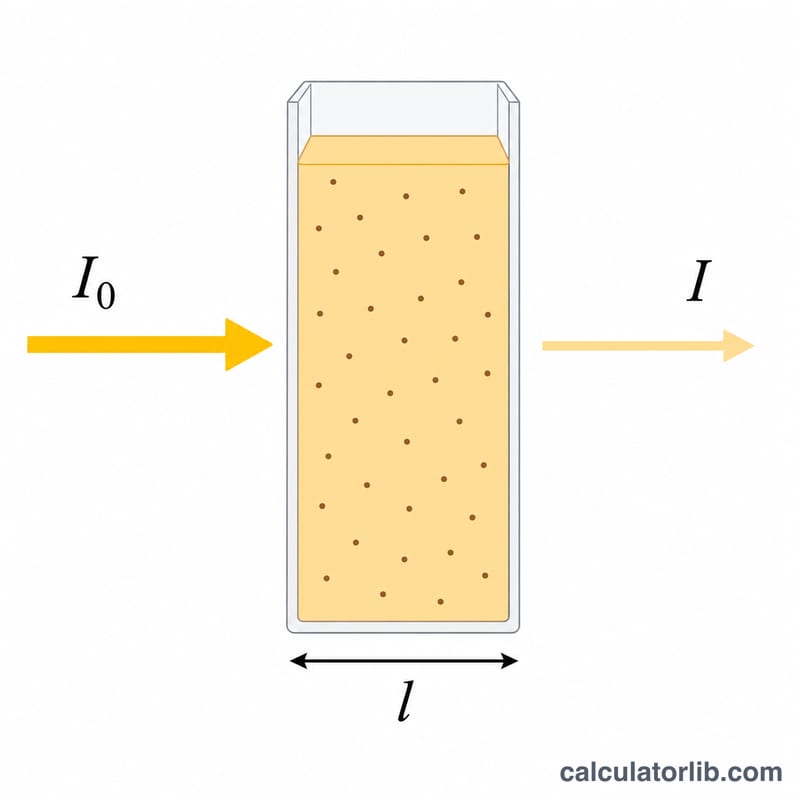
The Beer-Lambert law states \(A = \varepsilon \times C \times l\), where \(A\) is absorbance, \(\varepsilon\) is the extinction coefficient, \(C\) is concentration, and \(l\) is path length. Rearranging for concentration gives $$C = \dfrac{A_{280}}{\varepsilon \times l}$$ When the path length is 1 cm, this simplifies to \(C = \dfrac{A_{280}}{\varepsilon}\).
Worked Example
Suppose you measure A280 = 0.700 for an antibody with \(\varepsilon = 1.4\) mL·mg⁻¹·cm⁻¹ in a 1 cm cuvette. Then $$C = \frac{0.700}{1.4 \times 1} = 0.5 \text{ mg/mL}$$ or 500 µg/mL.
FAQ
What extinction coefficient should I use? Use the mass coefficient specific to your protein (often from ProtParam or the supplier datasheet). 1.0 is a rough default; 1.4 is typical for IgG.
Why measure at 280 nm? Aromatic amino acids absorb strongly at 280 nm, making it the standard wavelength for label-free protein quantification.
Does path length matter? Yes — most cuvettes are 1 cm, but micro-volume instruments (e.g. NanoDrop) use shorter paths, which must be entered correctly.