What Is the Cow Gestation Calculator?
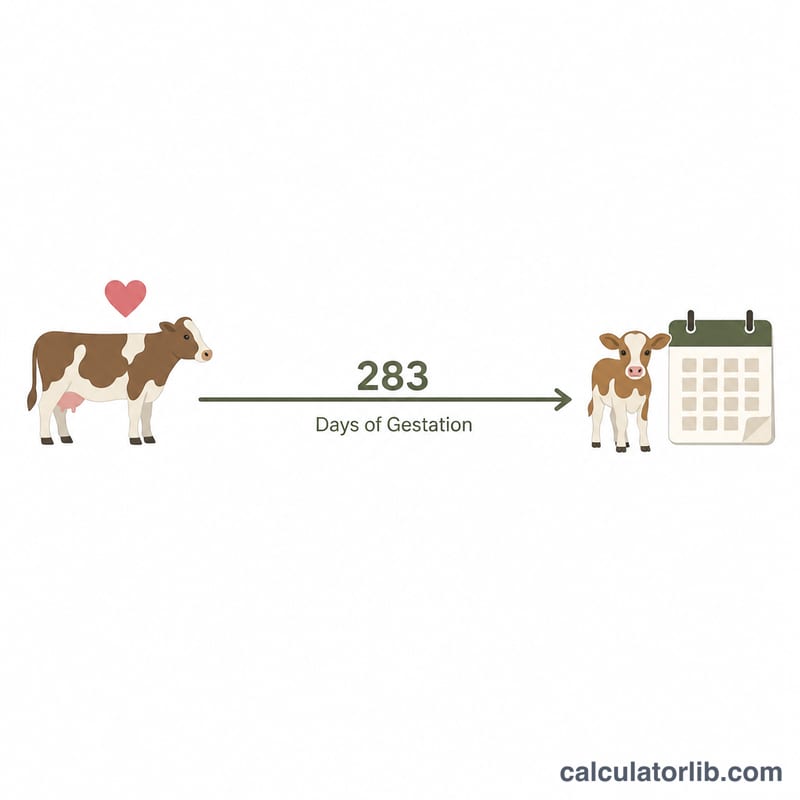
The Cow Gestation Calculator estimates when a cow will calve based on the date she was bred. Cattle (Bos taurus) have an average gestation period of about 283 days, though this varies by breed and individual animal — typically ranging from 279 to 287 days. Knowing the expected calving date helps producers plan calving pens, monitor close-up cows, schedule feed and labor, and prepare for veterinary assistance if needed.
How to Use It
Enter the breeding (service or insemination) date. The default gestation length of 283 days works well for most beef and dairy cattle, but you can adjust it — for example, Brahman and other Bos indicus breeds tend toward longer gestations, while some dairy breeds calve a few days earlier. The calculator returns the estimated calving date along with the gestation length used.
The Formula Explained
The math is a simple date addition:
$$\text{Due Date} = \text{Breeding Date} + \text{Gestation Days}$$With the default value, a cow bred on January 1, 2024 is expected to calve on October 10, 2024 (283 days later, accounting for 2024 being a leap year).
Worked Example
Suppose a heifer is artificially inseminated on March 15, 2023. Adding 283 days lands on December 23, 2023. A manager would begin watching her closely about two weeks before that date and move her to a clean calving area.
Gestation Length by Cattle Breed
Gestation length in cattle differs between breeds. The table lists commonly cited approximate averages and ranges. The default 283 days in the calculator sits near the middle of beef-breed values, and you can enter a breed-specific number in the gestation length field.
| Breed | Typical average gestation (days) | Approximate range (days) |
|---|---|---|
| Angus | about 281 | 279–283 |
| Hereford | about 284 | 283–286 |
| Holstein | about 279 | about 279 |
| Jersey | about 279 | about 279 |
| Charolais | about 288 | 287–289 |
| Simmental | about 287 | 286–289 |
| Limousin | about 289 | 288–290 |
| Brahman | about 288 | 285–292 |
These are approximate averages, not fixed values. Actual gestation varies by individual cow, by sire, by calf sex, and by whether the cow carries a single calf or twins. Crossbred animals often fall between the values of their parent breeds.
Interpreting Your Calving Date
The calculated date is a midpoint estimate, not a deadline. Most normal calvings fall within a window of roughly 279–287 days after breeding, which is about ±4 days around a 283-day estimate. Calving a few days before or after the date is normal.
Factors that shift timing
- Genetics: The breed of the cow and bull, and the individual sire, influence gestation length. Some sires are known to produce calves with consistently shorter or longer gestations.
- Calf sex: Bull calves are on average carried slightly longer than heifer calves, often by about one to two days.
- Twins: Twin pregnancies usually end earlier than single pregnancies.
- Heifers vs. mature cows: First-calf heifers can differ slightly from mature cows, and the difference depends on breed and management.
- Nutrition and environment: Poor nutrition and heat stress are reported to influence gestation length and calf size.
- Breeding date accuracy: With natural service over several days, or an uncertain breeding date, the real conception date may differ from the one entered.
Early and late calving
A calf born before about 270 days is generally classed as premature, and such calves have a lower chance of survival and may need extra care. Cows that are more than about a week past the expected date are commonly flagged for a veterinary check. This is general information about how these terms are used, not advice about any individual animal.
Calving Timeline Reference
The table shows typical industry-practice milestones, counted in days after breeding and based on a 283-day gestation. Exact timing varies between herds and veterinarians.
| Days after breeding | Milestone |
|---|---|
| ~21 | Return-to-heat (non-return) check: a cow that does not return to estrus around the next expected cycle may be pregnant |
| 30–45 | Earliest pregnancy check by ultrasound |
| ~60 | Pregnancy check by palpation |
| ~223 | Dry-off for dairy cows, at roughly 60 days before calving (283 − 60 = 223) |
| ~263 | Move to calving area, about 20 days before the due date (283 − 20 = 263) |
| 283 | Expected calving date |
If you use a breed-specific gestation length, subtract the same intervals from that number to adjust the dry-off and calving-area dates.
FAQ
How long are cows pregnant? On average about 283 days, or roughly 9 months and 9 days. Normal range is 279–287 days.
Does breed change the due date? Yes. Bos indicus breeds (e.g., Brahman) often gestate 285–292 days, so adjust the gestation length accordingly.
Is the calculated date exact? No — it is an estimate. Individual cows can calve several days before or after the predicted date.