What Is the Swine Gestation Calculator?
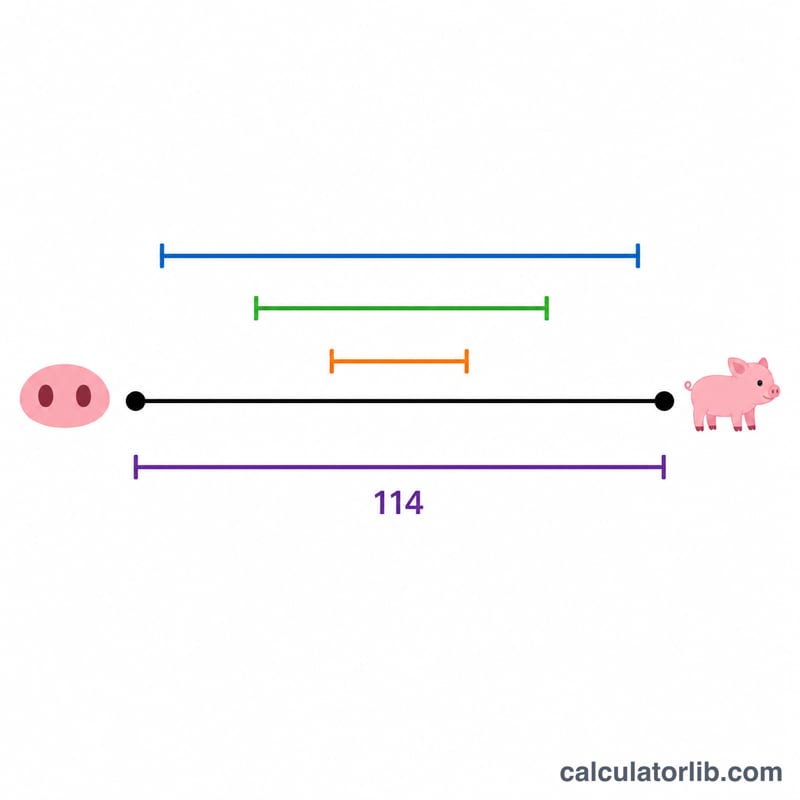
The Swine Gestation Calculator estimates the farrowing (birthing) date for a sow or gilt based on her breeding date. The average gestation period for pigs is about 114 days — easily remembered by the rule of thumb "3 months, 3 weeks, and 3 days." Most sows farrow between 111 and 116 days, so this tool lets you adjust the gestation length to match your herd's history.
How to Use It
Enter the date the sow was bred (or artificially inseminated) and the expected gestation length in days. The default of 114 days reflects the breed-average for domestic pigs. Click calculate to see the predicted farrowing date along with a breakdown of the day, month, and year.
The Formula Explained
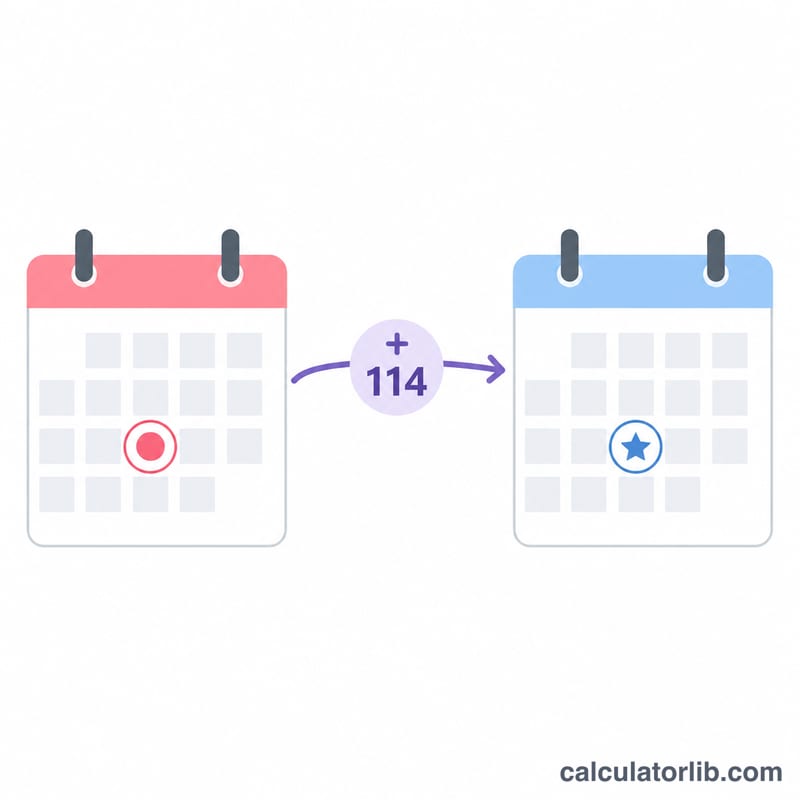
The calculation simply adds the gestation period to the breeding date:
$$\text{Due Date} = \text{Breeding Date} + 114 \text{ days}$$
Calendar math handles month lengths and leap years automatically, so you always get an accurate target date.
Worked Example
Suppose a sow is bred on January 1, 2024. Adding 114 days lands on April 24, 2024. January contributes 30 remaining days, February (a leap year) adds 29, March adds 31, leaving 24 days into April — $$30 + 29 + 31 + 24 = 114.$$ So the expected farrowing date is April 24, 2024.
Farrowing Date Scenarios Compared
The standard swine gestation length is 114 days — the familiar "3 months, 3 weeks, 3 days" rule — but individual sows commonly farrow anywhere from about 111 to 116 days after service. The table below takes five realistic breeding (or insemination) dates and advances each one by true calendar arithmetic, so month lengths and the leap day of 2028 are both accounted for.
| Breeding / AI date | 111 days (early) | 113 days | 114 days (expected) | 115 days | 116 days (late) | Farrowing window (111–116 days) |
|---|---|---|---|---|---|---|
| Jan 1, 2026 | Apr 22, 2026 | Apr 24, 2026 | Apr 25, 2026 | Apr 26, 2026 | Apr 27, 2026 | Apr 22 – Apr 27, 2026 |
| Mar 15, 2026 | Jul 4, 2026 | Jul 6, 2026 | Jul 7, 2026 | Jul 8, 2026 | Jul 9, 2026 | Jul 4 – Jul 9, 2026 |
| Jun 30, 2026 | Oct 19, 2026 | Oct 21, 2026 | Oct 22, 2026 | Oct 23, 2026 | Oct 24, 2026 | Oct 19 – Oct 24, 2026 |
| Oct 20, 2026 | Feb 8, 2027 | Feb 10, 2027 | Feb 11, 2027 | Feb 12, 2027 | Feb 13, 2027 | Feb 8 – Feb 13, 2027 |
| Dec 10, 2027 (spans Feb 29, 2028) | Mar 30, 2028 | Apr 1, 2028 | Apr 2, 2028 | Apr 3, 2028 | Apr 4, 2028 | Mar 30 – Apr 4, 2028 |
Leap-year effect. The last row crosses February 2028, which has 29 days. Because the extra calendar day is "absorbed" inside the gestation period, the due date lands one day earlier on the calendar than it would in an ordinary year: a Dec 10, 2026 breeding gives April 3, 2027, while the identical Dec 10, 2027 breeding gives April 2, 2028. Any hand calculation that assumes a 28-day February will be off by a day for every service that spans a leap day.
Plan around the window, not the single date. The 114-day column is only the most likely day; roughly speaking, gilts and sows will distribute across the whole 111–116 day span, and that span is 6 days wide. Farrowing crates, heat lamps, creep mats, bedding, induction decisions and staffing should therefore be ready from the 111-day date and stay ready through the 116-day date. Washing and moving a sow into the farrowing house 5–7 days before the expected date — not on it — is what keeps a 3-day-early litter from being born in the gestation pen.
These are general animal-husbandry figures, not veterinary advice; herd-specific gestation length, induction protocols and intervention decisions should be set with your own veterinarian.
How to Calculate a Farrowing Date by Hand
The underlying arithmetic is simply
$$\text{Farrowing Date} = \text{Breeding Date} + \text{Gestation Length (days)}$$with a default gestation length of 114 days. Worked example below: a sow served on April 5, 2026.
-
Write down the breeding date. Use the date of service — for artificial insemination, most producers record the first insemination of the heat, even when a second dose is given 12–24 hours later. Keeping that convention consistent across the herd matters more than which one you pick, because it is what makes your average gestation length meaningful. Here: April 5, 2026.
-
Apply the 3 months + 3 weeks + 3 days shortcut. Advance 3 calendar months: April 5 → July 5. Add 21 days: July 5 → July 26. Add 3 more days: July 26 → July 29, 2026. This is the mental-arithmetic answer, good enough for a whiteboard.
-
Cross-check with the day-count method. Count the days left in the breeding month, then add whole months until the running total approaches 114, then push the remainder into the final month:
- Days remaining in April after the 5th: \(30 - 5 = 25\) days → running total 25 (April 30)
- Add May: \(25 + 31 = 56\) (May 31)
- Add June: \(56 + 30 = 86\) (June 30)
- Adding all of July (31 days) would give 117 — too far, so take the remainder: \(114 - 86 = 28\)
- 28 days into July → July 28, 2026
-
Adjust for February. When the count passes through February, add 28 days in an ordinary year and 29 in a leap year (a year divisible by 4, except centuries not divisible by 400 — so 2028 and 2032 are leap years, 2100 is not). Using 28 for a leap February pushes the due date one day too late.
-
Use your herd's own gestation length if it differs from 114. If your records show, say, a 116-day average for a particular line or parity, add 2 days to the 114-day answer (July 28 → July 30, 2026); for a 112-day average, subtract 2 (→ July 26, 2026). Litter size, breed and parity all nudge the average slightly, which is why a herd figure derived from your own farrowing records beats the textbook number.
-
Bracket the window. Mark the 111-day date and the 116-day date on the calendar as well: \(114 - 3 = 111\) days → July 25, 2026, and \(114 + 2 = 116\) days → July 30, 2026. Treat July 25 as the day the farrowing place must be clean, warm and staffed, and July 30 as the day to re-examine a sow that still has not farrowed.
Why the two methods disagree. The shortcut gave July 29 and the exact count gave July 28. "Three months" is not a fixed number of days — it is 89 days from February, 90 or 91 in spring, 92 across the long summer months — so 3 months + 24 days lands anywhere from 113 to 116 actual days depending on where in the year the breeding falls. The day-count result is the exact one; the shortcut is an approximation that can differ by about a day in either direction. For records, breeding cards and crate scheduling, use the counted date (or this calculator, which counts real calendar days including leap years).
FAQ
How long are pigs pregnant? The average swine gestation is 114 days (about 3 months, 3 weeks, and 3 days), with a normal range of roughly 111–116 days.
Why can I change the gestation length? Gestation varies slightly by breed, litter size, and individual sow. Adjusting the days lets you fine-tune the prediction based on your own records.
Is the due date exact? No — it is an estimate. Monitor the sow closely as the date approaches and prepare the farrowing area a few days early.