What this calculator does
Chocolate contains theobromine, a stimulant that dogs metabolize very slowly. This calculator estimates how much theobromine your dog ingested and compares it against weight-based toxicity thresholds to gauge the risk level. It is an educational estimate, not a substitute for veterinary care.
How to use it
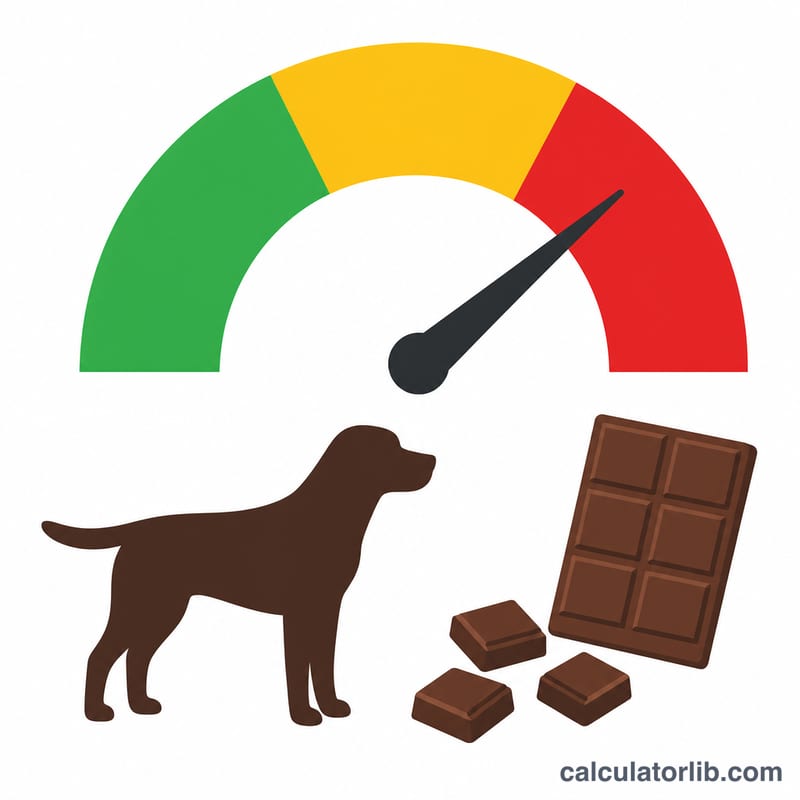
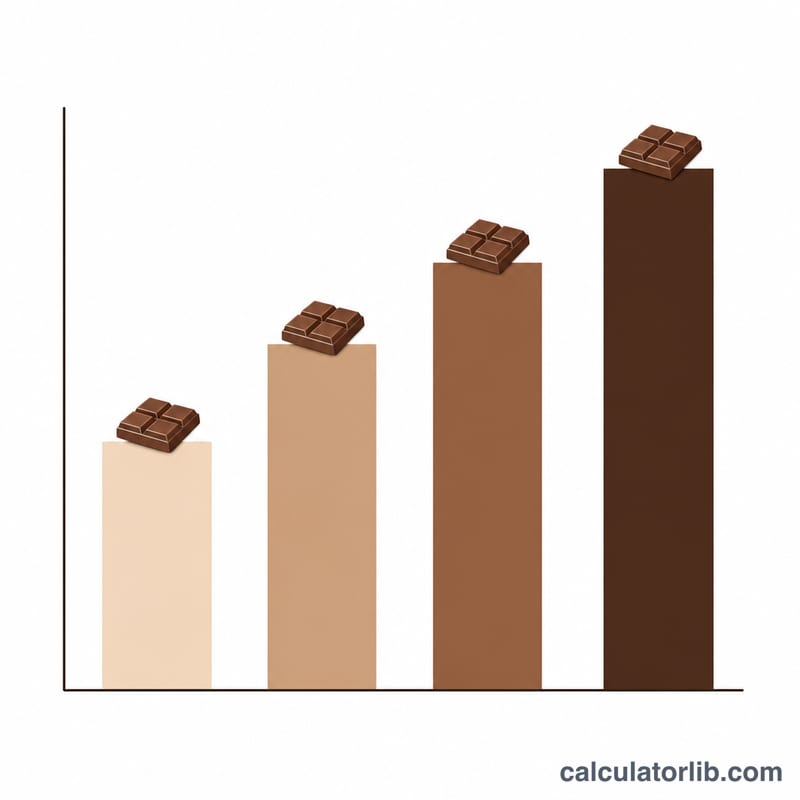
Enter your dog's weight in kilograms, the amount of chocolate eaten in grams, and the type of chocolate. Darker chocolate has far more methylxanthines (theobromine and caffeine): white (~0.04 mg/g), milk (~2.3 mg/g), semi-sweet/dark (~5.5 mg/g), cocoa powder (~28.5 mg/g) and baking/unsweetened (~15.5 mg/g). The tool returns the total methylxanthines, the dose per kilogram, and a risk category.
The formula explained
Total methylxanthines = chocolate grams × methylxanthines per gram:
$$\text{Methylxanthines (mg)} = \text{Chocolate (g)} \times \text{mg/g}$$The toxic dose scales with body weight: roughly \(20\ \text{mg/kg}\) can cause mild signs (vomiting, restlessness), \(40\ \text{mg/kg}\) moderate signs, and \(60\ \text{mg/kg}\) or more severe signs such as seizures and cardiac problems. The calculator places the ingested amount into the matching band.
Worked example
A 10 kg dog eats 50 g of dark chocolate (5.5 mg/g). Methylxanthines:
$$50 \times 5.5 = 275\ \text{mg}$$The mild threshold is \(10 \times 20 = 200\ \text{mg}\) and the moderate threshold is \(400\ \text{mg}\). Since \(275\ \text{mg}\) sits between \(200\) and \(400\ \text{mg}\), the result is "Mild toxicity possible" — a vet call is warranted.
FAQ
Is any amount of chocolate safe? Small amounts of very low-theobromine chocolate may stay below the mild threshold, but no chocolate is truly safe for dogs.
How fast do symptoms appear? Signs typically start within 6–12 hours and can last for days because theobromine clears slowly.
Should I wait to see symptoms? No. If your dog ate chocolate, contact your vet or a pet poison hotline immediately.