What the Dog Pregnancy Calculator Does
This calculator estimates when your dog is likely to give birth (whelp) based on the date she was mated and her breed size. Canine pregnancy is short and fairly predictable, so a single mating date and a breed-size choice are enough to map out the key milestones of her pregnancy — including the expected due date, the earliest day she might safely deliver, and when each trimester ends.
How to Use It
- Mating Date: Enter the day your dog was bred. If she was mated over several days, use the first mating date for a conservative estimate.
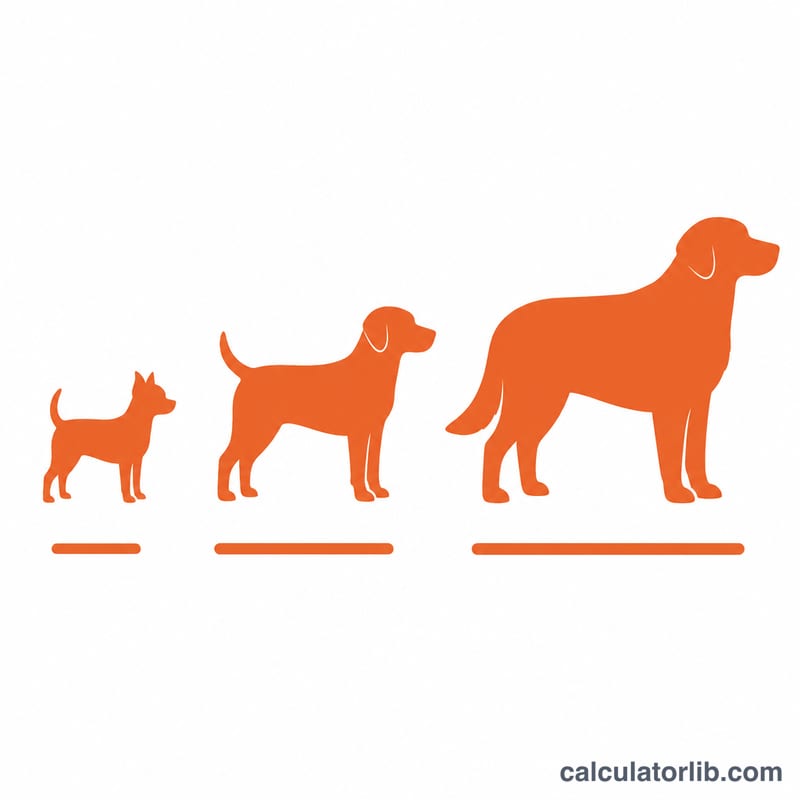
- Dog Breed: Choose Small Breed, Medium Breed, or Large Breed. Breed size adjusts the gestation length used in the calculation.
The tool then returns the expected due date, the earliest likely labor date, the end of the first and second trimesters, and how many days and weeks remain until the due date from today.
The Formula Explained
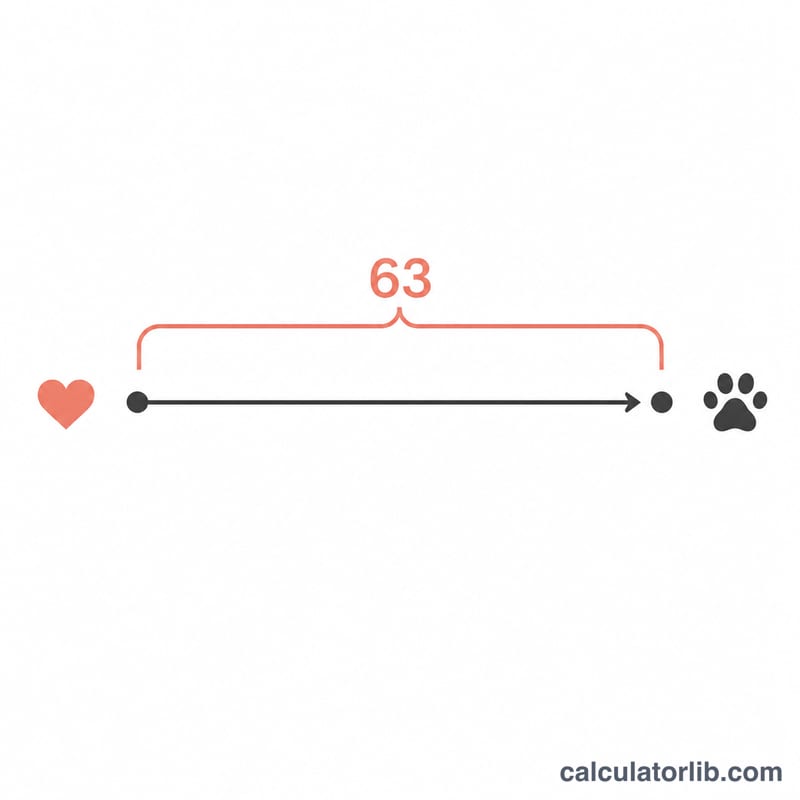
Dog gestation averages about 63 days, but the calculator fine-tunes this by breed size:
- Medium breed: Due date = mating date + 63 days; earliest labor = + 58 days.
- Small breed: Due date = mating date + 60 days; earliest labor = + 55 days.
- Large breed: Due date = mating date + 65 days; earliest labor = + 60 days.
The medium-breed estimate uses the standard formula:
$$\text{Due Date} = \text{Mating Date} + 63 \text{ days}$$Two trimester markers are fixed regardless of breed: the first trimester ends at 21 days and the second trimester ends at 42 days after mating. The countdown (days and weeks until due date) is measured from today's date.
Worked Example
Suppose a medium-breed dog was mated on March 1. The calculator adds 63 days, giving an expected due date of May 3. The earliest likely labor date is 58 days later, on April 28. The first trimester ends on March 22 (\(+21\) days) and the second trimester ends on April 12 (\(+42\) days). If today were April 1, the tool would show roughly 32 days (about 4 weeks) until the due date.
Interpreting Your Whelping Date
The date this tool returns is a statistical estimate, not an appointment. The widely cited figure of 63 days of canine gestation is measured from ovulation — more precisely from the luteinising hormone (LH) surge that precedes it — and not from the day the dogs were mated. Because a bitch may be mated several days before or after she ovulates, and because canine sperm can remain viable in the female reproductive tract for roughly 5–7 days, the interval from a single observed mating to whelping is much more variable than the interval from ovulation to whelping.
In practice, that means whelping commonly occurs anywhere from about day 58 to day 68 after mating, while the ovulation-anchored interval is far tighter (approximately 63 ± 1 day). If your dog whelps five days "early" or four days "late" relative to the calculated due date, that is usually a reflection of when mating happened relative to ovulation rather than a sign of a problem.
The earliest likely labour date shown alongside the due date should be read as the opening of the viable window — the point from which a normal, full-term delivery becomes plausible — and not as a prediction that labour will begin then. Puppies delivered before roughly day 58 from mating are generally regarded as premature and are at meaningfully higher risk, particularly for incomplete lung maturity and difficulty maintaining body temperature.
The trimester markers correspond to real diagnostic milestones rather than arbitrary thirds:
- End of first trimester (~day 21): around this point pregnancy can typically first be confirmed by ultrasound, which can also assess fetal heartbeats and viability. Ultrasound is poor at counting puppies accurately.
- End of second trimester (~day 42): fetal skeletons begin to mineralise and become visible on radiographs (X-ray) from roughly day 42–45 onward, which is why radiography — usually performed in the last week or two — is the more reliable way to estimate litter size.
Note that these day numbers are conventionally quoted from ovulation or from a known breeding date; if your mating date is uncertain, the whole timeline shifts with it, and every marker becomes correspondingly less precise.
This calculator is an informational estimate only. Confirming pregnancy, timing any imaging, monitoring the dam's health and managing whelping itself are matters for a veterinarian who can examine the animal. This article gives general information and is not veterinary advice; it deliberately contains no dosing, treatment or intervention guidance. If you observe signs of distress, a prolonged interval between puppies, unusual discharge, or if the due window passes without labour, contact your veterinarian.
Key Terms Explained
- Whelping
- The act of a dog giving birth. A dog in labour is said to be "whelping", and the newborn puppies are "whelps".
- Gestation period
- The interval from conception to birth. In dogs it averages about 63 days measured from ovulation, but roughly 58–68 days when measured from a single observed mating.
- Mating (breeding) date
- The date the dogs were bred — the single input this calculator asks for. If several matings occurred, using the first one gives the earliest plausible window and using the last gives the latest; many breeders record all of them.
- Conception date
- The date fertilisation actually occurs. It can lag the mating date by several days, because canine sperm can survive in the female reproductive tract for roughly 5–7 days and will wait for ovulation. This lag is the main reason a mating-based due date is only an estimate.
- Estrus (heat)
- The receptive phase of the reproductive cycle during which a bitch will accept a male. It typically lasts around one to two weeks, and ovulation occurs within it — but not at a fixed point, which is why heat dates alone are a weak predictor of due date.
- Ovulation and the LH surge
- Ovulation is the release of eggs from the ovaries; it is triggered by a sharp rise in luteinising hormone, the LH surge. The 63-day average is anchored to this event, not to mating. Veterinary progesterone testing or LH testing during heat is how the anchor is pinned down precisely.
- Trimester
- One of three roughly equal ~21-day thirds of the pregnancy: days 1–21, 22–42 and 43–63. The boundaries are useful because they line up with when ultrasound confirmation and radiographic skeleton visibility become possible.
- Due date vs. earliest likely labour date
- The due date is the single most probable whelping day given the inputs. The earliest likely labour date marks the beginning of the window in which a full-term delivery becomes plausible; it is a boundary, not a forecast, and most dogs will not whelp on it.
- Litter
- All the puppies born from one pregnancy. Litter size varies widely with breed and size and cannot be estimated from dates alone.
- Dam
- The mother dog. The father is the sire.
These definitions are general educational information about canine reproduction and are not a substitute for veterinary advice; decisions about breeding, testing and care for an individual dog should be made with a veterinarian.
Frequently Asked Questions
How accurate is the whelping date? It's an estimate. The mating date isn't always the exact conception date because sperm can survive several days, so actual delivery can vary by a few days around the calculated due date.
Why does breed size change the result? Smaller breeds tend to deliver slightly earlier and larger breeds slightly later, so the calculator shifts the gestation window accordingly.
What does the early labor date mean? It's the earliest day a healthy litter would typically be expected. Delivery before this date may need veterinary attention.
This tool is for guidance only and does not replace professional veterinary care.