What This Calculator Does
This tool estimates the amount of amoxicillin (a common broad-spectrum antibiotic) a dog may need based on its body weight. The US label dose for dogs (Amoxi-Tabs) is 5 mg per pound of body weight (about 11 mg/kg) every 12 hours; rates below it, such as 5 mg/kg, under-dose the antibiotic. This calculator is for educational purposes; dosing decisions should always be made by a licensed veterinarian.
How to Use It
Enter your dog's weight and choose whether it is in kilograms or pounds. The default dose rate is 11 mg/kg (the US label's 5 mg/lb); change it only to the rate your vet prescribed. The calculator returns the dose per administration (every 12 hours), the total daily dose, and the US label dose for your dog's weight.
The Formula Explained
The core calculation is simple: dose = dose rate × weight.
$$\text{Dose (mg)} = \text{Dose Rate (mg/kg)} \times \text{Weight (kg)}$$If weight is entered in pounds, it is first converted to kilograms (\(1\ \text{lb} = 0.45359237\ \text{kg}\)). With amoxicillin given twice daily, the total daily dose is the per-dose amount multiplied by two.
$$D_{daily} = 2 \times R \times W$$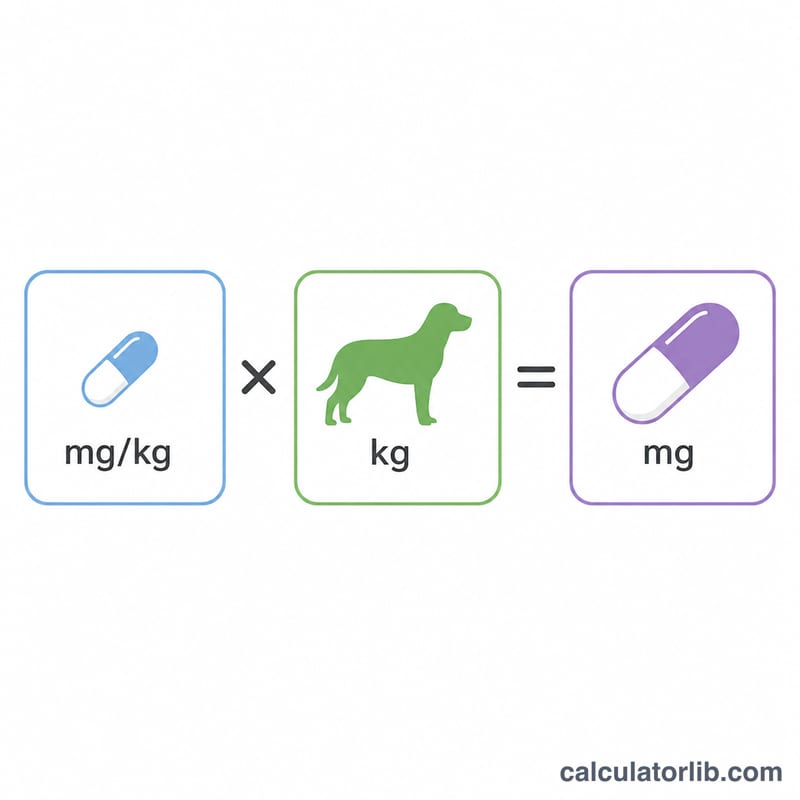
Worked Example
A 10 kg dog at the US label rate (5 mg/lb, about 11 mg/kg): \(11 \times 10 = \textbf{110 mg per dose}\), given every 12 hours, for a total of 220 mg per day.
Amoxicillin Dose by Dog Weight (Reference Chart)
The chart below shows the US label dose for dogs, 5 mg/lb (about 11 mg/kg) every 12 hours (q12h), per dose and per day. Each figure is computed strictly as
$$\text{Dose (mg)} = \text{Rate (mg/kg)} \times \text{Weight (kg)}$$using the exact conversion \(1\ \text{lb} = 0.45359237\ \text{kg}\), then rounded to the nearest milligram. The 24-hour column is simply the label dose given twice.
| Weight (lb) | Weight (kg) | Dose per administration at 5 mg/lb (US label, ≈11 mg/kg) | Total daily dose at 5 mg/lb q12h |
|---|---|---|---|
| 5 | 2.27 | 25 mg | 50 mg |
| 10 | 4.54 | 50 mg | 100 mg |
| 15 | 6.80 | 75 mg | 150 mg |
| 20 | 9.07 | 100 mg | 200 mg |
| 30 | 13.61 | 150 mg | 300 mg |
| 40 | 18.14 | 200 mg | 400 mg |
| 50 | 22.68 | 250 mg | 500 mg |
| 60 | 27.22 | 300 mg | 600 mg |
| 80 | 36.29 | 400 mg | 800 mg |
| 100 | 45.36 | 500 mg | 1000 mg |
For a weight not listed, interpolation is not needed — multiply directly. A 32 kg dog at 11 mg/kg is \(11 \times 32 = 352\) mg per administration, or 704 mg per day on a q12h schedule.
Note: this chart covers only plain amoxicillin given every 12 hours (q12h). An actual prescription may differ — higher rates, different intervals, or a different drug entirely — depending on the infection type and site, the organism and its susceptibility, the formulation dispensed, and the dog's renal and hepatic status. Products and labelled dose ranges also vary between countries. Use the chart for orientation, not as a prescription.
Common Veterinary Amoxicillin Strengths
A calculated dose in milligrams only becomes usable once it is matched to a product strength you actually have. The table lists amoxicillin presentations commonly used in dogs and shows how each one would deliver a 150 mg dose — the US label dose for a 30 lb dog at 5 mg/lb (150 mg per administration).
| Formulation | Strength (mg per unit) | Delivering a 150 mg dose |
|---|---|---|
| Oral drops / suspension (veterinary) | 50 mg per mL | 3.0 mL |
| Oral suspension (human-style, 250 mg/5 mL) | 250 mg per 5 mL = 50 mg per mL | 3.0 mL |
| Oral suspension (human-style, 125 mg/5 mL) | 125 mg per 5 mL = 25 mg per mL | 6.0 mL |
| Tablet (chewable or film-coated) | 50 mg | 3 tablets |
| Tablet | 100 mg | 1½ tablets |
| Tablet | 150 mg | 1 tablet — exact match |
| Tablet | 200 mg | ¾ tablet (often impractical; usually rounded to 1 tablet = 200 mg) |
| Tablet | 400 mg | Too strong for this dose — use a lower strength |
| Capsule | 250 mg | Too strong for this dose — capsules are not split |
| Capsule | 500 mg | Too strong — suited to large dogs (e.g. a 100 lb dog at 5 mg/lb) |
To convert any dose to a liquid volume:
$$\text{Volume (mL)} = \frac{ {\text{Dose (mg)}}}{\text{Concentration (mg/mL)}}$$So a 68 mg dose from a 50 mg/mL suspension is \(68 \div 50 = 1.36\) mL, which a veterinarian would typically round to 1.4 mL with an appropriately graduated syringe.
- Strengths vary by country and manufacturer. The tablet and capsule strengths above are those widely encountered, but which ones are licensed for dogs — and whether a human-labelled product may legally be used — differs between the United States, the United Kingdom, the EU and elsewhere. Always read the label on the product actually dispensed.
- Amoxicillin–clavulanate is not the same drug. Combination products (sold as Clavamox in the US and Synulox in the UK and much of Europe, among other names) are dosed on the combined amoxicillin + clavulanic acid content and follow their own labelled rates. Do not apply a plain-amoxicillin calculation to them.
- Splitting, crushing and compounding only on veterinary instruction. Capsules and film-coated tablets are generally not meant to be divided, unscored tablets split inaccurately, and compounded suspensions have short shelf lives and specific storage requirements. Reconstituted suspensions usually need refrigeration and are discarded after the period stated on the label.
Interpreting Your Result
The number this calculator returns is a per-administration amount, not a daily total. On the standard twice-daily (q12h) schedule, the 24-hour total is simply double it:
$$\text{Daily total (mg)} = 2 \times \text{Dose per administration (mg)}$$For example, a 20 kg dog at 11 mg/kg needs 220 mg per administration, giving \(2 \times 220 = 440\) mg over 24 hours.
- 5 mg/kg is below the label dose. The US label dose for dogs is 5 mg/lb (about 11 mg/kg) twice a day, so 5 mg/kg is less than half of it and can leave the infection under-treated and encourage resistance. Do not lower the dose yourself; use the rate your veterinarian prescribed.
- Some infections are treated at higher rates or shorter intervals. Site matters: urinary tract infections benefit from the high urinary concentrations amoxicillin reaches, while skin, soft tissue, respiratory and dental infections may be approached differently. Rates above 11 mg/kg and q8h dosing are used in some protocols. That decision belongs to the attending veterinarian, who also weighs culture and susceptibility results.
- Calculated doses are rounded to something you can actually give. A computation of 181 mg is not dispensed as 181 mg — it becomes a practical tablet count or a measurable volume (e.g. 200 mg as one 200 mg tablet, or 3.6 mL of a 50 mg/mL suspension). Small upward or downward rounding is normal and expected for this drug.
- Course length is set by your veterinarian. The US label course is 5–7 days, or until 48 hours after all signs have stopped; if there is no improvement in 5 days, the vet reviews the diagnosis. The full course is completed as prescribed even after the dog appears well; stopping early encourages relapse and antimicrobial resistance.
- Several groups need different handling. Puppies and very small dogs, pregnant or lactating dogs, and dogs with reduced kidney function may need an adjusted dose or interval, since amoxicillin is cleared largely by the kidneys. Weight-based arithmetic alone does not account for this.
- Penicillin-class allergy is a contraindication. Amoxicillin is a penicillin. A dog with a known hypersensitivity to penicillins or to other beta-lactams (including cephalosporins, where cross-reactivity is possible) should not receive it. Vomiting, diarrhoea, facial swelling, hives or difficulty breathing after a dose warrant stopping the drug and contacting a veterinarian promptly.
- Weigh the dog, don't estimate. Every figure here scales linearly with body weight, so a guessed weight carries straight through into the dose. Use a current scale weight, and for overweight dogs ask whether dosing should be based on actual or lean body weight.
This is general educational information, not veterinary or medical advice. It is not a prescription and it gives no individual recommendation for any specific animal. Amoxicillin is a prescription medicine in most countries, and human medications, leftover prescriptions and doses intended for another animal must not be given to a dog on the basis of a calculation. Any dose, rate, interval and course length must be confirmed by a licensed veterinarian who has examined your dog.
FAQ
How often is amoxicillin given to dogs? Usually every 12 hours (twice daily), often for 5–7 days or as directed by your vet.
Can I use human amoxicillin for my dog? Only under veterinary direction. Human formulations may contain additives unsuitable for pets, and exact strengths differ.
What if I miss a dose? Give it as soon as you remember unless it is nearly time for the next dose. Never double up. Ask your vet for guidance.