What is the Dog Crate Size Calculator?
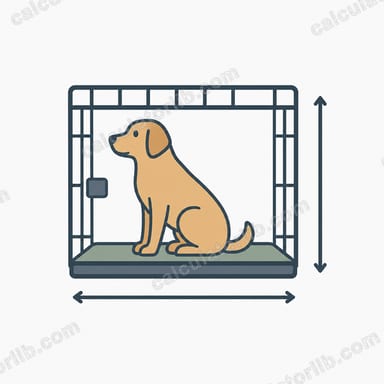
Choosing the right crate keeps your dog comfortable, safe, and relaxed. A crate should be large enough for your dog to stand up, turn around, and lie down fully stretched out — but not so large that it loses the cozy, den-like feeling that makes crate training effective. This calculator turns two simple body measurements into the recommended minimum crate dimensions.
How to use it
Take two measurements with a soft tape while your dog stands naturally. First, measure the length from the tip of the nose to the base of the tail (not the tip of the tail). Second, measure the standing height from the floor to the top of the head — or to the tips of the ears for breeds that hold them upright. Enter both values in inches and the calculator returns the smallest crate that should fit comfortably.

The formula explained
The widely used rule of thumb is to add roughly 4 inches to each body measurement so your dog has room to move without wasted space:
$$\text{Crate Length} = \text{Nose-to-Tail} + 4$$
$$\text{Crate Height} = \text{Standing Height} + 4$$
The extra inches give clearance to turn around and sit up without the head or back touching the top. For tall, ear-up breeds you may prefer measuring to the ear tips so the dog can sit fully upright.

Worked example
Suppose your dog measures 24 inches from nose to tail base and stands 20 inches tall. The recommended crate length is \(24 + 4 = 28\) inches, and the recommended height is \(20 + 4 = 24\) inches. You would look for a crate that is at least 28 inches long and 24 inches tall (most crate sizes are sold in standard increments, so round up to the next available size).
Standard Dog Crate Sizes by Breed Weight
Wire and plastic crates are sold in fairly consistent length classes, especially in the US market where sizes are quoted in inches. The table shows typical interior dimensions and weight ranges. These are general manufacturer guidelines, and exact sizes vary by brand. Your dog's measurements should take priority over weight or breed, because dogs of the same weight can differ a lot in body proportions.
| Crate length | Typical interior L × W × H (in) | Approx. dog weight | Example breeds |
|---|---|---|---|
| 18 in | 18 × 12 × 14 | Up to 10 lb | Chihuahua, Yorkshire Terrier, Pomeranian |
| 24 in | 24 × 18 × 19 | 11–25 lb | Miniature Dachshund, Pug, Boston Terrier |
| 30 in | 30 × 19 × 21 | 26–40 lb | Beagle, Cocker Spaniel, Staffordshire Bull Terrier |
| 36 in | 36 × 23 × 25 | 41–70 lb | Boxer, Border Collie, smaller Labrador Retrievers |
| 42 in | 42 × 28 × 30 | 71–90 lb | Labrador Retriever, Golden Retriever, German Shepherd |
| 48 in | 48 × 30 × 32 | 90+ lb | Rottweiler, Saint Bernard, Mastiff |
The calculator adds 4 in to your dog's length (nose to base of tail) and to standing height (floor to top of head, or to the ear tips if the ears stand upright), so the dog can stand, turn around and lie down comfortably. Giant breeds may need an extra-large or giant crate, which is larger than the standard classes above.
Crate Size Examples by Dog Type
The calculator uses \(\text{Crate Length} = \text{Dog Length} + 4\) and \(\text{Crate Height} = \text{Dog Height} + 4\). For a Labrador of 34 in length: \(34 + 4 = 38\) in, which rounds up to the 42 in class. The dog measurements below are rough, illustrative averages; measure your own dog.
| Dog | Length / height (in) | Minimum crate length | Minimum crate height | Nearest standard size (round up) |
|---|---|---|---|---|
| Chihuahua | 14 / 10 | 18 in | 14 in | 18 in crate |
| Beagle | 24 / 15 | 28 in | 19 in | 30 in crate |
| Labrador Retriever | 34 / 24 | 38 in | 28 in | 42 in crate |
| Great Dane | 44 / 32 | 48 in | 36 in | Giant/XXL crate (a standard 48 in crate is often only about 32 in tall) |
Always check both numbers. A crate may be long enough but too low for a tall or upright-eared dog, and the Great Dane example shows that height can decide the size class.
Practical Tips for Choosing and Fitting a Crate
- Round up to the next standard size. If the calculated length or height falls between sizes, choose the larger one.
- Check interior, not exterior, dimensions. Trays, latches and frames reduce usable space, so compare the manufacturer's interior measurements.
- Use a divider panel for puppies. Buy a crate sized for the expected adult dog and partition it, so the puppy has room to stand and turn but not a separate corner to soil.
- Consider width and door placement. Broad-chested breeds may need a wider crate, and a side door or a front-and-side door layout can suit your space better.
- Account for bedding. A thick mat or orthopedic bed lowers the effective height, so add a little extra if you plan to use one.
- Use a sturdier or travel-rated crate for car trips. Look for crash-tested or reinforced designs rather than a light wire folding crate, and check the maker's size guidance.
- Re-measure when in doubt. Re-measure if your dog is between sizes, still growing or has upright ears, which add height when measured to the ear tips.
This is general information, not professional veterinary or training advice. Ask a vet or trainer about crate use for dogs with health or anxiety concerns.
FAQ
Should I size up for a puppy? Buy for the adult size and use a divider panel to shrink the usable space while your puppy grows. This avoids buying multiple crates and discourages soiling at one end.
Is a bigger crate always better? No. Too much space can encourage a dog to use one corner as a bathroom and reduces the secure den feeling that helps with training and anxiety.
What if my dog is between sizes? Always round up to the next standard crate size so your dog can comfortably stand and turn.