What this calculator does
The Epoxy Mix Ratio Calculator splits a desired total batch of epoxy into the correct amount of resin (Part A) and hardener (Part B) based on the manufacturer's mix ratio. Whether your product calls for 2:1, 1:1, 3:1, 5:1 or any custom ratio, this tool gives you exact quantities so the epoxy cures properly. It works for any unit — milliliters, ounces, grams or liters — and applies equally whether the ratio is specified by volume or by weight.
How to use it
Enter the total amount of mixed epoxy you need. Type the resin parts (R) and hardener parts (H) from your product label, then choose your unit. The calculator returns how much resin and hardener to combine to reach that total, plus the simplified R:1 ratio.
The formula explained
The ratio R:H means each batch is divided into \(R + H\) equal parts. The resin fraction is \(\frac{R}{R+H}\) and the hardener fraction is \(\frac{H}{R+H}\). Multiply each fraction by the total batch size to get the actual quantity. Because both fractions add to 1, the resin and hardener always sum back to your total.
$$\text{Resin} = \text{Total} \times \frac{R}{R+H}, \quad \text{Hardener} = \text{Total} \times \frac{H}{R+H}$$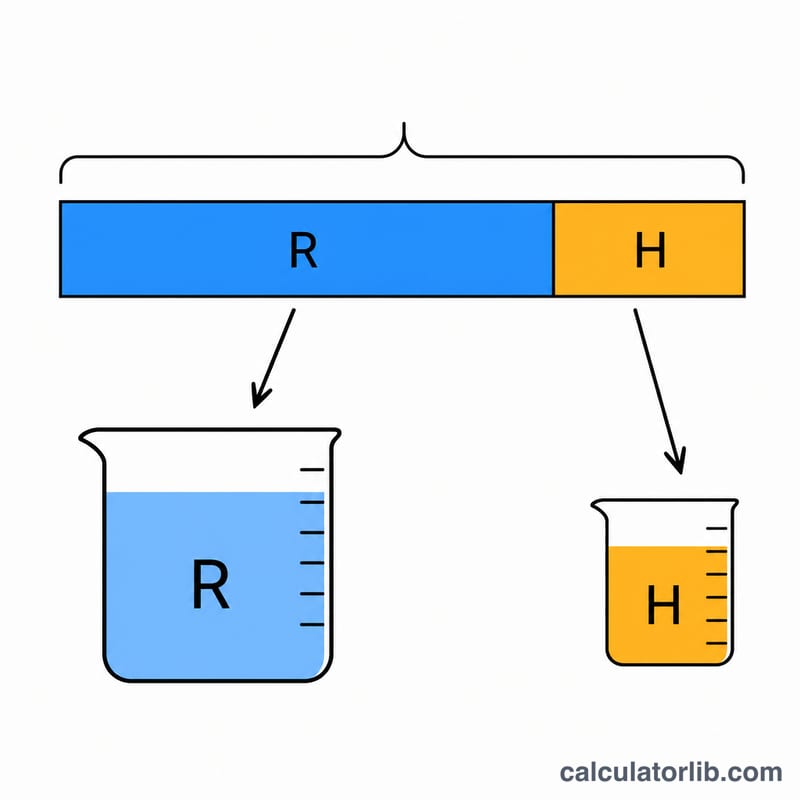
Worked example
You need 150 ml of epoxy at a 2:1 ratio. Total parts = 2 + 1 = 3.
$$\text{Resin} = 150 \times \frac{2}{3} = 100 \text{ ml}$$$$\text{Hardener} = 150 \times \frac{1}{3} = 50 \text{ ml}$$Mix 100 ml resin with 50 ml hardener for exactly 150 ml.
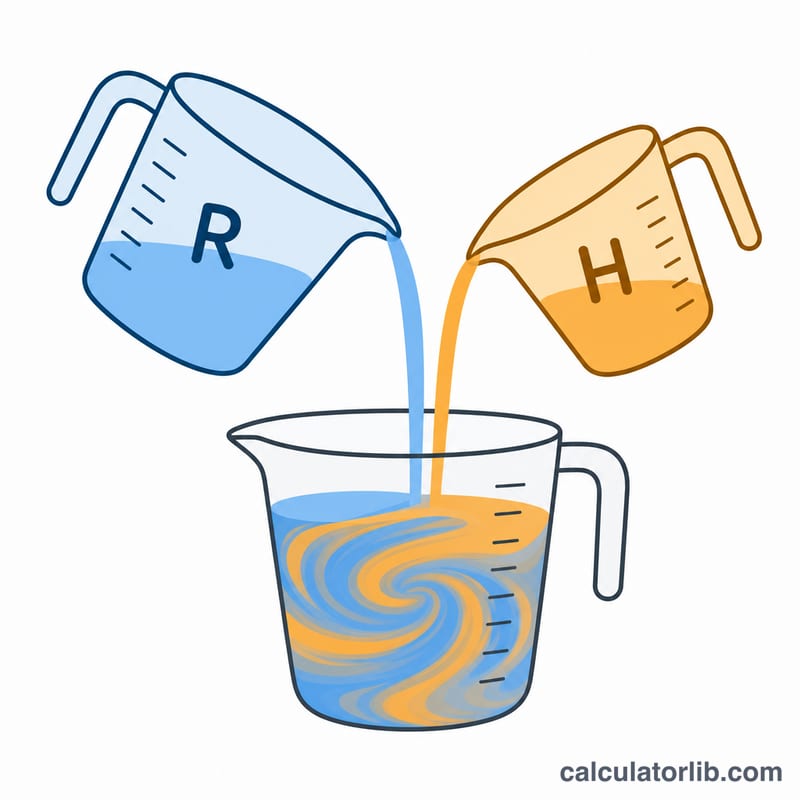
Common Epoxy Mix Ratios Compared
The table shows how a fixed 300 ml batch splits at common resin:hardener ratios. The fractions come from \(\text{Resin} = \text{Total} \cdot \frac{R}{R+H}\) and \(\text{Hardener} = \text{Total} \cdot \frac{H}{R+H}\). For example, at 2:1 the resin is \(300 \cdot \frac{2}{3} = 200\) ml and the hardener is \(300 \cdot \frac{1}{3} = 100\) ml.
| Ratio (R:H) | Resin % | Hardener % | Resin (ml) | Hardener (ml) | Typical product type |
|---|---|---|---|---|---|
| 1:1 | 50% | 50% | 150 | 150 | Casting and art resin, general-purpose adhesives |
| 2:1 | 66.7% | 33.3% | 200 | 100 | Tabletop and coating epoxies |
| 3:1 | 75% | 25% | 225 | 75 | Specialty and laminating systems |
| 4:1 | 80% | 20% | 240 | 60 | Specialty and laminating systems |
| 5:1 | 83.3% | 16.7% | 250 | 50 | Fast-cure adhesives |
These product types are general examples only. Ratios vary between brands, so the ratio printed on the product label or technical data sheet always takes precedence. Also check whether the ratio is by volume or by weight.
Volume and Weight Conversion for Epoxy
| Unit | Equivalent |
|---|---|
| 1 US fluid ounce | 29.57 ml |
| 1 US pint | 473 ml |
| 1 US quart | 946 ml |
| 1 US gallon | 3.785 L (3,785 ml) |
| 1 litre | 1,000 ml |
The US units above are US customary units; imperial (UK) pints, quarts and gallons are larger.
Volume is not weight. Epoxy resin typically has a density of about 1.1–1.2 g/ml and hardener about 0.95–1.0 g/ml. Because the two densities differ, a ratio by volume is not the same as a ratio by weight. As an illustration only, a 2:1 mix by volume with a resin of 1.1 g/ml and a hardener of 1.0 g/ml weighs in at roughly \(2 \cdot 1.1 : 1 \cdot 1.0 = 2.2 : 1\).
Only convert between volume and weight using the manufacturer's stated densities or stated weight ratio. Do not rely on the typical ranges above for a real mix.
Practical Mixing Tips
- Mix about 10% extra to allow for residue left on cups and sticks. For example, if you need 300 ml, prepare about 330 ml in the same ratio.
- Measure accurately. Use graduated mixing cups, or a scale accurate to 0.1 g when mixing by weight.
- Mix for the time the manufacturer states, typically 2–5 minutes. Scrape the sides and bottom of the container so no unmixed material remains.
- Use small batches. Large masses of mixed epoxy build up heat, which shortens the working time.
- Control the temperature. Work at the recommended temperature, typically 20–25°C (68–77°F). Cold slows the cure and heat speeds it up.
- Follow the technical data sheet. It gives the correct ratio, pot life, cure time and safety guidance for your specific product.
Wear gloves and eye protection, and work in a ventilated area. This is general information, not a substitute for the manufacturer's instructions.
FAQ
Is the ratio by volume or weight? Both work with this calculator, but volume and weight ratios are usually different — always read your label and don't swap one for the other.
What if I measure too much? Off-ratio epoxy may stay tacky or never fully cure. Measure carefully, ideally with graduated cups or a scale.
Can I scale a small test batch? Yes. Just enter a small total (e.g. 30 ml) and the same ratio to get a proportional mini-mix.