
What is the Concrete Mix Ratio Calculator?
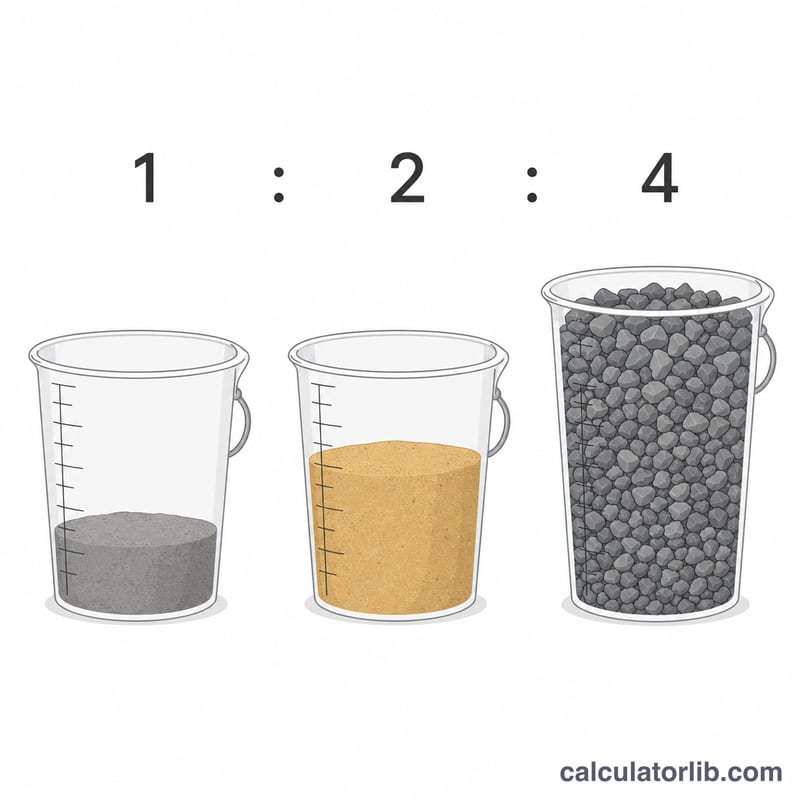
This calculator estimates how much cement, sand and gravel you need to produce a given volume of concrete using a chosen volumetric mix ratio such as 1:2:4 (cement:sand:gravel). It converts the finished (wet) volume into the larger dry material volume and splits that dry volume among the three ingredients according to their ratio parts. It works with any unit system as long as you enter volume in cubic metres.
How to use it
Enter the wet concrete volume you want to place in cubic metres. Then enter the ratio parts for cement, sand and gravel — a common general-purpose mix is 1:2:4, while structural concrete often uses 1:1.5:3. Finally set the cement bag weight (typically 50 kg, or 94 lb ≈ 42.6 kg in the US). The tool returns the dry volume, the volume of each material, the total cement mass, and the number of bags.
The formula explained
Fresh concrete contains water and air voids, so a batch of dry materials shrinks when mixed and compacted. The industry rule of thumb multiplies the wet volume by 1.54 to obtain the required dry volume. Each ingredient then gets a fraction equal to its ratio part divided by the sum of all parts:
$$V_i = V_{dry} \times \frac{r_i}{\Sigma r}$$Cement mass uses a bulk density of about 1440 kg/m³, and bags are mass divided by bag weight.
$$\begin{gathered} \text{Bags} = \frac{V_{dry}\cdot\dfrac{\text{Cement}}{S}\times 1440}{\text{Bag Weight (kg)}} \\[1.5em] \text{where}\quad \left\{ \begin{aligned} V_{dry} &= \text{Volume (m}^3\text{)} \times 1.54 \\ S &= \text{Cement} + \text{Sand} + \text{Gravel} \end{aligned} \right. \end{gathered}$$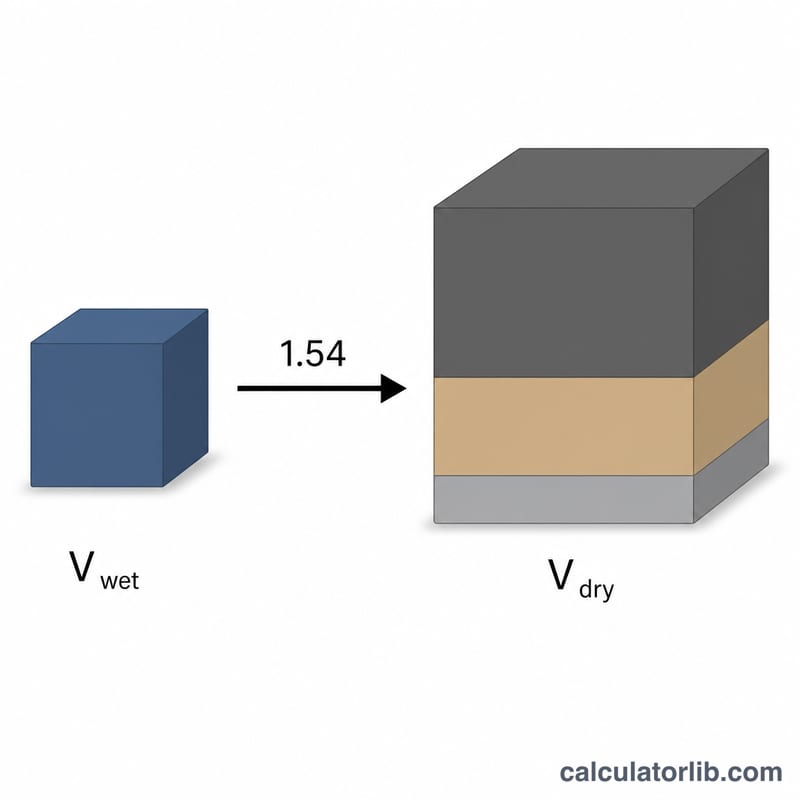
Worked example
For 1 m³ of concrete at a 1:2:4 ratio: dry volume =
$$1 \times 1.54 = 1.54 \text{ m}^3$$The ratio sum is 7.
$$\text{Cement volume} = 1.54 \times \frac{1}{7} = 0.22 \text{ m}^3$$$$\text{sand} = 1.54 \times \frac{2}{7} = 0.44 \text{ m}^3$$$$\text{gravel} = 1.54 \times \frac{4}{7} = 0.88 \text{ m}^3$$Cement mass =
$$0.22 \times 1440 \approx 316.8 \text{ kg}$$which is
$$316.8 / 50 \approx 6.34 \text{ bags}$$FAQ
Why 1.54? It accounts for the bulking and voids between dry aggregate particles that disappear once mixed with water and compacted. Some engineers use 1.50–1.57.
Does this include water? No. Water is added by water-cement ratio (often 0.4–0.6 of cement weight) and is not part of the dry volume split.
Can I use 1:1.5:3? Yes — enter those parts directly; the calculator handles any positive ratio values.