
What This Calculator Does
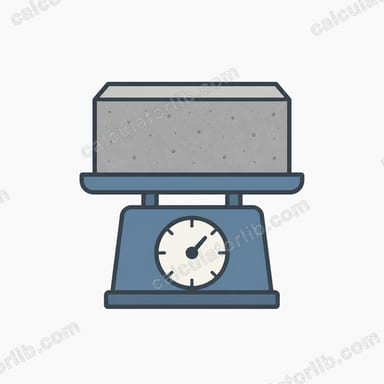
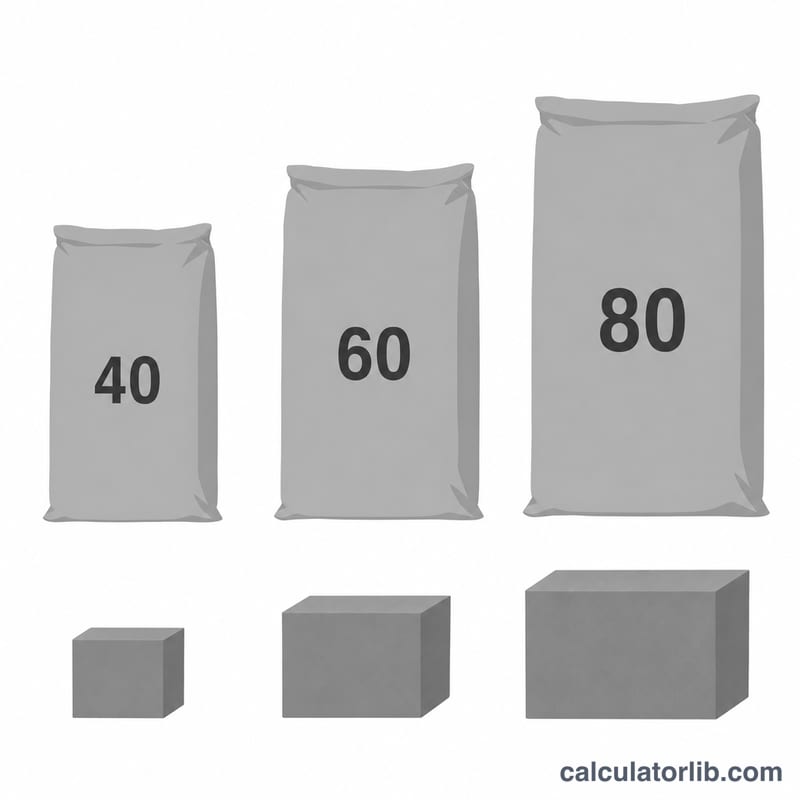
The Bags of Concrete Calculator tells you how many pre-mixed bags of concrete you need to pour a slab, pad, footing, or post fill. Instead of buying loose materials and mixing your own ratio, bagged concrete (like Quikrete or Sakrete) is sold in standard 40, 60, and 80 pound sizes. This tool converts your project dimensions into a bag count so you don't over- or under-buy.
How To Use It
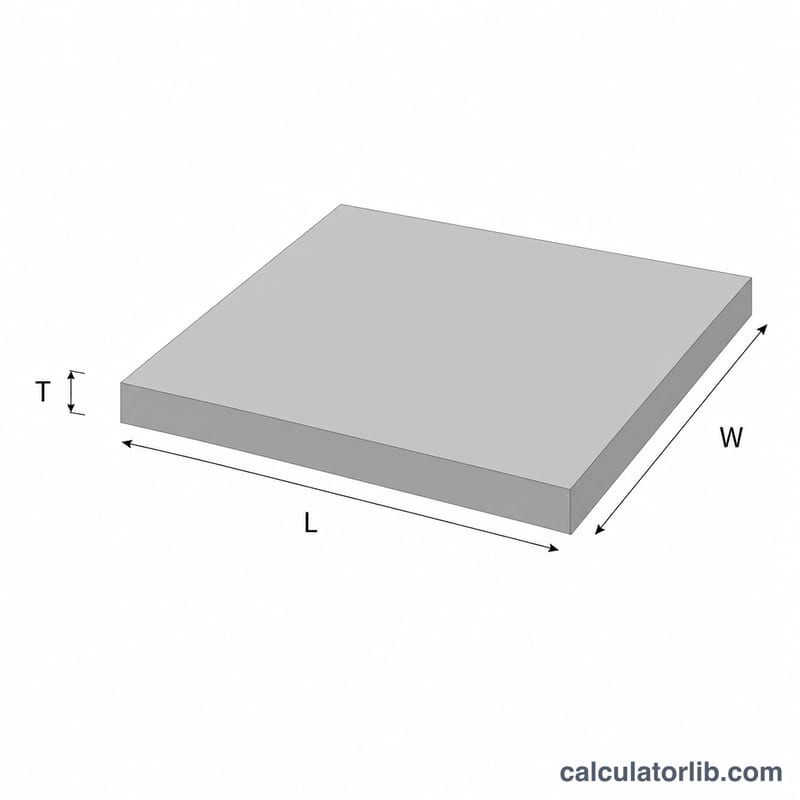
Enter the length and width of your pour in feet, and the thickness in inches. Pick your bag size. The calculator computes the volume in cubic feet, divides by the bag's yield, and rounds up to the next whole bag — because you can't buy a fraction of a bag.
The Formula Explained
First the volume is found: $$V = L \times W \times \frac{T}{12}$$ dividing thickness by 12 to convert inches to feet. Each bag yields a known volume of cured concrete: an 80 lb bag makes about \(0.60\ \text{ft}^3\), a 60 lb bag about \(0.45\ \text{ft}^3\), and a 40 lb bag about \(0.30\ \text{ft}^3\). The bag count is $$\text{Bags} = \left\lceil \frac{V}{\text{yield}} \right\rceil$$
Worked Example
For a 10 ft × 10 ft slab that is 4 inches thick using 80 lb bags: $$\text{volume} = 10 \times 10 \times \frac{4}{12} = 33.33\ \text{ft}^3$$ Dividing by 0.60 gives \(\frac{33.33}{0.60} = 55.56\), which rounds up to 56 bags. Always add a few extra bags for spillage and uneven subgrade.
FAQ
How much does an 80 lb bag cover? About 0.60 cubic feet of set concrete, roughly 1.8 ft² at 4 inches thick.
Should I round up? Yes — this tool always rounds up to a whole bag. Buying one or two extra is wise.
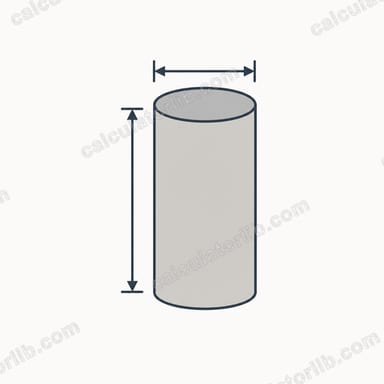
Does this work for any project? Use it for rectangular slabs, walkways, and pads. For cylindrical post holes, compute the volume separately and divide by the yield.