
What Is the Stud Count Calculator?
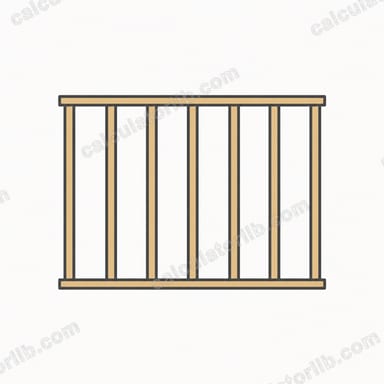
The Stud Count Calculator estimates how many vertical wall studs you need to frame a wall, based on its length and the on-center (OC) spacing of the studs. It is a quick material-takeoff tool for carpenters, DIY builders, and anyone planning a framing project. Standard framing uses either 16-inch or 24-inch on-center spacing, both of which are supported here.
How to Use It
Enter the total wall length in feet, choose the on-center spacing (16 in for most load-bearing walls, 24 in for some non-load-bearing or advanced framing), and add any extra studs needed for corners, T-intersections, or door/window framing. The calculator returns the total number of studs along with a breakdown of stud bays and base studs.
The Formula Explained
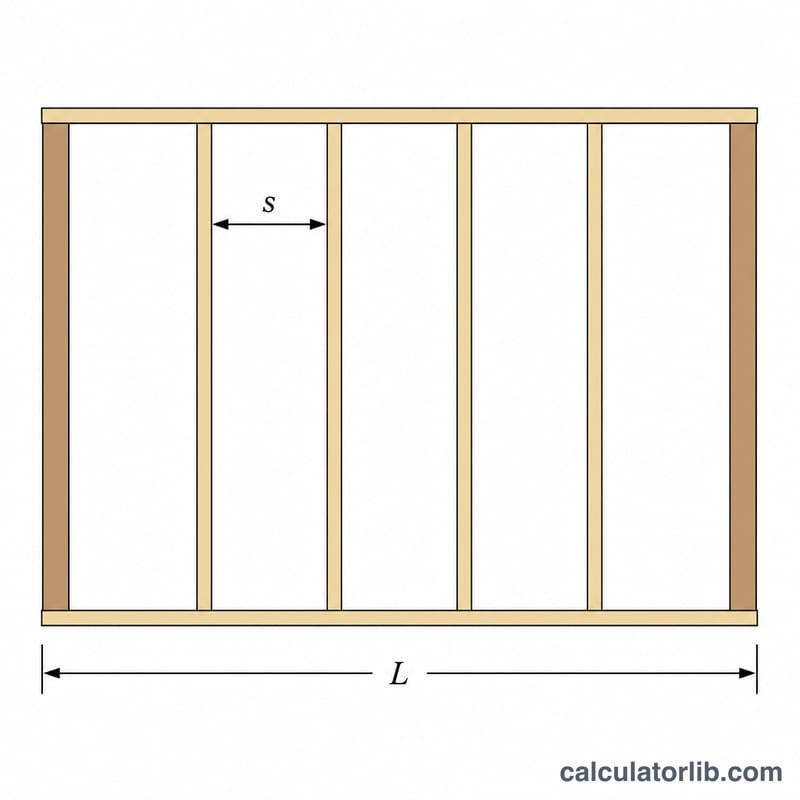
The core formula is $$\text{studs} = \left\lceil \frac{L \times 12}{s} \right\rceil + 1 + c$$ where \(L\) is wall length in feet, \(s\) is spacing in inches, and \(c\) is extra corner studs. Multiplying length by 12 converts feet to inches. Dividing by spacing gives the number of stud bays, and we round up so the last stud is never short. Adding 1 accounts for the closing stud at the far end of the wall — a run of \(N\) bays needs \(N+1\) studs.
Worked Example
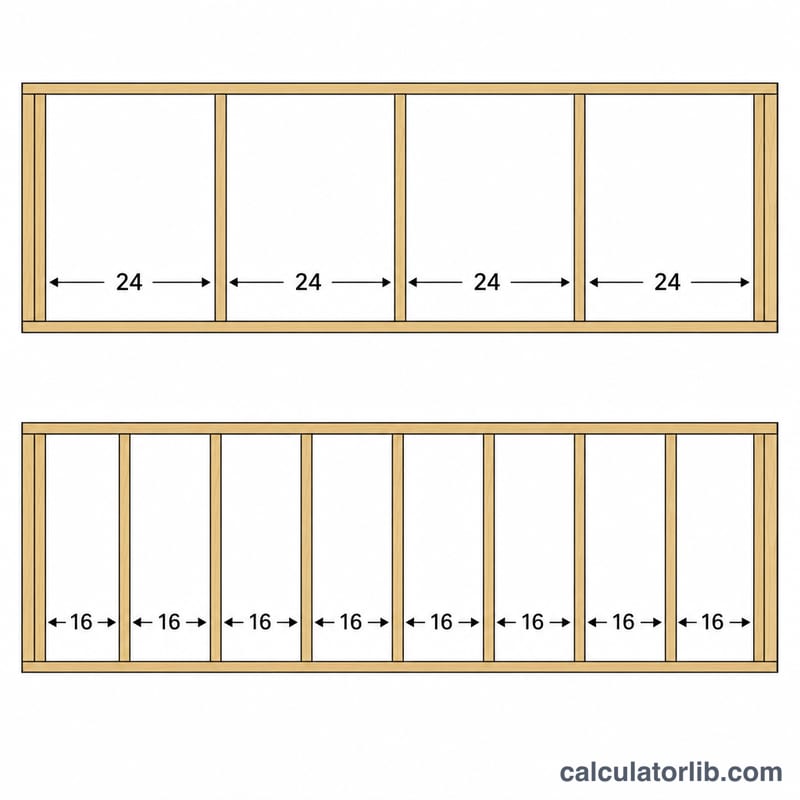
For a 20-foot wall at 16-inch OC spacing: \(20 \times 12 = 240\) inches. \(240 \div 16 = 15\) bays exactly, so \(\lceil 15 \rceil = 15\). Add 1 closing stud = 16 base studs. With 0 extra corner studs, the total is 16 studs. Bump spacing to 24 in and you get \(240 \div 24 = 10\), \(+1 = 11\) studs.
FAQ
Does this include plates or headers? No — it counts only vertical studs. Add lumber separately for top/bottom plates, headers, and blocking.
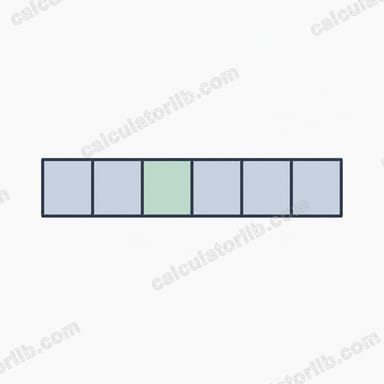
Why add 1? A wall divided into \(N\) equal bays needs \(N+1\) studs because each bay has a stud on both ends, and they share interior studs.
What about waste? This is a clean count. Order roughly 10% extra to cover cuts, crooked boards, and mistakes.