
What the Pallet Calculator Does
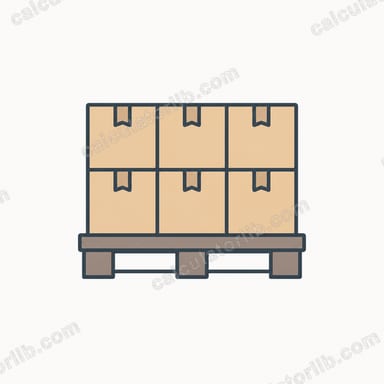
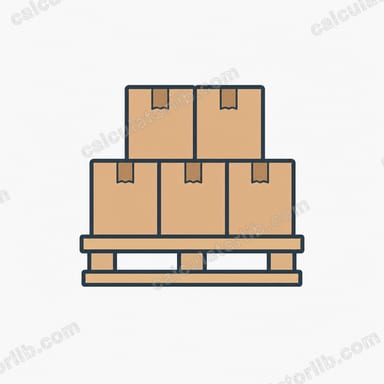
This pallet calculator estimates how many boxes or cases fit onto a single pallet. Enter the pallet footprint, your box dimensions, the maximum allowed stack height and the pallet base height, and it returns the boxes per layer, the number of layers and the total box count, plus how efficiently the deck is used. It is a units-agnostic tool — the example defaults are in inches (a 48 x 40 in GMA pallet), but any consistent unit works.
How to Use It
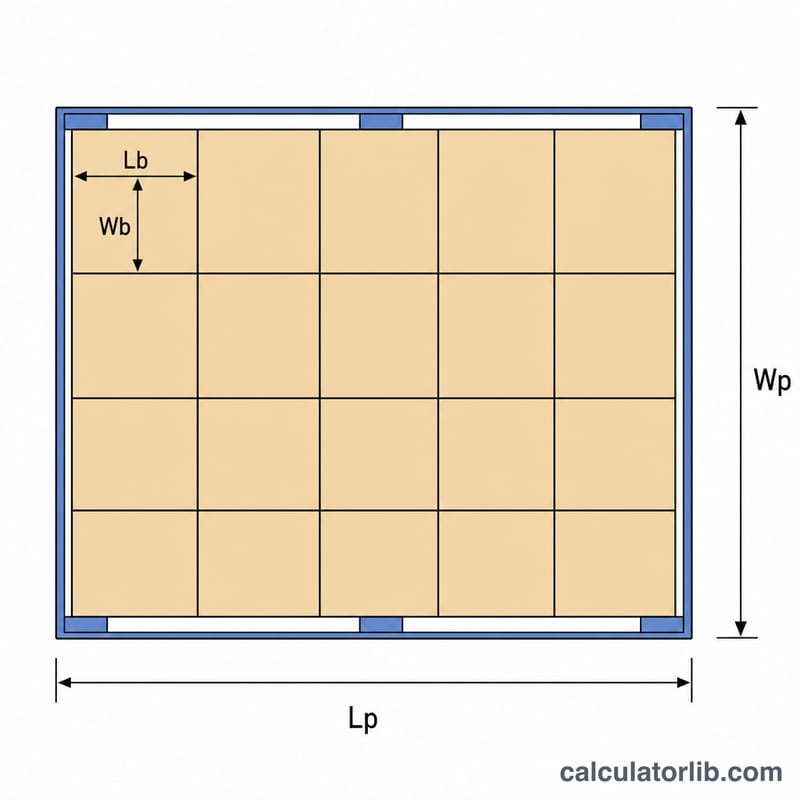
1. Enter the pallet deck length and width. 2. Enter the box length, width and height. 3. Set the maximum stack height your warehouse, truck or racking allows. 4. Enter the pallet base (deck board) height that is subtracted from the usable stacking space. The calculator tries the boxes in two flat orientations and keeps whichever packs more per layer.
The Formula
With \(L_p, W_p\) the pallet deck length and width, \(L_b, W_b, H_b\) the box dimensions, \(H_{max}\) the max stack height and \(H_{base}\) the pallet height, boxes per layer is:
$$P = \max\!\left(\left\lfloor\tfrac{L_p}{L_b}\right\rfloor\!\left\lfloor\tfrac{W_p}{W_b}\right\rfloor,\ \left\lfloor\tfrac{L_p}{W_b}\right\rfloor\!\left\lfloor\tfrac{W_p}{L_b}\right\rfloor\right)$$The number of layers and the total are:
$$N = P \times \left\lfloor\frac{H_{max}-H_{base}}{H_b}\right\rfloor$$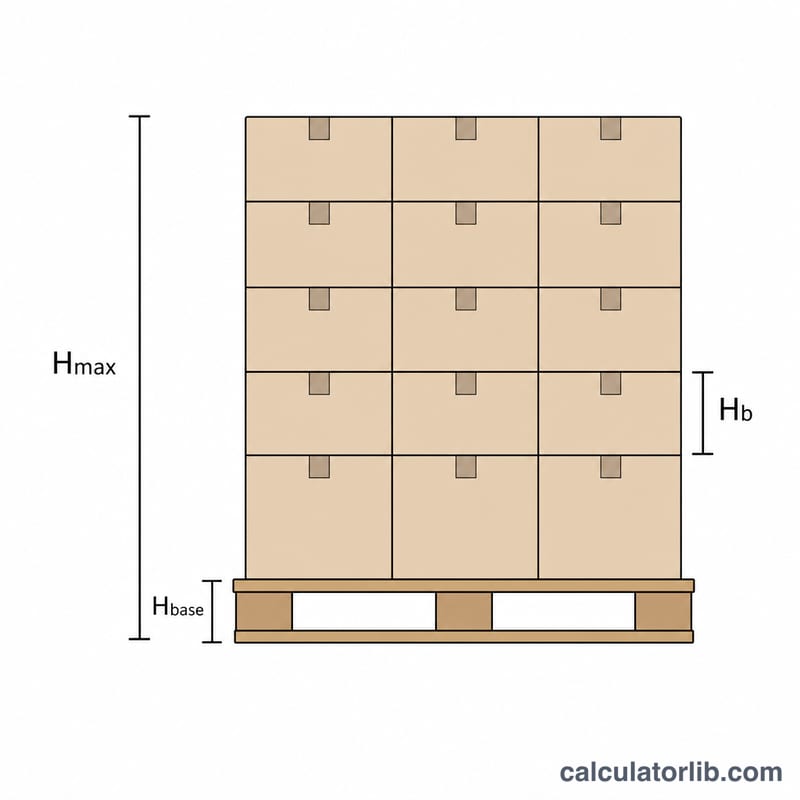
Worked Example
Pallet 48 x 40 in, box 12 x 10 x 8 in, max stack 60 in, base 6 in. Straight: \(\lfloor 48/12\rfloor \times \lfloor 40/10\rfloor = 4 \times 4 = 16\). Rotated: \(\lfloor 48/10\rfloor \times \lfloor 40/12\rfloor = 4 \times 3 = 12\). So \(P = 16\). Layers: \(\lfloor (60-6)/8\rfloor = \lfloor 6.75\rfloor = 6\). Total:
$$N = 16 \times 6 = 96 \text{ boxes}$$FAQ
Does it account for overhang or interlocking? No — it assumes a simple block-stack with no overhang. Treat the result as a clean maximum.
What units should I use? Any single consistent unit for all dimensions; inches and centimeters both work.
Why subtract the pallet base height? Total shipment height usually includes the pallet itself, so the usable cargo height is the max height minus the pallet deck height.