
What Is the Pallet Configurator Calculator?
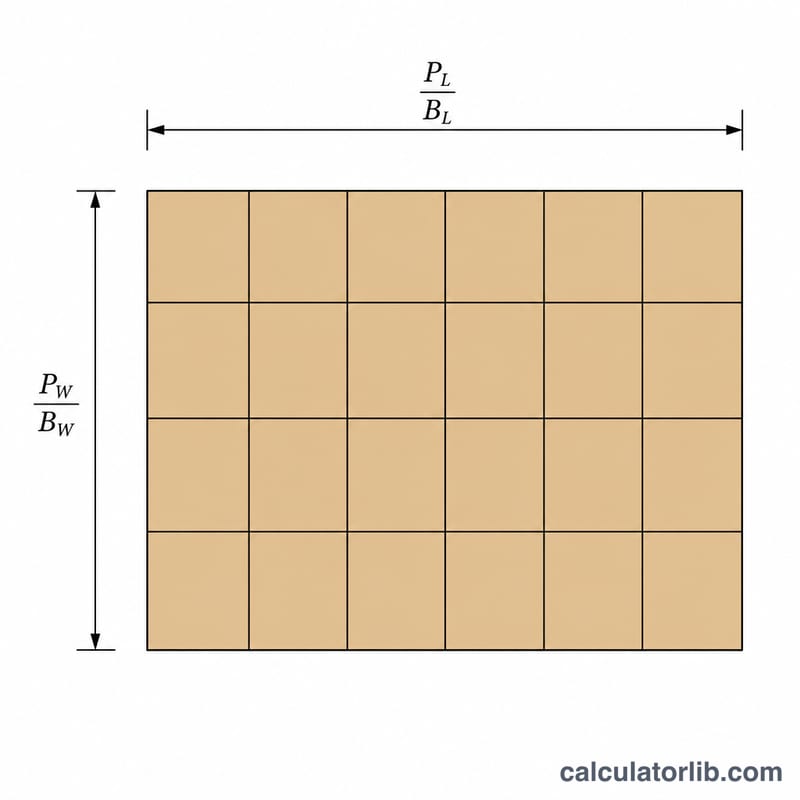
The Pallet Configurator Calculator estimates how many boxes (cartons) fit on a single pallet given the pallet dimensions, box dimensions, and the maximum allowed stack height. It is a universal logistics and warehousing tool that helps you plan loads, estimate freight, and reduce wasted space. It uses a simple single-orientation grid-packing model: boxes are arranged in neat rows and columns on each layer, and layers are stacked until the height limit is reached.
How to Use It
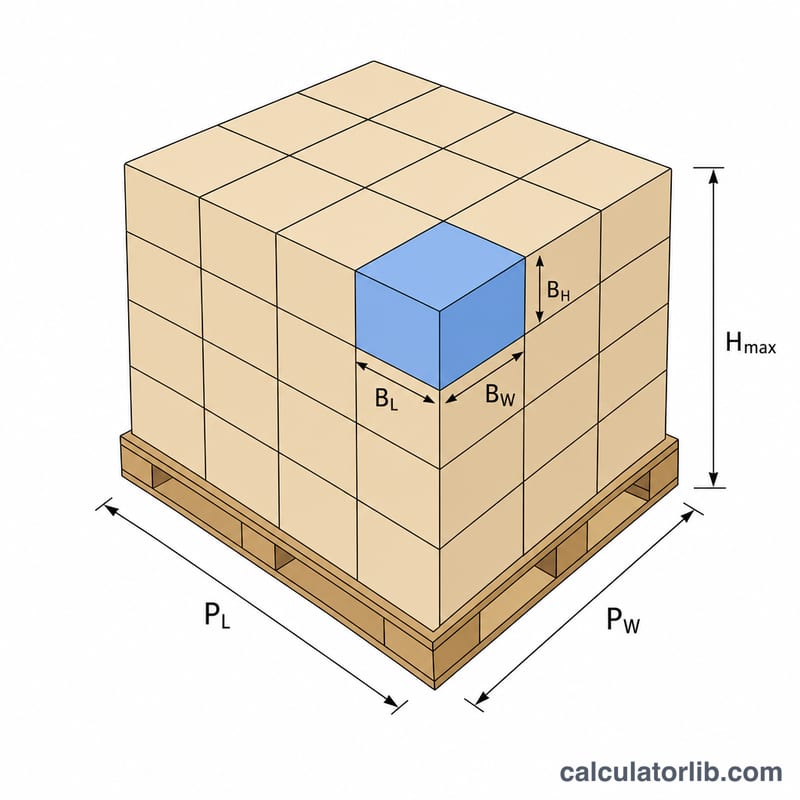
Enter the pallet footprint length and width, the box length, width and height, the pallet base thickness, and the maximum stack height (pallet plus load). All values should use the same unit (for example inches or cm). The calculator returns boxes per layer, number of layers, and the total number of boxes.
The Formula
With \(P_L,P_W\) = pallet length and width, \(B_L,B_W,B_H\) = box dimensions, \(H_{max}\) = max stack height and \(P_H\) = pallet base height:
$$N_{layer}=\left\lfloor\frac{P_L}{B_L}\right\rfloor\times\left\lfloor\frac{P_W}{B_W}\right\rfloor$$ $$L=\left\lfloor\frac{H_{max}-P_H}{B_H}\right\rfloor,\qquad N_{total}=N_{layer}\times L$$\(N_{layer}\) = boxes per layer, \(L\) = number of layers, \(N_{total}\) = total boxes.
Worked Example
A 48 × 40 inch pallet (base height 6 in), boxes 12 × 10 × 8 in, max stack height 54 in:
$$N_{layer}=\left\lfloor\tfrac{48}{12}\right\rfloor\times\left\lfloor\tfrac{40}{10}\right\rfloor=4\times4=16$$ $$L=\left\lfloor\tfrac{54-6}{8}\right\rfloor=\left\lfloor\tfrac{48}{8}\right\rfloor=6,\quad N_{total}=16\times6=96$$So 96 boxes fit on the pallet.
FAQ
Does this rotate boxes for a better fit? No — this uses a single fixed orientation. Real-world interlocked or rotated patterns may fit slightly more.
What units should I use? Any unit, as long as every field uses the same one.
Why is my pallet base height subtracted? The maximum stack height usually includes the pallet itself, so its thickness is removed before stacking layers.